
Fidelity

Search documents
SEC to Open Floodgates for Dual Share Classes
Yahoo Finance· 2025-12-22 05:02
Core Viewpoint - The SEC's recent decision to allow dual share classes for ETFs and mutual funds marks a significant development in the investment landscape, reflecting the ongoing ETF boom and the increasing adoption of ETFs by traditional money managers [2][4]. Group 1: SEC Announcement - The SEC will permit numerous issuers to offer ETF share classes of mutual funds and vice versa, contingent on no hearings being ordered against the applications [2][6]. - This announcement is the SEC's first on the topic since November, when it approved a proposal from Dimensional Fund Advisors [2]. Group 2: Market Impact - The approval of dual share classes is expected to ignite interest among traditional managers who have not previously engaged in the ETF space, providing them access to new channels [3][4]. - The dual-share-class structure offers benefits such as tax efficiency and liquidity, potentially enhancing mutual fund structures and retirement accounts [4]. Group 3: Operational Challenges - Despite the advantages, traditional managers may face logistical and operational hurdles as they adapt to the ETF model, particularly regarding in-kind custom baskets [4]. - Smaller money managers may need to rely on external expertise to successfully launch their funds, while larger managers may already have the necessary resources [4]. Group 4: Future Considerations - Liquidity will be a critical factor to monitor, as many funds will need to maintain higher cash or liquid asset holdings, which could lead to increased underlying fees [5]. - The SEC's notice applies to 30 asset managers, including major firms like BlackRock, PIMCO, and JPMorgan, with petitions for dual share classes potentially being granted as early as January 12 [6].


SCHD Offers a Higher Yield While FDVV Grows Faster
The Motley Fool· 2025-12-22 02:00
Core Insights - The article compares two popular dividend ETFs, Fidelity High Dividend ETF (FDVV) and Schwab U.S. Dividend Equity ETF (SCHD), highlighting their differences in cost, yield, performance, and sector focus, which are crucial for income-focused investors [1][2]. Cost and Size - FDVV has an expense ratio of 0.15%, while SCHD has a lower expense ratio of 0.06%, making SCHD more affordable [3][4]. - As of December 16, 2025, FDVV delivered a 1-year return of 10.3%, whereas SCHD experienced a decline of 1.4% [3]. - The dividend yield for FDVV is 3.0%, compared to SCHD's higher yield of 3.7% [3][4]. - SCHD has over $73 billion in assets under management, making it the second-largest ETF focused on dividend-paying stocks, significantly larger than FDVV [8]. Performance and Risk Comparison - Over a 5-year period, FDVV had a maximum drawdown of 20.2%, while SCHD's was lower at 16.8% [5]. - An investment of $1,000 in FDVV would grow to $1,757 over 5 years, compared to $1,285 for SCHD [5]. Portfolio Composition - SCHD holds around 100 stocks, with significant allocations in energy (19%), consumer staples (19%), and healthcare (16%), focusing on companies with strong dividend histories [6]. - FDVV invests in approximately 120 stocks, with a notable tilt towards technology (26%) and financial services (22%), indicating a growth-oriented strategy [7]. Investment Strategy - SCHD tracks the Dow Jones U.S. Dividend 100 Index, emphasizing quality and consistency in dividend payers [2][9]. - FDVV targets higher-yielding stocks with a focus on growth potential, particularly in the technology sector [10].


Is VGT or FTEC the Better Tech ETF? Here's How They Compare on Risk, Returns, and Fees
The Motley Fool· 2025-12-22 01:30
Core Insights - The Fidelity MSCI Information Technology Index ETF (FTEC) and the Vanguard Information Technology ETF (VGT) are both designed to provide broad exposure to the U.S. information technology sector, with slight differences in cost, size, and holdings [1][2]. Cost & Size Comparison - FTEC has a lower expense ratio of 0.08% compared to VGT's 0.09%, making it slightly more affordable for investors [3]. - VGT has a significantly larger Assets Under Management (AUM) of $130 billion versus FTEC's $16.7 billion, indicating greater liquidity [3][8]. - The one-year return for both ETFs is nearly identical, with FTEC at 21.66% and VGT at 21.65% [3]. Performance & Risk Metrics - The maximum drawdown over five years for FTEC is -34.95%, while VGT's is -35.08%, showing comparable risk levels [4]. - The growth of a $1,000 investment over five years would yield $2,181 for FTEC and $2,165 for VGT, indicating similar performance [4]. Holdings & Sector Exposure - VGT consists of 322 holdings, while FTEC has 288 holdings, providing VGT with a slight edge in diversification [5][6]. - Both ETFs primarily invest in technology stocks, with top holdings including Nvidia, Apple, and Microsoft [5][6]. - VGT has a higher allocation to Nvidia at 18.19% compared to FTEC's 16.61%, which could lead to different returns based on Nvidia's performance [9][10]. Summary of Differences - The main distinctions between FTEC and VGT lie in the number of holdings, AUM, and slight variations in the allocation of top holdings, while performance, risk, fees, and dividend yields are nearly identical [11].




VYM vs. FDVV: How These Popular Dividend ETFs Stack Up on Yield, Costs, and Risk
The Motley Fool· 2025-12-21 23:00
Core Insights - The Vanguard High Dividend Yield ETF (VYM) and Fidelity High Dividend ETF (FDVV) both target U.S. companies with above-average dividend yields but differ in their strategies and characteristics [1][2]. Cost and Size Comparison - FDVV has an expense ratio of 0.15% and assets under management (AUM) of $7.7 billion, while VYM has a lower expense ratio of 0.06% and AUM of $84.6 billion [3]. - As of December 18, 2025, FDVV's one-year return is 10.62% compared to VYM's 9.99%, and FDVV offers a higher dividend yield of 3.02% versus VYM's 2.42% [3]. Performance and Risk Analysis - Over the past five years, FDVV experienced a maximum drawdown of -20.17%, while VYM had a drawdown of -15.87% [4]. - An investment of $1,000 in FDVV would grow to $1,754 over five years, compared to $1,567 for VYM [4]. Portfolio Composition - VYM tracks the FTSE High Dividend Yield Index with 566 holdings, primarily in financial services (21%), technology (18%), and healthcare (13%), featuring top stocks like Broadcom, JPMorgan Chase, and Exxon Mobil [5]. - FDVV has a more concentrated portfolio with 107 holdings, focusing heavily on technology (26%) and consumer defensive (12%) sectors, with major positions in Nvidia, Microsoft, and Apple [6]. Investment Implications - While FDVV offers a higher dividend yield, its higher expense ratio may offset some income benefits, making the net earnings from both funds relatively similar for most investors [7][8]. - The sector allocation indicates that VYM is more stable due to its focus on financial services, whereas FDVV's heavier tech exposure may lead to higher volatility and potential returns [9][10].
Are You Saving Enough for Retirement in Your 30s? Compare Your Rate
Yahoo Finance· 2025-12-21 10:00
Core Insights - Many individuals in their 30s are actively saving for retirement despite economic fluctuations, highlighting the importance of this decade for financial planning [2][8] Retirement Savings Trends - The average 401(k) balance for individuals in their 30s in 2025 is projected to range from approximately $74,000 to $103,000, with median balances between $22,000 and $40,000, indicating that most savers are still in the early stages of building their retirement funds [3][4] - On average, individuals in their 30s contribute about 11% to 13% of their income to retirement accounts, which is below the recommended target of 15% [4][8] Importance of the 30s for Financial Growth - The 30s are a critical period for financial growth, as income typically increases, and early savings can significantly benefit from compounding returns by retirement age [5][6] - Financial experts suggest that saving a portion of any raises received can lead to a higher savings rate, potentially reaching 20% to 30% by the time individuals reach their 40s [7] Comparative Analysis - Recent data indicates that millennials (ages 28 to 43) have an average 401(k) balance of $74,800, reflecting an increase from earlier in the year, while median balances for younger workers (ages 25 to 34) are reported at $16,255 and for those aged 35 to 44 at $39,958 [8] - The Transamerica Center for Retirement Studies found that middle-class households (earning between $50,000 and $199,000) have a median of $65,000 saved in retirement accounts [8]
Fidelity Limited Term Bond ETF Q3 2025 Commentary (FLTB)
Seeking Alpha· 2025-12-21 07:25
Core Viewpoint - The article emphasizes the importance of enabling Javascript and cookies in browsers to prevent access issues, particularly when ad-blockers are enabled [1] Group 1 - The article suggests that users may face restrictions if they have ad-blockers enabled, indicating a need for adjustments in browser settings to ensure smooth access [1]

VDC vs. FSTA: Comparing Two Similar Consumer Staples ETFs
The Motley Fool· 2025-12-21 03:05
Core Insights - The Vanguard Consumer Staples ETF (VDC) has a larger asset base and a longer track record compared to the Fidelity MSCI Consumer Staples Index ETF (FSTA), making it a more established option for investors [1][10]. Cost & Size - FSTA has an expense ratio of 0.08%, while VDC's is slightly higher at 0.09%, indicating that FSTA is marginally more affordable [3][4]. - As of the latest data, FSTA manages $1.3 billion in assets under management (AUM), whereas VDC has $7.4 billion in AUM, highlighting VDC's significant size advantage [3][10]. Performance & Risk - Over the past year, FSTA has returned -2.7% and VDC has returned -2.4%, showing that VDC has performed slightly better [3][15]. - The maximum drawdown over five years for FSTA is -17.08%, while VDC's is -16.54%, indicating that VDC has experienced less volatility [5]. Portfolio Composition - VDC holds 107 stocks primarily focused on consumer defensive companies, with top holdings including Walmart, Costco, and Procter & Gamble [6]. - FSTA has a similar focus, with 98% of its holdings in consumer defensive stocks and also includes Walmart, Costco, and Procter & Gamble among its top holdings [7]. Historical Performance - VDC has been operational for nearly 22 years, while FSTA was launched in 2013, giving VDC a historical performance advantage [10]. - Since FSTA's inception, it has achieved a compound annual growth rate (CAGR) of 8.5%, while VDC has a CAGR of 8.7%, indicating comparable long-term performance [15].


VYM vs. FDVV: Which High-Yield Dividend ETF Is the Best Choice for Investors?
The Motley Fool· 2025-12-20 22:00
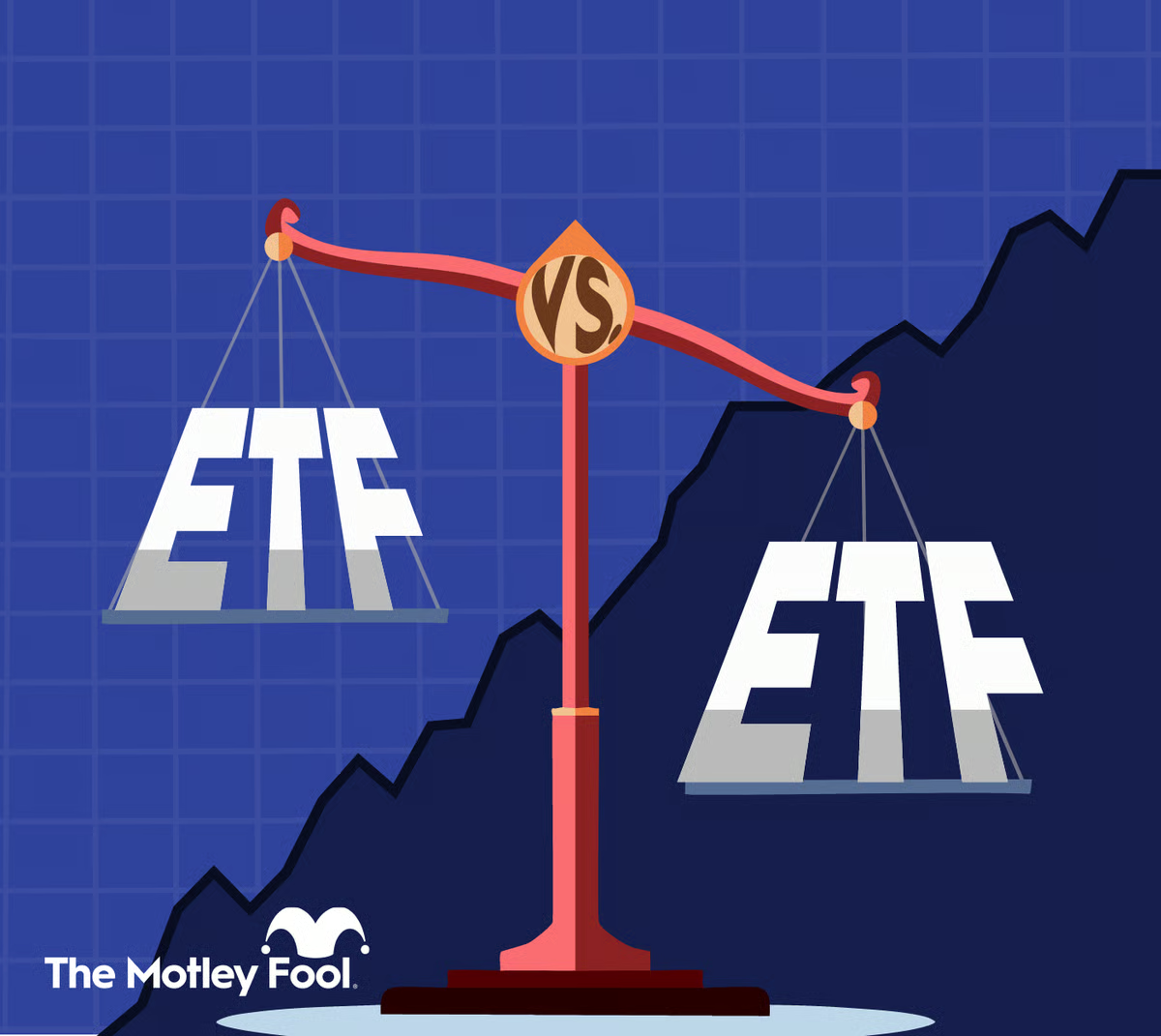
Core Insights - The Fidelity High Dividend ETF (FDVV) and the Vanguard High Dividend Yield ETF (VYM) focus on delivering above-average income through strong dividend profiles [1] Expense Structure and Size - FDVV has an expense ratio of 0.15% and AUM of $7.7 billion, while VYM has a lower expense ratio of 0.06% and AUM of $84.6 billion [3] - FDVV offers a higher dividend yield of 3.02% compared to VYM's 2.42% [3] Performance and Risk Comparison - Over five years, FDVV has a max drawdown of -20.17% compared to VYM's -15.87% [4] - Growth of $1,000 over five years is $1,772 for FDVV and $1,565 for VYM [4] Portfolio Composition - VYM holds 566 stocks with significant sector exposure in financial services (21%), technology (18%), and healthcare (13%) [5] - FDVV invests in 107 holdings with a heavier tilt towards technology (26%), followed by financial services (19%) and consumer defensive (12%) [6] Investment Implications - FDVV provides higher yield but comes with a higher expense ratio, which may affect net earnings [7] - VYM is more diversified with a broader mix of stocks, potentially offering more stability [9] - FDVV may appeal to those seeking higher earnings despite its volatility, while VYM may suit investors looking for diversification and lower fees [10]

3 Best Bitcoin ETF Picks for 2026
Yahoo Finance· 2025-12-20 18:20
Core Insights - The launch of spot Bitcoin ETFs has been highly successful, with 11 ETFs approved by the SEC, collectively managing over $110 billion in assets, primarily driven by the iShares Bitcoin ETF [1] Group 1: Bitcoin ETF Overview - Spot Bitcoin ETFs are structurally identical, all investing in spot Bitcoin without selection or weighting methodologies [2] - Investors need to focus on details such as expense ratios and trading costs to differentiate between Bitcoin ETFs [3] Group 2: Recommended Bitcoin ETFs - The Grayscale Bitcoin Mini Trust ETF is highlighted for its low fees, tight spreads, and high liquidity, making it the best option for retail traders [5][7] - The Grayscale Bitcoin Mini Trust ETF has an expense ratio of 0.15%, significantly lower than its larger counterpart, which has a 1.5% expense ratio [6][7] - The iShares Bitcoin ETF, while the largest with over $70 billion in assets, is not recommended as the first choice despite its popularity [8][9]
Ethereum Leads Wall Street Tokenization Race as Mass Adoption Looms
Yahoo Finance· 2025-12-20 12:02
Core Insights - Wall Street firms, including JPMorgan, BlackRock, and Fidelity, have chosen Ethereum as their preferred blockchain for tokenization, indicating a significant trend in the financial industry [1][2][3]. Group 1: Adoption of Ethereum - JPMorgan's launch of the OnChain Net Yield Fund (MONY) follows BlackRock's USD Institutional Digital Liquidity Fund and Fidelity's Treasury Digital Fund, all utilizing Ethereum for tokenized money market funds (MMFs) [2]. - The largest funds from these firms each manage assets exceeding $1 trillion, contributing to a broader U.S. MMF market valued at over $7.5 trillion [2]. Group 2: Significance of Ethereum - The convergence of major asset management firms on Ethereum highlights its advantages, such as decentralization, a robust developer ecosystem, and regulatory familiarity, as opposed to private blockchains or newer networks [3]. - Ethereum's existing infrastructure supports asset managers in creating compliant and liquid on-chain offerings, reinforcing its position in the tokenization landscape [4]. Group 3: Alternative Blockchain Considerations - Despite Ethereum's dominance, alternative blockchains should not be overlooked; Provenance holds a significant share of the on-chain private credit market, and Polygon has seen substantial corporate bond issuance [5]. - Many companies developing tokenization solutions are adopting a blockchain-agnostic approach, indicating ongoing interest in both public and private networks [6]. Group 4: Future Implications - As tokenization gains traction on Wall Street, the current choices of infrastructure may establish standards for future on-chain markets, with Ethereum leading the way [7]. - JPMorgan's use of Ethereum for MONY contrasts with its deployment of other tokenized assets on its proprietary Kynexis platform, showcasing a diverse strategy in asset tokenization [8].