Strategy

Search documents
X @Bloomberg
Bloomberg· 2025-12-01 12:58
Concerns are rising that Strategy soon may be forced to sell some of its roughly $56 billion cryptocurrency haul if token prices continue to fall, leading its shares to wobble in pre-market trading https://t.co/dFIc5n6cV7 ...
X @Wu Blockchain
Wu Blockchain· 2025-12-01 09:59
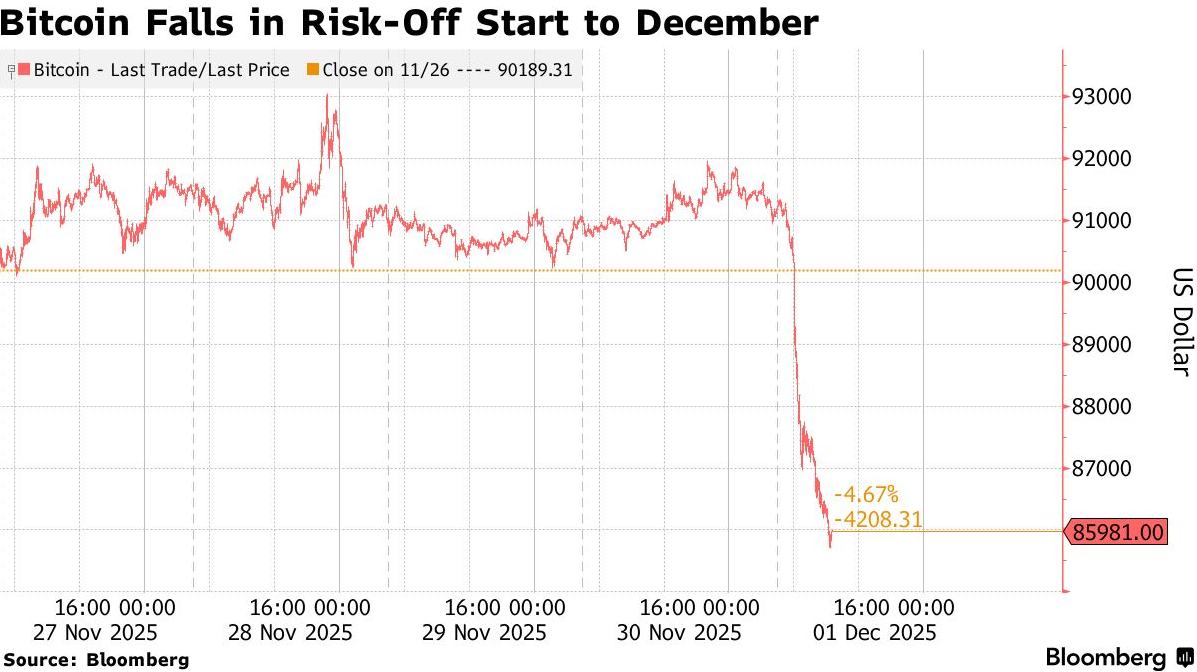
Market Trends & Analysis - BTC fell from $91,000 to $86,000 despite supportive macro factors [1] - The drop was driven by Asia shocks, BOJ's hawkish tone and China's weak PMI [1] - Worries arose after Strategy hinted it could sell BTC if its mNAV breaks [1] Investment & Risk - Focus is now on whether BTC can hold its recent lows [1] - Macro factors such as the end of QT, rising rate-cut odds, and positive ETF flows provided support [1]
Bitcoin, Ethereum, and XRP Crash Triggering $637M in Liquidations
Yahoo Finance· 2025-12-01 09:53
Core Insights - Bitcoin experienced a 5% decline in the past 24 hours, contributing to a 21% drop over the past month, with current trading around $86,800, down 31% from its all-time high [1] - Total crypto market liquidations surged to $637 million, with $568 million attributed to long positions [2] Market Dynamics - The recent sell-off was driven by a rapid, momentum-driven drop that led to significant long liquidations, amplifying selling across both spot and derivatives markets [3] - Comments from Strategy CEO Phong Le regarding the potential sale of Bitcoin to fund dividend payments have sparked fear among investors, altering perceived supply dynamics [4][5] Investor Sentiment - Despite concerns raised by Le's comments, traders on the prediction market Myriad assign only a 5% chance of Strategy selling any Bitcoin before year-end [6] - Tether's potential insolvency, particularly if Bitcoin and gold decline by 30%, has also contributed to market volatility, as concerns about liquidity premia and margin risk have increased [7]
12月开局避险情绪弥漫 比特币跌超6%失守86,000美元
智通财经网· 2025-12-01 06:40
Market Overview - The cryptocurrency market experienced a significant downturn, reigniting a large-scale sell-off trend that had seemed to stabilize [1] - Bitcoin dropped over 6% during Asian trading, falling below $86,000, while Ethereum saw a decline of over 7%, reaching approximately $2,800 [1] - Most altcoins followed a similar trend, with Solana decreasing by 7.8% [1] Market Conditions - The cryptocurrency market has been unstable since early October, with a prolonged downtrend leading to the liquidation of approximately $19 billion in leveraged positions shortly after Bitcoin reached a historical high of $126,251 [4] - By November, Bitcoin's value had significantly decreased, with a drop of 16.7%, although it rebounded to above $90,000 last week due to reduced selling pressure [4] - Traders are preparing for further declines as a new wave of selling emerged [4] Key Indicators - Sean McNulty from FalconX noted a cautious outlook for December, highlighting minimal inflows into Bitcoin ETFs and a lack of buyers at lower prices, with a focus on the critical support level of $80,000 for Bitcoin [4] - Phong Le, CEO of Strategy, indicated that if the market value to Bitcoin holding ratio (mNAV) turns negative, the company may sell its Bitcoin holdings to pay dividends, with the current mNAV at 1.19 and holdings valued at $56 billion [4] Regulatory Environment - S&P Global Ratings downgraded the stability assessment of the largest stablecoin, USDT, to the lowest level, warning that a decline in Bitcoin prices could lead to insufficient collateral for the token [5] - The People's Bank of China issued a warning regarding the risks associated with virtual currencies, including stablecoins, emphasizing the need for government coordination to combat illegal activities, which adds to market uncertainty [5] Market Sentiment - Jeff Ko, Chief Analyst at CoinEx, attributed the pressure on the cryptocurrency market to a series of negative news, including the downgrade of USDT and the warning from the Chinese central bank [6] - Upcoming key economic data will provide insights into the short-term direction of the U.S. economy, influencing expectations regarding the Federal Reserve's interest rate adjustments [6]

What 'mNAV' Really Means for Bitcoin Treasury Companies — and Where It Falls Short
Yahoo Finance· 2025-11-30 21:45
The most common valuation yardstick is the mNAV. It compares a company's enterprise value (EV) — which is a firm's market cap plus debt minus any cash — to the market value of its bitcoin holdings. This provides investors with a means to evaluate the extent to which the market assigns a premium or discount to its treasury. The metric is now widely followed. Strategy publishes its own mNAV on its investor site, while third-party dashboards such as BitcoinTreasuries.net track various mNAV figures across mul ...
X @Cointelegraph
Cointelegraph· 2025-11-30 12:31
🔥 LATEST: Strategy will only sell $BTC if its stock falls below NAV (Net Asset Value) and if no capital is available. https://t.co/T4cflUisas ...
Will Michael Saylor’s Strategy Ever Join the S&P 500?
Yahoo Finance· 2025-11-30 09:28
Strategy has made no secret of the fact that it would like to join the S&P 500 — but at least for now, a spot in this flagship index remains elusive. Earlier this week, the Bitcoin treasury company was snubbed again, with Sandisk joining the ranks of America’s most prestigious large-cap companies instead. The S&P 500 rebalances every three months — meaning Michael Saylor’s firm will get another shot at inclusion soon — but this is by no means guaranteed. On an earnings call for its Q2 results back in Oct ...
Strategy CEO: Equity and Debt Flexibility Power Long-Term Bitcoin Accumulation Plan
Yahoo Finance· 2025-11-29 18:12
Strategy CEO Phong Le says the company now has “more flexibility than ever” to continue accumulating bitcoin, citing a capital structure built on long-dated debt, opportunistic equity access, and no short-term refinancing pressure. Speaking on the most recent episode of the “What Bitcoin Did” podcast, Le told host Danny Knowles that Strategy’s ability to raise capital through both debt and equity has become a central part of the firm’s long‑term bitcoin operating strategy. He described capital‑market acce ...
X @Michael Saylor
Michael Saylor· 2025-11-28 21:38
Bitcoin Investment - Strategy 讨论了 600 亿美元的比特币投资策略 [1] - 讨论了如何看待 mNAV (可能指管理资产净值) [1] - Strategy 是否会出售比特币 [1] - Strategy 对比特币的五年展望 [1] Strategy & Outlook - Strategy 的策略手册 [1]
Strategy's Michael Saylor weighs in on whether bitcoin's four-year cycle is dead: CNBC Crypto World
Youtube· 2025-11-28 20:00
Core Insights - The outlook for Bitcoin in 2026 is bullish, driven by increased bank acceptance and credit development within the banking network [4][44] - The traditional four-year Bitcoin cycle is considered obsolete, with structural market developments now being the primary drivers of Bitcoin's value [6][7][8] - Institutional adoption of Bitcoin is expected to continue growing, supported by regulatory changes and positive guidance from banking regulators [46][47] Group 1: Market Dynamics - Approximately half of large U.S. banks have begun extending credit against Bitcoin, with major banks like Charles Schwab and Citigroup planning to custody Bitcoin and extend credit in early 2026 [4][44] - The impact of Bitcoin's halving is diminishing, with daily trading volumes reaching up to $100 billion, making the halving's effect of $20 million negligible in comparison [7][8] - The embrace of Bitcoin by traditional finance is leading to significant demand, as evidenced by the increase in open interest in Bitcoin derivatives from $10 billion to $50 billion following regulatory changes [8] Group 2: Digital Asset Companies - The number of companies holding Bitcoin as digital capital has surged, with over 200 crypto treasury companies now in existence [11][12] - Strategy has evolved from merely holding Bitcoin to issuing digital credit, positioning itself as the largest issuer of digital credit globally [11][12] - The rise of digital credit is seen as a key development in the crypto economy, with potential yields significantly higher than traditional banking products [21][22] Group 3: Regulatory Environment - The current U.S. administration is supportive of digital assets, which has led to a favorable environment for crypto IPOs and institutional adoption [24][25] - The introduction of fair value accounting has allowed companies to recognize gains from Bitcoin on their balance sheets, enhancing the appeal of holding Bitcoin [18][19] - The anticipated Clarity Act aims to provide clearer regulations for tokenization and digital finance, which is crucial for the industry's growth [41][42] Group 4: Future Outlook - Institutional adoption of Bitcoin is expected to accelerate, with banks beginning to offer credit on digital assets, recognizing the $2 trillion of unbanked wealth in this sector [45][46] - The combination of supportive regulatory frameworks and institutional interest is likely to catalyze further investment in Bitcoin and digital assets [48][49] - The competitive landscape for digital finance is evolving, with a distinction between digital capital (Bitcoin) and digital finance (stablecoins and tokenized assets) [27][33]