
Freddie Mac

Search documents
New credit score models could open the door to homebuyers who were shut out in the past. Here's how they work
Yahoo Finance· 2026-02-12 13:45
Core Viewpoint - The mortgage industry is shifting away from a single credit score system to a more comprehensive evaluation of borrowers' financial behavior, which could benefit those who manage their finances well but have lower traditional credit scores [2][3]. Group 1: Changes in Credit Scoring - The traditional minimum credit score of 620 for qualifying for conventional mortgages is being reconsidered as lenders and regulators explore new scoring models [1][2]. - Fannie Mae has removed its minimum credit score requirement, encouraging lenders to assess borrowers based on a broader range of factors such as cash reserves and debt levels [5][6]. - New credit scoring models like FICO Score 10T and VantageScore 4.0 are being tested, which utilize "trended data" to evaluate borrowers' credit management over time [7]. Group 2: Implications for Borrowers - The changes in credit scoring are aimed at making it easier for responsible borrowers, including renters and younger individuals, to qualify for mortgages despite not having high traditional credit scores [6]. - The new evaluation methods may not guarantee approvals for riskier borrowers but could provide opportunities for those who have demonstrated financial responsibility [3][4].
Freddie Mac Announces Fourth Quarter and Full-Year 2025 Financial Results
Globenewswire· 2026-02-12 13:07
Core Viewpoint - Freddie Mac reported its Fourth Quarter and Full-Year 2025 financial results and filed its Annual Report on Form 10-K with the U.S. Securities and Exchange Commission [1] Group 1 - The company will hold a call at 9 a.m. Eastern Time (ET) on February 12, 2026, to share its results with the media [2] - The call will be concurrently webcast, and the replay will be available on the company's website for approximately 30 days [2] Group 2 - Freddie Mac's mission is to make home possible for families across the nation, promoting liquidity, stability, and affordability in the housing market throughout all economic cycles [3] - Since 1970, the company has helped tens of millions of families buy, rent, or keep their home [3]


Mortgage and refinance interest rates today, February 12, 2026: Mostly unchanged
Yahoo Finance· 2026-02-12 11:00
Mortgage Rates Overview - The average 30-year fixed mortgage rate is currently 5.87%, while the 15-year fixed rate averages 5.44% according to Zillow [1] - Zillow's reported rates are significantly lower than those from other sources like Freddie Mac [1] Current Mortgage Rates - National average mortgage rates include: - 30-year fixed: 5.87% - 20-year fixed: 5.80% - 15-year fixed: 5.44% - 5/1 ARM: 6.01% - 7/1 ARM: 6.00% - 30-year VA: 5.36% - 15-year VA: 4.95% - 5/1 VA: 4.93% [4] Refinance Rates - Current refinance rates are generally higher than purchase mortgage rates, but this is not always the case [3] - National average refinance rates include: - 30-year fixed: 6.05% - 20-year fixed: 6.02% - 15-year fixed: 5.52% - 5/1 ARM: 6.21% - 7/1 ARM: 6.32% - 30-year VA: 5.61% - 15-year VA: 5.40% - 5/1 VA: 5.07% [5] Mortgage Rate Mechanics - Mortgage interest rates are determined by factors that can be controlled, such as comparing lenders and improving credit scores, and factors that cannot be controlled, such as economic conditions [9][10] - A strong economy typically leads to higher mortgage rates, while a struggling economy results in lower rates to encourage borrowing [11] Mortgage Types - Fixed-rate mortgages lock in the interest rate for the entire loan term, while adjustable-rate mortgages (ARMs) have a fixed rate for an initial period before adjusting periodically [7] - 30-year fixed mortgages are popular for their lower monthly payments but incur more interest over time, whereas 15-year fixed mortgages have higher monthly payments but lower overall interest costs [12][13] Market Insights - The lowest-ever 30-year fixed mortgage rate was 2.65% in January 2021, and rates are unlikely to dip below 3% in the near future [16] - Experts suggest refinancing when a new rate is at least 1% to 2% lower than the current rate, depending on individual financial goals [17]
Mortgage rates dip back down to near 3-year lows
Yahoo Finance· 2026-02-12 11:00
Mortgage rates dipped slightly lower this week, weathering volatility in bond markets. While bond yields sagged early in the week, Wednesday's surprising jobs report sent yields soaring. The news was digested quickly by the Treasury market, and a recovery to previously low levels took just a day. According to Freddie Mac, the average 30-year fixed rate this week was 6.09%, down from 6.11% the previous week. The 52-week low is 6.06%. Meanwhile, the 15-year fixed averaged 5.44%, down from 5.50%. “Bolstered ...
L.A. wildfire victims would get mortgage relief under new bill
Yahoo Finance· 2026-02-12 11:00
Core Viewpoint - A new bill, AB 1847, aims to provide extended mortgage relief for wildfire victims in Los Angeles County, tripling the relief period from 12 to 36 months compared to the previous legislation, AB 238 [1][5]. Group 1: Legislative Changes - AB 1847, introduced by Assemblymember John Harabedian, extends mortgage relief to 36 months and allows borrowers to repay through a deferral that extends their mortgage [1]. - The previous legislation, AB 238, prohibited lenders from requiring lump-sum repayments and banned late fees, foreclosures, and negative credit reports [2]. - The deadline for applying for the new relief under AB 1847 is extended to January 7, 2029 [5]. Group 2: Borrower Challenges - Borrowers have reported difficulties in obtaining relief under AB 238, often facing conditions that did not comply with the law, such as being forced into loan modifications that could increase interest rates [2][4]. - Issues primarily stem from mortgage servicing companies, while larger institutions like Bank of America have been more accommodating in providing relief [4]. Group 3: Impact of Wildfires - The wildfires in areas like Altadena and Pacific Palisades resulted in at least 31 fatalities and damaged or destroyed over 18,000 homes, highlighting the need for extended relief for affected homeowners [7].
Here Come the HELOCs: Mortgages, Housing-Debt-to-Income-Ratio, Serious Delinquencies, and Foreclosures in Q4 2025
Wolfstreet· 2026-02-12 07:17
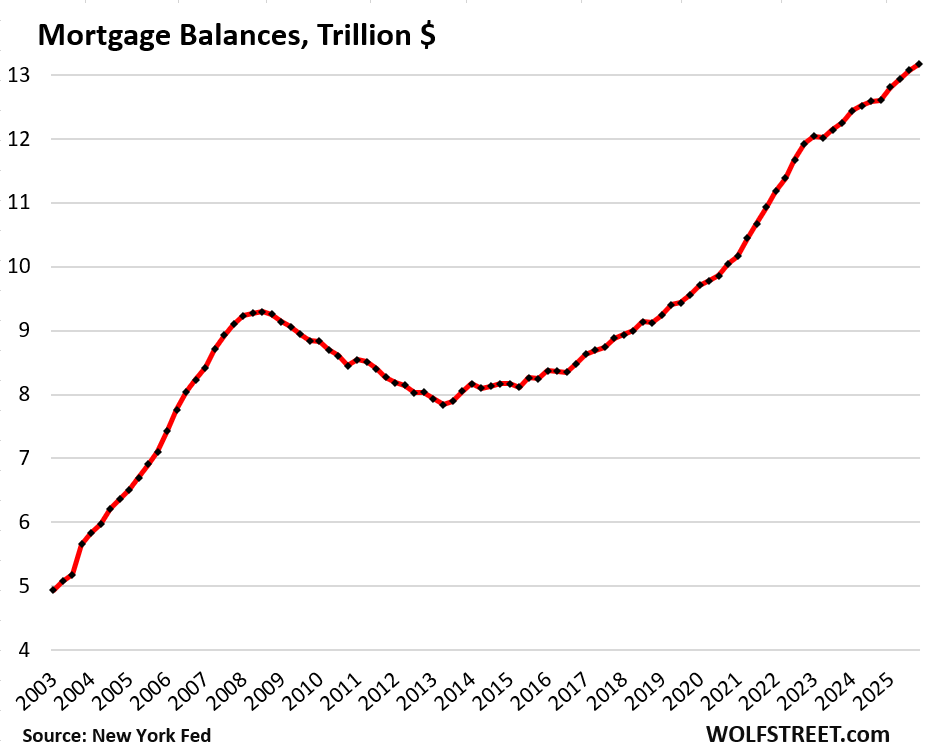
Core Insights - The transfer of mortgage risk from banks to taxpayers is a fundamental change resulting from the Financial Crisis [23] - Mortgage balances have increased significantly, with a year-over-year rise of $564 billion (+4.5%) and a surge of 38% since the beginning of 2020 [2][4] - The current housing debt-to-disposable income ratio remains stable at 58.8%, slightly higher than the previous year, indicating a manageable debt burden [13] Mortgage Balances - Mortgage balances rose by $98 billion (+0.7%) in Q4 from Q3, reaching $13.2 trillion [1] - Factors contributing to the growth of mortgage balances include financing new home purchases, buyers taking on larger mortgages when purchasing homes without existing mortgages, and cash-out refinancing [4] - The principal portion of mortgage payments, paydowns, payoffs, and foreclosures reduce mortgage balances [5] Home Equity Lines of Credit (HELOCs) - HELOC balances increased by 1.9% in Q4 from Q3 and by 8.6% year-over-year, totaling $430 billion, with a 36% surge since Q1 2021 [6] - HELOCs are second-lien loans that can lead to foreclosure if defaulted on, and they are full recourse loans in certain states [7] - The previous disfavor of HELOCs was due to ultra-low-rate mortgages, but this trend has reversed [8] Delinquencies and Foreclosures - Serious delinquency rates for mortgages and HELOCs are low, at 0.92% and 0.82% respectively, returning to normal levels post-pandemic [16] - Foreclosure numbers in Q4 were 58,140, significantly lower than the 65,000 to 90,000 range seen in 2018-2019 [18] - A massive wave of foreclosures is unlikely unless there are sharp declines in home prices and high unemployment rates [20] Government Involvement - 65% of all outstanding mortgages ($9.4 trillion) are guaranteed or insured by government entities, reducing banks' exposure to mortgage risk [23] - Banks and credit unions hold only about $2.7 trillion in mortgages, less than 20% of the total, indicating they are largely insulated from another mortgage crisis [24] - Mortgages that do not qualify for government backing, totaling about $1.7 trillion, are securitized into private-label mortgage-backed securities, placing risk on institutional investors [25]
Why "Golden Handcuffs" are a Gift to Homebuilders in 2026
ZACKS· 2026-02-12 05:30
Core Insights - Many investors have lost faith in housing stocks due to the rise in 30-year fixed mortgage rates from under 3% in 2021 to nearly 8% in 2023, but homebuilders are expected to thrive by 2026 [1] Group 1: Housing Supply Dynamics - The U.S. housing market is experiencing a supply crisis, exacerbated by underbuilding since the 2008 financial crisis and the acquisition of homes by private equity firms like Blackstone [1] - The monthly supply of new houses in the U.S. is at its lowest level since September 2024, indicating a significant supply constraint [1] Group 2: Homeowner Behavior - Approximately half of U.S. homeowners have mortgage rates below 4%, leading to a 'Golden Handcuff' effect that freezes the existing home market and increases reliance on new construction [2][5] Group 3: Future Mortgage Rates - Analysts predict a gradual decline in mortgage rates by 2026, which could create favorable conditions for homebuilders as demand rises while existing homeowners remain in place due to low rates [6] Group 4: Government Initiatives - The Trump Administration has proposed a plan to construct 1 million entry-level homes to increase housing supply, supported by bipartisan efforts [7] - Fannie Mae and Freddie Mac are set to purchase $200 billion in mortgage-backed securities to help lower interest rates [7] Group 5: Earnings Expectations - Homebuilders like DR Horton and Lennar are expected to return to double-digit EPS growth by next year after several quarters of negative EPS [8] - Zacks Consensus Estimates show a projected EPS growth of 26.61% from 2026 to 2027, indicating a positive outlook for the sector [9] Group 6: Market Performance - The stock performance of homebuilders is showing strength, with companies like Toll Brothers experiencing a 19% increase year-to-date [10] Group 7: Structural Advantages - The current market conditions present a unique structural advantage for homebuilders, bridging the gap between supply deficits and federal initiatives aimed at affordability [11]




Pershing Square Holdings (OTCPK:PSHZ.F) Update / briefing Transcript
2026-02-11 16:02
Summary of Pershing Square Holdings Investor Meeting (February 11, 2026) Company Overview - **Company**: Pershing Square Holdings (OTCPK:PSHZ.F) - **Key Speaker**: Ryan Israel, Chief Investment Officer - **Chairman**: Rupert Morley Core Industry Insights - **Market Context**: The current market environment is seen as fascinating for public market investors, with significant updates across the portfolio and broader business strategies being discussed [1][3]. Key Financial Performance - **2025 Performance**: - Net Asset Value (NAV) grew by **20.9%** - Total shareholder return was **33.9%** - Compound growth in NAV and share price over 8 years is **23%** [9][10]. - **Share Buybacks**: In 2025, **6.6 million shares** were repurchased for approximately **$370 million**, totaling **$1.8 billion** in buybacks since inception [12]. - **Dividends**: The company has paid out **$666 million** in dividends, with an **86%** increase since the dividend policy was amended in 2022 [11][12]. Strategic Updates - **Howard Hughes Holdings**: - Acquired **$900 million** worth of shares, increasing ownership to **46.9%** [8][9]. - Committed to purchasing up to **$1 billion** in preferred securities to facilitate the acquisition of Vantage, an insurance company [9][22]. - The transformation aims to turn Howard Hughes into a diversified holding company akin to Berkshire Hathaway [17][20]. Investment Strategy - **Investment Focus**: The strategy emphasizes acquiring high-quality, durable growth companies, with a focus on long-term value creation [17][20]. - **Recent Investments**: - New investments in **Hertz**, **Amazon**, and **Meta** were disclosed, with a focus on companies with strong growth potential [43][46]. - Exited positions in **Chipotle**, **Canadian Pacific**, and **Nike** due to underperformance [44][41]. Market Analysis - **S&P 500 Performance**: The S&P 500 has seen a **112%** increase over the last six years, with earnings growth being the primary driver [53][56]. - **Top Companies**: The top 10 companies in the S&P 500 are expected to grow earnings at **25%**, significantly influencing overall market growth [58][59]. - **Valuation Insights**: Current market multiples are seen as potentially undervalued given the expected earnings growth, suggesting optimism for future performance [59][60]. Organizational Updates - **Team Expansion**: New hires include Jordan Aguiar-Lucander, Jill Chapman, and Lucas Richards, enhancing the investment and legal teams [49][50]. - **Investment Philosophy**: The firm maintains a concentrated investment strategy, focusing on a select number of high-quality businesses while keeping a library of potential investment opportunities [52][60]. Conclusion - **Future Outlook**: The firm is optimistic about navigating the current market environment, leveraging its investment strategy and organizational strengths to capitalize on emerging opportunities [45][51].
Freddie Mac Announces Release Date for Fourth Quarter and Full-Year 2025 Financial Results
Globenewswire· 2026-02-10 21:12
Group 1 - Freddie Mac plans to report its Fourth Quarter and Full-Year 2025 financial results on February 12, 2026, before U.S. financial markets open [1] - A conference call will be held at 9 a.m. Eastern Time on the same day to discuss the results, which will also be webcasted and available for replay for approximately 30 days [2] - Freddie Mac's mission is to promote liquidity, stability, and affordability in the housing market, having assisted millions of families since its inception in 1970 [3]

Mortgage Rates Are Stuck Near 6% — Should You Buy, Refinance or Wait?
Yahoo Finance· 2026-02-10 13:55
Mortgage Rates Overview - Mortgage rates have increased significantly from a low of 2.65% during the pandemic to nearly 8% in 2023, with a stabilization around 6.10% as of early February 2026, showing a slight improvement from 6.9% in February 2025 [1] - The historical context indicates that rates near 6% are moderate compared to the sub-3% rates seen during the pandemic, which are unlikely to return soon [2] Future Rate Predictions - Morgan Stanley projects a slight decline in mortgage rates through 2026, targeting the 5.75% range, while many economists expect rates to remain around 6% [3] Financial Implications for Buyers - For a $400,000 home purchase with a 20% down payment, the remaining loan balance of $320,000 at a 6.10% rate results in a monthly payment of $1,939.18 [4] - If rates drop to 5.75%, the monthly payment would decrease to $1,867.43, saving approximately $72 per month [5] - Buyers should consider if the potential savings of $72 per month over 30 years outweigh the risks of missing out on desired properties or facing higher future prices, making current rates appealing for those planning to stay long-term [6] Refinancing Considerations - The industry standard suggests refinancing if savings of 1% to 2% can be achieved, meaning refinancing is advisable if the current mortgage rate is 7.10% or higher, given the current rate of 6.10% [7] - An example shows that refinancing a $300,000 mortgage from a 7.25% rate to 6.10% would reduce the monthly payment from approximately $2,314 to $1,818 [8]