ITC

Search documents
Ahead of Market: 10 things that will decide stock market action on Wednesday
The Economic Times· 2025-09-30 15:24
Market Overview - Nifty continues to form a pattern of lower highs and lower lows, defending the 24,600 level for the third consecutive session, indicating a weak overall structure unless it reclaims 24,800 [1][12] - The S&P 500 and Nasdaq declined on concerns over a potential U.S. government shutdown affecting economic data releases [2][4] - European markets closed slightly higher, with the pan-European STOXX 600 rising 0.5%, marking its best quarterly performance since May [5][12] Sector Performance - In European markets, most sectors saw gains, with media stocks up 1.2% and retail stocks up 1.1%, while industrial and healthcare sectors provided significant boosts to the STOXX 600 [5][6] - In the Indian market, consumer, realty, and IT stocks dragged down the Nifty and Sensex, while auto, banking, and metal shares helped limit losses [11][12] Stock Activity - Tata Investments was among the most active stocks in terms of turnover, with Rs 571 crore, while Vodafone Idea led in volume with 4.23 crore shares traded [8][12] - A total of 141 stocks reached their 52-week highs, while 156 stocks hit their 52-week lows, indicating mixed market sentiment [9][12] - Significant selling pressure was observed in large-cap stocks such as Bharti Airtel, ITC, and Trent, contributing to a negative market close [10][11] Technical Analysis - Immediate support for Nifty is at 24,500, with resistance near 24,800; a cautious stance is advised following the RBI policy outcome and auto sales data [7][12] - Momentum indicators and oscillators have confirmed a bearish crossover on the daily chart, suggesting a potential decline towards 24,400 if the index breaks below 24,600 [1][12]


Sensex falls 97 pts on relentless foreign fund outflows
Rediff· 2025-09-30 11:27
Market Performance - Benchmark indices Sensex and Nifty closed lower, marking the eighth consecutive session of decline due to foreign fund outflows and caution ahead of the RBI's interest rate decision [1][3] - The BSE Sensex declined by 97.32 points or 0.12% to settle at 80,267.62, with a high of 80,677.82 and a low of 80,201.15 during the day [3] - In eight trading days, the Sensex has decreased by 2,746.34 points or 3.30% [3] - The NSE Nifty fell by 23.80 points or 0.10% to 24,611.10 [3] Sector Performance - Metal and banking stocks advanced, while realty and consumer durables faced selling pressure [5] - Major laggards among Sensex firms included ITC, Bharti Airtel, Trent, Bajaj Finserv, Titan, and Reliance Industries [5] - Major gainers included UltraTech Cement, Adani Ports, Tata Motors, Bharat Electronics, Bajaj Finance, and Hindustan Unilever [5] Foreign Investment Activity - Foreign Institutional Investors (FIIs) offloaded equities worth Rs 2,831.59 crore, while Domestic Institutional Investors (DIIs) bought stocks worth Rs 3,845.87 crore [7] Upcoming Events - The RBI rate-setting panel's decision is expected to be announced on Wednesday [8]
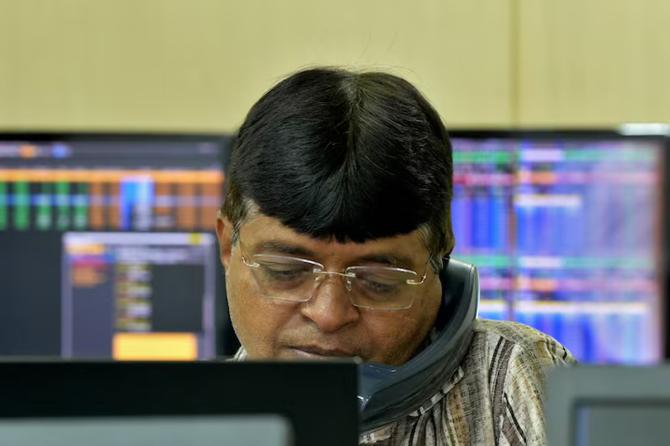
Sensex up 313 points on buying in IT, banking, and auto shares
Rediff· 2025-09-17 11:40
Benchmark indices Sensex and Nifty rose for the second day on Wednesday on buying in IT, banking, and auto shares by investors enthused by positive day-long discussions with the visiting US team on a bilateral trade deal.Photograph: Hemanshi Kamani/ReutersThe 30-share BSE Sensex edged higher by 313.02 points or 0.38 per cent to settle at 82,693.71.During the day, it jumped 361.26 points or 0.43 per cent to 82,741.95. The 50-share NSE Nifty climbed 91.15 points or 0.36 per cent to 25,330.25.Growing expectati ...
Top gainers losers today 17th Sep 2025: Markets surge as Nifty tops 25,300 mark, Sensex up 360 pts led by PSU banks, defence & auto stocks
BusinessLine· 2025-09-17 09:42
Market Overview - Equity markets experienced a significant rally, with Nifty 50 surpassing the 25,300 mark and Sensex gaining over 360 points, driven by strong investor confidence following US-India trade talks [1] - The Nifty PSU Bank index led sectoral gains, while healthcare, metal, consumer durables, and pharma stocks saw declines [3] Index Performance - Sensex traded 310.09 points or 0.38% higher at 82,690.78, and Nifty traded 89.50 points or 0.35% positive at 25,328.60 [2] - The smallcap index outperformed the midcap index, gaining 0.74%, while the midcap index rose 0.17% [2] Sector Performance - Gains were primarily observed in financials, auto, IT, and oil & gas sectors, while the defence index rose over 2% [1][3] - Among the top gainers in the Sensex firms were Tata Consumer Products, Bharat Electronics, and Kotak Mahindra Bank, while Titan and Tata Steel were among the major laggards [4] Stock Movements - A total of 3,024 stocks were traded on the National Stock Exchange, with 1,827 advancing and 1,107 declining [4] - Seventy-two stocks, including JSW Steel and Dalmia Bharat, hit their 52-week highs, while 19 stocks recorded 52-week lows [5] Midcap and Smallcap Highlights - In the midcap segment, Aditya Birla Fashion and Kalyan Jewellers saw gains of 3-5%, while Vodafone Idea and NHPC declined slightly [6] - Smallcap index gainers included GRSE and MCX, with upticks of 4-7%, while Godfrey Phillips and IndiaMart dropped 1-2% [6] BSE Performance - On the BSE, KNR Constructions and PC Jeweller surged 6-8%, while Moschip and Home First depreciated by 2-3% [7]

Wealth Creation with The Power of Compounding | Dr. Farzan Ghadially | TEDxVIIT
TEDx Talks· 2025-09-11 15:22
Investment Principles - Compounding is crucial for wealth creation, with those understanding it accumulating significant wealth [2] - Consistent investment and patience are key, exemplified by Warren Buffett's long-term investment strategy [4][5] - The Rule of 72 highlights the power of compounding, showing how quickly investments can double based on returns [6] - Avoid get-rich-quick schemes and focus on consistent, long-term investing [7] Market Analysis & Opportunities - Nifty50 data shows a historical compounding rate of 1563% annually over 15 years, indicating potential for wealth growth [9] - Indian stock market rebounded significantly after major falls in 2008 (69-70%) and 2020 (70%), demonstrating resilience [12][14] - Only 3-5% of Indians invest directly or indirectly in the stock market, suggesting significant growth potential compared to developed countries like the US (52%) [14] - Monthly SIP inflows exceed 200 billion rupees, driven by small retail investors seeking to combat inflation [16] Investment Strategies & Recommendations - Start investing early with small amounts to build a base and benefit from compounding [6][23] - Stay invested long-term, avoiding panic during market fluctuations [24][26] - Save consistently and increase investments over time as income grows [26][27] - Prioritize investing over spending, and create an emergency fund of 6-8 months' worth of savings [28][29] - Conduct thorough research before investing in stocks, or opt for mutual funds for professional management [31]

摩根士丹利:印度必需消费品研究
摩根· 2025-06-27 02:04
Investment Rating - The report assigns an "In-Line" investment rating to the India Consumer Staples sector [3]. Core Insights - India's Consumer Staples sector is characterized by high consumption growth, with households spending nearly 50% of their expenditure on food [16]. - The total addressable market (TAM) for India's FMCG market is estimated at approximately US$164 billion, with varying growth drivers across sub-categories [35][32]. - The sector has underperformed relative to the MSCI India index over the past three years, indicating potential challenges in stock performance [10]. Summary by Sections Consumption Landscape - India's consumption growth is among the highest globally, with significant expenditure on food [16]. - The penetration of packaged foods in India remains low compared to global peers, indicating room for growth [38]. Growth Drivers - Key growth drivers include volume growth, market share, raw material price movements, and currency fluctuations [19]. - The FMCG market is projected to grow at a compound annual growth rate (CAGR) of 10-11% over the next five years [35]. Key Players - Major players in the sector include HUL, Nestle, Britannia, and Dabur, with varying degrees of rural revenue contribution [24][89]. - The rural market is crucial, with companies like Dabur and HUL having significant exposure [89]. Market Performance - The report highlights that rural food and beverages (F&B) have outperformed, while rural home and personal care (HPC) remains weak [27]. - The FMCG sector's revenue growth has shown fluctuations, with a notable decline in certain periods [92]. Distribution and Market Strategy - Companies are focusing on expanding their distribution reach, particularly in rural areas, to tap into the growing consumer base [62]. - The rise of e-commerce and modern trade channels is reshaping the market dynamics, with increasing revenue shares from these segments [70][72]. Financial Metrics - The report provides insights into revenue contributions and growth trends for various categories, indicating a shift towards premium products [49][50]. - The financial performance of key players shows varying gross margins and EBITDA margins, reflecting operational efficiencies and cost management strategies [103]. Future Outlook - The sector is expected to benefit from innovations and expansions into adjacent categories, with companies identifying aspirational brands for future growth [79]. - The overall sentiment in the sector remains cautiously optimistic, with macroeconomic factors and consumer sentiment playing a significant role in shaping future performance [19][40].
摩根士丹利:印度消费_亚太地区_估值等情况
摩根· 2025-06-06 02:37
Investment Rating - The industry view is rated as In-Line [14] Core Insights - In May, the consumer sector underperformed the Sensex after two consecutive months of outperformance, with approximately 60% of the stocks under coverage underperforming [2][3] - Food & Beverages (F&B) stocks were the worst performers, particularly Varun Beverages and Tata Consumer, while Discretionary & Retail stocks saw some outperformance led by IGI (India) and Trent [2][5] - Over the past 12 months, only Discretionary & Retail stocks outperformed the Sensex, with Jubilant and Nykaa being the best performers, while paint stocks, led by Asian Paints, underperformed the most [3][5] Summary by Category Consumer Sector Performance - The consumer sector saw a valuation de-rating relative to their 5-year average multiples, with exceptions like Jubilant, ITC, Marico, and GCPL experiencing re-rating [1][4] - Majority of stocks are trading below their 200-day moving average (DMA), while most are above their 50-DMA, except for Varun Beverages, ABFRL, Asian Paints, Jubilant, Avenue Supermarts, and ITC [3][19] Stock Ratings and Consensus - Recent consensus rating downgrades were most notable for Vedant Fashion, Dabur, Asian Paints, and Avenue Supermarts, while Page and Titan saw upgrades [5] - Key consensus buy ideas include ITC, Varun Beverages, GCPL, Marico, and Trent, while Asian Paints, Berger, Avenue Supermarts, and ABFRL are key sell ideas [5][20] Earnings Estimates - Downward revisions to consensus earnings estimates for F26 and F27 have continued for most companies, with Berger, Page, and Britannia being the only stocks to see positive upward revisions [6][22] - Changes to consensus earnings estimates show a decline for most companies, particularly in the Paints and F&B sectors [22] Valuation Trends - Paint stocks, Trent, Avenue Supermarts, Dabur, and HUL have seen the most de-rating compared to their five-year trailing average valuation multiples [4] - Current P/E multiples for various sectors indicate a significant range, with Paints at 42.5x and F&B at 55.7x, reflecting a premium over their historical averages [15][24]
Is British American Tobacco Stock a Long-Term Buy?
The Motley Fool· 2025-04-28 16:05
Core Viewpoint - British American Tobacco (BAT) is emerging from a challenging decade and is positioned to potentially outperform the market moving forward, despite the inherent risks associated with tobacco investments [1][2][3]. Company Performance - BAT has faced significant challenges over the past decade, including a tumultuous market environment and the consequences of a costly merger with Reynolds American, which resulted in a $31.5 billion non-cash write-down on its U.S. cigarette brands in late 2023 [3][10]. - The stock has shown a 43% increase over the past year, although it remains down 25% from a decade ago, indicating a potential shift in market sentiment towards a more favorable outlook for the company [11]. Revenue and Growth - BAT's new category products, including electronic cigarettes and heated tobacco, have seen organic, currency-neutral sales growth of 8.9% in 2024, contributing to 17.5% of total revenue [4]. - Management anticipates annualized currency-neutral revenue growth of 3% to 5% starting in 2026, which, while modest, represents a recovery path from previous declines [5]. Dividend and Cash Flow - The company offers a nearly 7% dividend yield, providing attractive short-term returns, especially during periods of market volatility [2][6]. - In 2024, BAT generated £7.9 billion in free cash flow and paid out £5.2 billion in dividends, resulting in a payout ratio of 66%, indicating a healthy cash flow position [8]. Valuation and Market Position - BAT's stock valuation has improved, currently trading at under 10 times 2025 earnings estimates, which is a significant recovery from a low of under 8 times earnings early last year [12]. - The company’s strategic focus on transitioning to smoke-free products positions it favorably against competitors, although it still trails Philip Morris International in this area [4][10].