OPEC

Search documents
OPEC oil output rises by 30,000 bpd in October, survey finds
Reuters· 2025-11-04 16:46
Core Insights - OPEC's oil output increased in October following an OPEC+ agreement to raise production levels [1] - The increase in output was significantly lower compared to the rises seen in September and the summer months [1] Group 1 - OPEC's oil production rose in October as a result of a collective decision by OPEC+ to enhance production [1] - The pace of the output increase has decelerated sharply from previous months, indicating a potential stabilization in production levels [1]

Russian push for OPEC+ action pause met no Saudi resistance, sources say
Reuters· 2025-11-03 18:33
Core Insights - OPEC and its allies decided to maintain oil output targets for the first quarter of next year, influenced by Russia's lobbying for a pause due to its challenges in increasing exports [1] Group 1 - The decision to keep oil output steady reflects the ongoing dynamics within OPEC, particularly the influence of member countries like Russia [1] - Russia's struggle to boost exports was a significant factor in the decision-making process [1]

能源化工期权策略早报:能源化工期权-20251103
Wu Kuang Qi Huo· 2025-11-03 02:43
1. Report Industry Investment Rating - Not provided in the document 2. Core View of the Report - The energy and chemical sector is divided into energy, alcohols, polyolefins, rubber, polyesters, alkalis, and others. For each sector, options strategies and recommendations are provided for selected varieties. Options strategy reports are compiled based on the analysis of the underlying market, option factor research, and option strategy recommendations for each option variety. Strategies mainly involve constructing option combination strategies focused on sellers, as well as spot hedging or covered strategies to enhance returns [8]. 3. Summary by Relevant Catalogs 3.1 Futures Market Overview - The latest prices, price changes, price change percentages, trading volumes, volume changes, open interests, and open interest changes of various energy and chemical option underlying futures contracts are presented. For example, the latest price of crude oil (SC2512) is 464, with a price increase of 4 and a price change percentage of 0.91%, trading volume of 8.02 million lots, volume change of -2.85 million lots, open interest of 2.96 million lots, and open interest change of -0.19 million lots [3]. 3.2 Option Factors - Volume and Open Interest PCR - Volume and open interest PCR data for various energy and chemical options are provided. Volume PCR is used to describe whether the underlying market has a turning point, and open interest PCR is used to describe the strength of the option underlying market. For example, the volume PCR of crude oil options is 0.90, with a change of -0.03, and the open interest PCR is 0.66, with a change of -0.03 [4]. 3.3 Option Factors - Pressure and Support Levels - Pressure and support levels for various energy and chemical option underlying contracts are analyzed from the perspective of the strike prices with the largest open interest of call and put options. For example, the pressure level of crude oil (SC2512) is 500, and the support level is 440 [5]. 3.4 Option Factors - Implied Volatility - Implied volatility data for various energy and chemical options are presented, including at-the-money implied volatility, weighted implied volatility, weighted implied volatility changes, annual average implied volatility, call implied volatility, put implied volatility, historical 20 - day volatility, and the difference between implied and historical volatility. For example, the at-the-money implied volatility of crude oil options is 27.935%, the weighted implied volatility is 29.69%, with a change of -0.19% [6]. 3.5 Strategy and Recommendations 3.5.1 Energy Options - Crude Oil - Fundamental analysis: US refinery demand has stabilized and rebounded. During the recent oil price decline, shale oil production did not significantly decrease. OPEC exports have increased, but most are absorbed by China, so there is no obvious visible inventory in the market. In Europe, the overall refined oil inventory is in a low - level destocking state, and the crude oil inventory has increased, but refinery demand is about to enter the peak season, and the diesel crack spread remains high [7]. - Market analysis: Since July, crude oil prices have gradually weakened and then consolidated in a range. In August, prices first rose and then fell, showing short - term weak fluctuations. In September, the market continued to be weak and bearish before gradually rebounding. In October, prices fell sharply and then stopped falling and rebounded [7]. - Option factor research: The implied volatility of crude oil options has declined to near the average level. The open interest PCR of options is below 0.80, indicating that crude oil has been in a weak market recently. From the perspective of options, the pressure level of crude oil is 500, and the support level is 450 [7]. - Option strategy recommendations: Directional strategy: None. Volatility strategy: Construct a short - neutral call + put option combination strategy to obtain option time value and directional returns, and dynamically adjust the position to keep the position delta neutral. Spot long - hedging strategy: Construct a long collar strategy, holding a spot long position + buying a put option + selling an out - of - the - money call option [7]. 3.5.2 Energy Options - Liquefied Petroleum Gas (LPG) - Fundamental analysis: The cost - end crude oil is under pressure from oversupply on one hand and geopolitical issues on the other. Last week, the crude oil price fluctuated around the $65 mark, and OPEC maintained its production increase. US propane inventories continue to accumulate, and the inventory is at a historical high, waiting for an inventory inflection point [9]. - Market analysis: Since August, LPG prices have accelerated their decline, then rebounded and rose, but the upward movement was blocked and then declined. In September, prices first rose and then fell rapidly. In October, prices were first weak and then strong, gradually rebounding and rising, followed by slight fluctuations, showing an oversold rebound market with resistance above [9]. - Option factor research: The implied volatility of LPG options has significantly declined to near the lower - than - average level. The open interest PCR of LPG options is around 0.80, indicating that LPG has been in a weak market recently. From the perspective of options, the pressure level of LPG is 4500, and the support level is 4000 [9]. - Option strategy recommendations: Directional strategy: None. Volatility strategy: Construct a short - neutral call + put option combination strategy to obtain option time value and directional returns, and dynamically adjust the position to keep the position delta neutral. Spot long - hedging strategy: Construct a long collar strategy, holding a spot long position + buying a put option + selling an out - of - the - money call option [9]. 3.5.3 Alcohol Options - Methanol - Fundamental analysis: The port inventory of methanol is 150.65 million tons, with a month - on - month decrease of 0.57 million tons, remaining in a high - level shock state and difficult to effectively destock. The enterprise inventory is 37.61 million tons, with a month - on - month increase of 1.57 million tons, and the year - on - year level is low. The enterprise's pending orders are 21.56 million tons, with a month - on - month decrease of 0.01 million tons [9]. - Market analysis: In July, methanol prices rose and then fell, continuously declining and weakening, followed by significant fluctuations. Since August, prices have gradually weakened and trended downward. In September, prices consolidated at a low level and then rebounded. Since October, the market has continued to be weak and bearish, showing a weak market trend with resistance above [9]. - Option factor research: The implied volatility of methanol options fluctuates around the historical average level. The open interest PCR of methanol options is below 0.80, indicating that methanol has been in a weak and fluctuating market recently. From the perspective of options, the pressure level of methanol is 2300, and the support level is 2200 [9]. - Option strategy recommendations: Directional strategy: Construct a bear spread strategy of put options to obtain directional returns. Volatility strategy: Construct a short - bearish call + put option combination strategy to obtain option time value, and dynamically adjust the position to keep the position delta bearish. Spot long - hedging strategy: Construct a long collar strategy, holding a spot long position + buying a put option + selling an out - of - the - money call option. When the market rebounds to the high strike price, close the position in combination with spot sales [9]. 3.5.4 Alcohol Options - Ethylene Glycol - Fundamental analysis: The port inventory of ethylene glycol is 52.3 million tons, with a month - on - month destocking of 5.6 million tons; the downstream factory inventory days are 13.4 days, with a month - on - month decrease of 0.1 days. In the short term, the arrival volume was high last week, and the departure volume was moderately low. The port inventory is expected to accumulate. The domestic production load is at a high level, and the overseas arrival volume is increasing, so ethylene glycol has entered an inventory accumulation period [10]. - Market analysis: In July, ethylene glycol prices were in a low - level weak consolidation and gradually rose, then fell rapidly. In August, prices continued to show slight weak consolidation. Since September, the market has continued to be weak and bearish, showing a weak market trend with resistance above [10]. - Option factor research: The implied volatility of ethylene glycol options fluctuates around the lower - than - average level. The open interest PCR of options is around 0.70, indicating that the bearish force of ethylene glycol has been relatively strong recently. From the perspective of options, the pressure level of ethylene glycol is 4500, and the support level is 4050 [10]. - Option strategy recommendations: Directional strategy: Construct a bear spread strategy of put options to obtain directional returns. Volatility strategy: Construct a short - volatility strategy to obtain time value returns. Spot long - hedging strategy: Hold a spot long position + buy a put option + sell an out - of - the - money call option [10]. 3.5.5 Polyolefin Options - Polypropylene - Fundamental analysis: The inventory of PE production enterprises is 51.46 million tons, with a month - on - month destocking of - 2.81%, and a year - on - year inventory increase of 2.02%; the inventory of PE traders is 5.00 million tons, with a month - on - month destocking of - 0.70%. The inventory of PP production enterprises is 63.85 million tons, with a month - on - month destocking of - 5.92%, and a year - on - year inventory increase of 12.69%; the inventory of PP traders is 22.00 million tons, with a month - on - month destocking of - 7.80%; the port inventory of PP is 6.68 million tons, with a month - on - month destocking of - 1.62%. The overall inventory pressure of PP is higher than that of PE [10]. - Market analysis: Since July, the decline of polypropylene prices has narrowed, gradually stabilized, and slightly fluctuated upwards, then fell rapidly. In August, prices maintained slight weak fluctuations. Since September, the market has continued to be weak and bearish. In October, prices fell rapidly and then fluctuated at a low level, showing a weak market trend with bearish pressure above [10]. - Option factor research: The implied volatility of polypropylene options has declined to near the average level. The open interest PCR of options is around 0.70, indicating that polypropylene has been weak recently. From the perspective of options, the pressure level of polypropylene is 7000, and the support level is 6300 [10]. - Option strategy recommendations: Directional strategy: None. Volatility strategy: None. Spot long - hedging strategy: Hold a spot long position + buy an at - the - money put option + sell an out - of - the - money call option [10]. 3.5.6 Rubber Options - Rubber - Fundamental analysis: The social inventory of natural rubber in China is 103.89 million tons, with a month - on - month decrease of 1.1 million tons, a decline of 1%. The total inventory of natural rubber in bonded and general trade in Qingdao is 43.22 million tons, with a month - on - month decrease of 0.53 million tons, a decline of 1.2%. The bonded area inventory is 6.87 million tons, a decline of 1.29%; the general trade inventory is 36.35 million tons, a decline of 1.18% [11]. - Market analysis: Since July, rubber prices have continued to rise in the short term and then reached a peak and fell back. In August, prices gradually recovered and rose, then fluctuated in a range. Since September, the market has continued to be weak and bearish. In October, prices continued to be weak and fluctuated at a low level, showing a weak consolidation market trend with support below and resistance above [11]. - Option factor research: The implied volatility of rubber options has rapidly increased and then declined to near the lower - than - average level. The open interest PCR of rubber options is below 0.60. From the perspective of options, the pressure level of rubber has significantly moved down to 17000, and the support level is 14000 [11]. - Option strategy recommendations: Directional strategy: None. Volatility strategy: Construct a short - bearish call + put option combination strategy to obtain option time value and directional returns, and dynamically adjust the position to keep the position delta bearish. Spot hedging strategy: None [11]. 3.5.7 Polyester Options - PTA - Fundamental analysis: The operating load of PTA is 78%, with a month - on - month decrease of 0.8%. In terms of equipment, Yisheng Dalian and Weilian Chemical slightly reduced their loads, Zhongtai is restarting, and the new plant of Shanshan Energy has been put into production. The expected maintenance volume of PTA in November will increase significantly, and the overall load is under great pressure under low processing fees [11]. - Market analysis: In August, PTA prices fell back, then slightly consolidated, and then rebounded rapidly, but the upward movement was blocked and then declined. Since September, the market has continued to be weak and bearish. In October, prices first fell and then rose, followed by slight fluctuations, showing a weak and bearish market trend with resistance above [11]. - Option factor research: The implied volatility of PTA options fluctuates at a relatively high level compared to the average. The open interest PCR of PTA options is around 0.70, indicating that PTA has been in a fluctuating market recently. From the perspective of options, the pressure level of PTA is 4600, and the support level is 4300 [11]. - Option strategy recommendations: Directional strategy: None. Volatility strategy: Construct a short - bearish call + put option combination strategy to obtain option time value, and dynamically adjust the position to keep the position delta bearish. Spot hedging strategy: None [11]. 3.5.8 Energy and Chemical Options - Caustic Soda - Fundamental analysis: The average utilization rate of the production capacity of Chinese caustic soda sample enterprises with a capacity of 200,000 tons and above is 84.3%, a month - on - month increase of 3.5%. By region, the production loads in the northwest, north, east, northeast, and south have all increased [12]. - Market analysis: In July, caustic soda prices first rose and then fell. In August, prices fell rapidly and then gradually rebounded, showing short - term bullish upward movement and then high - level fluctuations. Since September, prices have continuously closed with negative candles and gradually weakened. In October, prices fell rapidly, showing a weak and bearish market trend with resistance above recently [12]. - Option factor research: The implied volatility of caustic soda options fluctuates at a relatively high level. The open interest PCR of caustic soda options is below 0.8, indicating that caustic soda has been in a weak and fluctuating market recently. From the perspective of options, the pressure level of caustic soda is 2600, and the support level is 2240 [12]. - Option strategy recommendations: Directional strategy: Construct a bear spread strategy to obtain directional returns. Volatility strategy: None. Spot collar hedging strategy: Hold a spot long position + buy a put option + sell an out - of - the - money call option [12]. 3.5.9 Energy and Chemical Options - Soda Ash - Fundamental analysis: As of October 31, 2025, the in - plant inventory of soda ash is 170.2 million tons, with a month - on - month decrease of 0.01 million tons; the inventory available days are 14.11 days, remaining unchanged month - on - month. The in - plant inventory of heavy soda ash is 88.64 yuan/ton, with a month - on - month decrease of 4.81 yuan/ton; the in - plant inventory of light soda ash is 81.56 yuan/ton, with a month - on - month increase of 4.80 yuan/ton [12]. - Market analysis: Since August, soda ash prices have continued to show weak consolidation. In September, prices fluctuated slightly at a low level and were weak. In October, the market continued to be weak, recently showing a low - level weak fluctuating market trend with support below [12]. - Option factor research: The implied volatility of soda ash options fluctuates at a relatively high historical level. The open interest PCR of soda ash options is below 0.60, indicating strong bearish pressure. From the perspective of options, the pressure level of soda ash is 1300, and the support level is 1100 [12]. - Option strategy recommendations: Directional strategy: Construct a bear spread strategy to obtain directional returns. Volatility strategy: Construct a short - volatility combination strategy to obtain volatility returns. Spot long - hedging strategy: Construct a long collar strategy, holding a spot long position + buying a put option + selling an out - of - the - money call option [12]. 3.5.10 Energy and Chemical Options - Urea - Fundamental analysis: The enterprise inventory of urea is 155.43 million tons, with a month - on - month decrease of 7.59 million tons. Some reserve demands have followed up, and the enterprise inventory has decreased from a high level. The port inventory is 11 million tons, with a month - on - month decrease of 10 million tons, and ports in many places have loaded and cleared the inventory [13]. - Market analysis: In July, urea prices fluctuated widely in a large range under the bearish pressure line and then rose rapidly. In August, prices continued to fluctuate widely
Oil Rises as OPEC+ Signals Output-Increase Pause
WSJ· 2025-11-02 23:39
Core Viewpoint - Oil prices increased following OPEC and its allies' decision to raise oil production by 137,000 barrels per day in December, while indicating no production increase for the first three months of 2026 due to seasonal factors [1] Group 1 - OPEC and its allies agreed to boost oil production by 137,000 barrels a day in December [1] - The decision to not increase production in the first quarter of 2026 is attributed to seasonal considerations [1]

Oil dips as OPEC output plans offset US-China trade optimism
Reuters· 2025-10-28 01:45
Core Insights - Oil prices have declined, continuing a downward trend from the previous two sessions [1] - The decline in oil prices is attributed to OPEC's plans to increase output, which has overshadowed positive sentiment regarding a potential U.S.-China trade deal [1] Group 1 - Oil prices slipped on Tuesday, extending falls from the two previous sessions [1] - Pressure from OPEC's plans to boost output is a significant factor in the decline of oil prices [1] - Optimism over a potential U.S.-China trade deal is not sufficient to counterbalance the impact of OPEC's output increase [1]

Oil settles lower as OPEC plans to increase oil output
Yahoo Finance· 2025-10-27 20:03
Core Insights - Oil prices experienced a slight decline due to OPEC's plans to increase oil output, overshadowing hopes for a U.S.-China trade deal and renewed U.S. sanctions on Russia [1][2][4] Oil Market Dynamics - Brent crude futures fell by approximately 32 cents (nearly 0.5%) to $65.62 per barrel, while U.S. West Texas Intermediate crude futures decreased by 19 cents (0.3%) to $61.31 [1] - Eight OPEC+ nations are considering a modest increase in oil output for December, driven by Saudi Arabia's strategy to regain market share [2] - U.S. sanctions on major Russian oil companies could negatively impact Russia's oil exports, potentially benefiting crude prices if enforced [4] Trade Negotiations Impact - U.S. Treasury Secretary indicated that a substantial framework for a trade deal between the U.S. and China could be established, which may defer U.S. tariffs on Chinese goods and China's rare-earth export controls [3] - The upcoming meeting between U.S. President Trump and Chinese President Xi is anticipated to address trade negotiations, which could influence market sentiment [4] Demand Concerns - Market concerns regarding weak demand have contributed to oil price fluctuations, with Brent crude reaching its lowest point since May earlier this month [6] - Despite these concerns, stronger-than-expected U.S. demand has provided some support for oil prices [6] - Analysts suggest that continued recovery in U.S. consumption is crucial for maintaining price stability [6] OPEC Production Strategy - OPEC and its allies have shifted their strategy this year by reversing previous production cuts to reclaim market share, which has helped to stabilize oil prices [7] - Iraq, as the largest overproducer within OPEC, is currently negotiating its production quota based on its capacity of 5.5 million barrels per day [7]
Oil edges lower as OPEC plans to increase oil output
Yahoo Finance· 2025-10-27 18:00
Core Insights - Oil prices have slightly decreased due to OPEC's plans to increase oil output, overshadowing hopes for a U.S.-China trade deal and renewed U.S. sanctions on Russia [1][2][3] Group 1: Oil Prices and Market Reactions - Brent crude futures fell by approximately 26 cents, or nearly 0.4%, to $65.68 per barrel, while U.S. West Texas Intermediate crude futures decreased by 9 cents, or 0.2%, to $61.41 [1] - The futures market is reacting to ongoing trade negotiations between the U.S. and China, with expectations that a substantial framework for a trade deal could be established [2][3] - Concerns regarding lackluster demand have also impacted oil prices, with Brent reaching its lowest level since May earlier this month [5] Group 2: OPEC's Production Decisions - Eight OPEC+ nations are considering a modest increase in oil output for December, driven by Saudi Arabia's desire to regain market share [2][6] - Iraq, as the largest overproducer in OPEC, is negotiating its production quota within its capacity of 5.5 million barrels per day [6] - OPEC's strategy this year has shifted from production cuts to increasing output to maintain market share, which has contributed to stabilizing oil prices [6] Group 3: U.S. Sanctions and Demand Factors - Renewed U.S. sanctions on Russia could negatively impact Russia's oil exports, potentially benefiting crude prices if enforced [3] - Stronger-than-expected U.S. demand has provided some support for oil prices despite overall concerns about demand [5]
Oil prices fall after US and China reach trade deal framework
Yahoo Finance· 2025-10-27 10:55
Core Insights - Oil prices fell around 1% due to a trade deal framework between U.S. and Chinese officials, alleviating fears of tariffs impacting global economic growth [1][2] - Brent crude futures decreased by 63 cents to $65.31 per barrel, while U.S. West Texas Intermediate crude futures fell by 62 cents to $60.88 [1] - The trade deal discussions have positively influenced global stocks, while safe-haven assets like gold and bonds saw a decline [2] Demand Concerns - There are ongoing concerns regarding lackluster demand in the oil market, with Brent crude reaching its lowest price since May earlier this month [3] - Despite these concerns, renewed U.S. sanctions on Russia and stronger-than-expected U.S. demand have provided some support for oil prices [3] - Analysts express skepticism about the immediate impact of trade negotiations on oil demand, indicating that a positive negotiating atmosphere does not guarantee increased demand [2] OPEC Dynamics - Iraq, the largest overproducer in OPEC, is negotiating its production quota within its capacity of 5.5 million barrels per day [4] - OPEC and its allies have reversed previous production cuts this year to regain market share, which has contributed to stabilizing oil prices [4] - A recent fire at Iraq's Zubair oilfield did not affect the country's oil exports, according to the oil minister [4] Recent Price Movements - Last week, Brent and WTI crude prices rose by 8.9% and 7.7%, respectively, due to U.S. and EU sanctions on Russia [5] - Continued challenges for Russian oil to enter the market are anticipated, depending on the enforcement of sanctions [5]
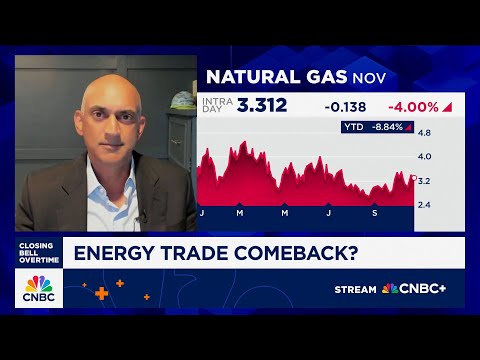
Oil is in broader, bottoming phase, says Veriten's Arjun Murti
CNBC Television· 2025-10-23 21:32
Joining us now is Arjun Merty, partner at Veritin. Arjun, a lot of this seems to be driven by the macro and uh certainly in this administration, the headlines can change quickly. How much can investors bank on this.>> John, we've been here before. We've had a bunch of bouts of geopolitical turmoil, both bullish and bearish. Bullish, the sanctions on Russia announced over the weekend.We saw Israel bomb Iran. And previously we've had bearish headlines whether it was liberation day tariffs or spiking uh China ...
OPEC ready to raise oil output if required after US sanctions on Russia, Kuwaiti minister says
Reuters· 2025-10-23 15:17
OPEC is ready to raise production by rolling back its oil output cuts further if required to address market shortfalls after the United States imposed new sanctions on Russian oil majors, Kuwait's oil... ...