HDFC Bank

Search documents
PSU banks counting on QR-based payments to breach a fintech fort
The Economic Times· 2026-01-21 18:56
Core Insights - Public sector banks (PSBs) are increasingly entering the QR-code led merchant payments space, aiming to compete with fintech companies like BharatPe, PhonePe, and Paytm [15] - This shift in strategy is driven by the revenue opportunities in the small merchant ecosystem and the dominance of UPI payments [2][15] - Banks are focusing on building direct relationships with merchants and enhancing their payment platforms with features like instant onboarding and on-demand settlement [10][15] Industry Trends - The Reserve Bank of India reports approximately 728 million QR codes deployed in the country, compared to only 11 million POS terminals, indicating a significant market potential [7] - Industry estimates suggest there are around 30 million soundbox terminals in India, further highlighting the growth opportunities in the small merchant payment sector [7] - Paytm has disclosed quarterly disbursals of around ₹4,500 crore for merchants, with a significant portion of transactions driven by UPI QR code-based payments [8][9] Competitive Landscape - Players like Worldline are collaborating with banks to provide technology stacks and backend settlements, enabling a comprehensive payment service for small merchants [5][15] - Banks are motivated by the low cost of deploying payment solutions and the potential for data and lending opportunities in this market [6][15] - The entry of banks into the small merchant payment business may lead to competition with fintechs, although industry insiders believe this conflict may not be immediate [12][15]


Sensex sinks below 82K; Nifty ended down 75 points
Rediff· 2026-01-21 11:50
Market Overview - Indian equity markets experienced losses for the third consecutive session due to heightened geopolitical tensions, weak global peers, and persistent foreign fund outflows [3][9] - The 30-share BSE Sensex closed at 81,909.63, down 270.84 points or 0.33 percent, while the NSE Nifty declined 75 points or 0.30 percent to 25,157.50 [4][5] Stock Performance - Major laggards included ICICI Bank, Trent, Bharat Electronics, Axis Bank, HDFC Bank, Larsen & Toubro, State Bank of India, and Maruti [6][7] - Gainers in the market were Eternal, UltraTech Cement, InterGlobe Aviation, and Reliance Industries [7][8] Investor Activity - Foreign institutional investors sold equities worth ₹2,938.33 crore, while domestic institutional investors purchased stocks worth ₹3,665.69 crore [8] Market Sentiment - Analysts noted that domestic markets were affected by global risk factors, leading to volatility, although some value buying helped recover early losses [10] - The weakening rupee and uncertainties regarding trade ties are expected to prolong market volatility [10]
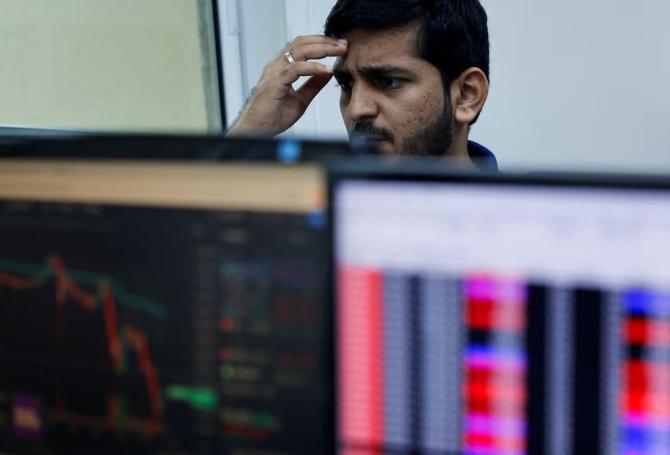
Sensex tanks over 1,000 points, Nifty tumble over 1%
Rediff· 2026-01-20 11:36
Market Performance - The benchmark indices Sensex and Nifty fell over 1 percent due to heavy selling pressure in major companies like Reliance, Bajaj Finance, and M&M amid rising geopolitical tensions [1][3] - The BSE Sensex dropped 1,065.71 points, or 1.28 percent, closing at 82,180.47, with an intraday low of 82,010.58, down 1,235.6 points or 1.48 percent [3] - The NSE Nifty decreased by 353 points, or 1.38 percent, ending at 25,232.50 [3] Sector Performance - Among the 30 Sensex firms, notable declines included Eternal at 4.02 percent, Bajaj Finance at 3.88 percent, and several others like Sun Pharma and Mahindra & Mahindra [4] - HDFC Bank was the only stock to gain among the Sensex firms [4] Foreign Investment Trends - Foreign institutional investors sold equities worth ₹3,262.82 crore on Monday, while domestic institutional investors purchased stocks worth ₹4,234.30 crore [4] Global Market Influence - Asian markets, including South Korea's Kospi, Japan's Nikkei 225, Shanghai's SSE Composite, and Hong Kong's Hang Seng, all closed lower [5] - The unpredictable use of tariffs by the US administration has created unease among global market participants, leading to volatility in financial markets [7] - Fresh threats from US President Donald Trump regarding additional tariffs on European nations have contributed to global equity selling, impacting Indian markets [8] Investor Sentiment - The Indian equity market ended on a negative note, influenced by weak global cues, cautious investor positioning, and a subdued risk appetite [9] - Brent crude oil prices increased by 0.09 percent to $63.91 per barrel [9]
Mcap of 3 of top-10 most valued firms jumps by ₹75,855 cr; State Bank, Infosys biggest winners
BusinessLine· 2026-01-18 10:02
Market Valuation Changes - The combined market valuation of three top firms, ICICI Bank, State Bank of India, and Infosys, increased by ₹75,855.43 crore in a holiday-shortened week [1] - SBI's market valuation rose by ₹39,045.51 crore to ₹9,62,107.27 crore, making it the largest gainer [3] - Infosys saw its market capitalization surge by ₹31,014.59 crore to ₹7,01,889.59 crore [3] - ICICI Bank's valuation increased by ₹5,795.33 crore, reaching ₹10,09,470.28 crore [3] Valuation Erosion of Other Firms - Reliance Industries, HDFC Bank, TCS, Bharti Airtel, Bajaj Finance, Hindustan Unilever, and Larsen & Toubro experienced a combined valuation loss of ₹75,549.89 crore [2] - Reliance Industries' market capitalization fell by ₹23,952.48 crore to ₹19,72,493.21 crore [3] - Larsen & Toubro's valuation decreased by ₹23,501.8 crore to ₹5,30,410.23 crore [3] - HDFC Bank's valuation dropped by ₹11,615.35 crore to ₹14,32,534.91 crore [4] - Bharti Airtel's market capitalization declined by ₹6,443.38 crore to ₹11,49,544.43 crore [4] - Bajaj Finance's valuation fell by ₹6,253.59 crore to ₹5,91,447.16 crore [4] - Hindustan Unilever's market capitalization diminished by ₹3,312.93 crore to ₹5,54,421.30 crore [4] - TCS's valuation dipped by ₹470.36 crore to ₹11,60,212.12 crore [4] Ranking of Firms - Reliance Industries remains the most valued domestic firm, followed by HDFC Bank, TCS, Bharti Airtel, ICICI Bank, State Bank of India, Infosys, Bajaj Finance, Hindustan Unilever, and Larsen & Toubro [5]

Sensex drops 245 points on persistent foreign fund outflows
Rediff· 2026-01-14 11:39
Market Performance - Equity benchmark indices Sensex and Nifty declined, with Sensex dropping 244.98 points (0.29%) to 83,382.71 and Nifty falling 66.70 points (0.26%) to 25,665.60, extending previous losses due to weakness in IT, consumption, and select banking stocks [1][4] - The BSE Sensex experienced a larger intraday drop of 442.49 points (0.52%) during the trading session [4] Sector Performance - Major laggards included Tata Consultancy Services, Asian Paints, Maruti, Sun Pharma, Hindustan Unilever, ICICI Bank, Kotak Mahindra Bank, Tech Mahindra, HDFC Bank, and Larsen & Toubro [4] - Conversely, Tata Steel, NTPC, Axis Bank, and UltraTech Cement were among the gainers [6] Investor Activity - Foreign institutional investors sold equities worth ₹1,499.81 crore, while domestic institutional investors purchased stocks worth ₹1,181.78 crore [6] Geopolitical and Economic Factors - Escalating geopolitical tensions and persistent foreign fund outflows contributed to market weakness, alongside fresh tariff-related uncertainties that unsettled investors [1][3] Global Market Context - In Asian markets, South Korea's Kospi, Japan's Nikkei 225, and Hong Kong's Hang Seng indices closed higher, while Shanghai's SSE Composite index ended lower [6] - Brent crude oil prices decreased by 0.99% to $64.82 per barrel [7]
RIL, MCX, JSW Energy feature among mutual funds’ key December trades
The Economic Times· 2026-01-14 06:40
Core Insights - Mutual funds invested Rs 38,900 crore into Indian equities in December, indicating strong market activity and portfolio management [1] - Significant stock additions included ICICI Bank and HDFC Bank, while notable sales were observed in Infosys and State Bank of India [1] - The report emphasizes consistent buying trends in certain large-cap stocks along with specific mid and small-cap companies [1]
Deposit Rate Cuts Tough For Banks As Govt Retains Small Savings Rates
Rediff· 2026-01-14 03:34
Core Viewpoint - The government's decision to maintain interest rates on small savings schemes will limit banks' ability to further reduce deposit rates, impacting their overall deposit strategies [1][9]. Group 1: Government's Decision on Small Savings Rates - The government has decided to keep interest rates unchanged for various small savings schemes for the January-March 2026 quarter, including the Public Provident Fund (PPF) at 7.1%, Sukanya Samriddhi Yojana at 8.2%, and National Savings Certificate (NSC) at 7.7% [3][4]. - This marks the eighth consecutive quarter that these rates have remained unchanged, despite the Reserve Bank of India (RBI) cutting the repo rate by 125 basis points since February of the previous year [5]. Group 2: Impact on Banks and Deposit Rates - Banks are facing challenges in reducing deposit rates further due to the unchanged small savings rates, which could make deposits less attractive compared to alternative investment options [8][10]. - The weighted average lending rate (WALR) on fresh rupee loans decreased by 69 basis points from February to October 2025, while the weighted average domestic term deposit rate (WADTDR) on fresh deposits declined by 105 basis points during the same period [5][6]. - Deposit growth has slowed to 9.35% year-on-year, while credit growth has risen to nearly 12%, widening the credit-deposit growth gap by over 260 basis points [11]. Group 3: Market Competition and Strategy - Banks are experiencing increased competition from capital markets, particularly mutual funds and equity markets, which are attracting household savings away from traditional deposits [14]. - Each bank will determine its deposit rate strategy based on its credit growth ambitions and net interest margin (NIM) outlook, influenced by the liquidity conditions and interest rates of competing investment products [10][14]. - The certificate of deposit (CD) market has seen significant activity, with banks raising over ₹50,000 crore through this route in recent weeks, indicating a shift in funding strategies [15].
Sensex falls over 200 points led by FMCG, IT stocks; Nifty below 25,750
The Economic Times· 2026-01-13 04:17
Market Overview - Indian equities experienced a reversal after an initial positive opening, with the Sensex falling 200 points, or 0.23%, to 83,678.17, while the Nifty 50 surpassed the 25,700 level as investor caution set in [1][12] - The previous session saw both the Sensex and Nifty rise approximately 0.4% due to optimism surrounding U.S.-India trade negotiations, following comments from a U.S. envoy about upcoming discussions [5][12] Sector Performance - On the Sensex, gains were primarily driven by Tech Mahindra, with IT stocks outperforming and the index rising 0.6% [2][12] - The advance was broad-based, with small-cap and mid-cap indices each increasing by about 0.4% [3][12] Geopolitical Influences - Geopolitical developments, particularly related to U.S. trade policies under President Trump, are expected to continue influencing market dynamics. Trump's recent announcement of 25% tariffs on countries trading with Iran highlights ongoing trade tensions [6][12] - The necessity for a U.S.-India trade agreement was underscored by a market rebound following the U.S. ambassador's declaration of intent to resume trade talks as early as January 13th [6][12] Global Market Trends - Asian equities advanced, led by a significant rally in Japanese stocks, with the Nikkei 225 surging 3.4% to a record high, supported by a weaker yen and speculation about fiscal stimulus [7][8] - The MSCI index of Asia-Pacific shares outside Japan rose 0.8%, reaching a new record [8] Oil Market Impact - Oil prices increased due to renewed concerns over Iran and potential supply disruptions, with Brent crude futures rising 28 cents, or 0.4%, to $64.15 per barrel [10][12] Currency Movements - The Indian rupee declined by 5 paise to 90.22 against the U.S. dollar, influenced by a stronger dollar, rising crude oil prices, and ongoing foreign fund outflows [11][12]
Energy, banking and metal stocks push Sensex up 302 points
Rediff· 2026-01-12 11:16
Market Performance - Equity benchmark indices Sensex and Nifty showed recovery after a significant decline in the previous five trading sessions, driven by bargain hunting in energy, banking, and metal stocks [1] - The BSE Sensex increased by 301.93 points, or 0.36%, closing at 83,878.17, after initially dropping 715.17 points, or 0.85%, to 82,861.07 [3] - The NSE Nifty rose by 106.95 points, or 0.42%, to settle at 25,790.25, following a morning dip of 209.9 points, or 0.81%, to 25,473.40 [4] Sector Performance - Among the gainers in the 30-Sensex firms were Tata Steel, Asian Paints, Trent, State Bank of India, Hindustan Unilever, UltraTech Cement, ICICI Bank, and Bharti Airtel [4] - Conversely, laggards included Infosys, Bajaj Finance, Bharat Electronics, Larsen & Toubro, and HDFC Bank [4] Foreign and Domestic Investment - Foreign institutional investors sold equities worth ₹3,769.31 crore, while domestic institutional investors purchased stocks worth ₹5,595.84 crore [8] - Over the past five trading days, the BSE benchmark fell by 2,185.77 points, or 2.54%, and the Nifty decreased by 645.25 points, or 2.45% [8] Geopolitical Influence - The new US ambassador to India emphasized the importance of India to the United States and mentioned ongoing efforts to solidify a trade deal, which positively influenced market sentiment [5][6] - Investor sentiment improved following favorable remarks regarding the trade deal, contributing to the market's recovery [6][7]
Nifty Bank Prediction Today – January 12, 2026: Nifty Bank futures: Go short as outlook is bearish
BusinessLine· 2026-01-12 05:19
Group 1 - Nifty Bank index opened lower at 59,217, down from Friday's close of 59,252, and is currently at 59,160, reflecting a decline of 0.15% [1] - The advance-decline ratio is 5-9, indicating a bearish market sentiment [1] - IndusInd Bank and AU Small Finance Bank are the top gainers, with increases of 1% and 0.4% respectively, while IDFC First Bank is the top loser, down 0.7% [1] Group 2 - Both Nifty PSU Bank and Nifty Private Bank indices have experienced a decline of over 0.1% today, reinforcing the bearish trend [2] - Nifty Bank futures opened lower at 59,600 compared to last week's close of 59,541 and are currently trading at 59,380, down about 0.3% [3] - The price action indicates a bearish bias, with potential support levels at 59,200-59,000 [3] Group 3 - If Nifty Bank futures surpass 59,500, there could be a potential rise to 59,700 or 59,800, but the intraday outlook remains bearish [4] - A trading strategy suggests selling Nifty Bank futures at current levels of 59,380 and 59,500, with targets set at 59,200 and a stop-loss at 59,600 [5] - Support levels are identified at 59,200 and 59,000, while resistance levels are at 59,500 and 59,700 [5]