
GEP

Search documents
2026年度ProcureCon CPO报告:关于首席采购官角色演变的新见解
GEP· 2026-02-14 00:40
Investment Rating - The report does not explicitly provide an investment rating for the industry Core Insights - The role of Chief Procurement Officers (CPOs) is expanding significantly, with 89% of respondents indicating that their CPO plays a greater role in high-level decision-making compared to previous years [14][26] - There is a notable increase in the expectation for CPOs' influence in decision-making, with 82% anticipating further growth in this area [29] - The report highlights the importance of AI integration in procurement, with only 11% of respondents feeling fully ready to leverage AI [14][70] Summary by Sections Executive Summary - The report examines the evolving role of CPOs and their increasing strategic influence within organizations, based on a survey of senior procurement leaders [5] Key Insights - 89% of respondents say their CPO plays a greater role in high-level decision-making, with 82% expecting this role to increase [14][29] - Only 11% describe their CPO as a core member of the executive team, indicating room for growth in strategic integration [36] The Expanding Strategic Role of the CPO - CPOs are expected to drive significant changes in 2026, with 25% of respondents noting a "significant" increase in their role [26] - The majority of organizations see the influence of CPOs growing, yet only 11% currently treat them as true strategic equals [36] CPO Priorities and Challenges in 2026 - Enhancing supplier relationship management (55%) and implementing AI-driven automation (45%) are top priorities for CPOs [43][18] - Major challenges include securing talent with advanced digital skills (54%) and balancing cost reduction with growth (52%) [55] Procurement's Role in Technology Implementation and AI Readiness - 43% of respondents plan to invest in integrated cloud-based procurement platforms, indicating a shift towards modernization [62] - 69% of organizations report that AI initiatives are part of broader digital transformation investments, but only 11% feel fully ready to implement AI [68][76] How the CPO Role will Change in Three Years - CPOs are expected to evolve into strategic partners, focusing on sustainability and AI governance [82][85] - Future CPOs will play a critical role in shaping corporate narratives and influencing perceptions of corporate credibility [86] Conclusion - The report confirms that CPOs are transitioning from a cost and compliance function to a strategic business discipline, with expectations for their influence to continue growing [95][96]
电子屏障:人工智能电源准备的统一战略和蓝图
GEP· 2026-02-11 00:40
Investment Rating - The report indicates a shift in the technology sector from a chip-constrained environment to a power-constrained one, emphasizing the importance of power readiness in market valuation [7][8]. Core Insights - The global technology sector is facing a significant challenge due to the scarcity of high-density electrical power, with electricity demand from data centers expected to exceed 1,000 TWh in 2026, comparable to Japan's annual consumption [5][6]. - The North American market is projected to experience a shortfall of 19 GW in grid-ready power by 2028, leading to potential stranded capital risks [7]. - Time-to-power (TTP) has emerged as a critical driver of enterprise value, with delays costing companies significant revenue [8]. - A proactive approach is necessary for both industry and government to address power constraints, including improving supply chain visibility and diversifying power generation [9]. Summary by Sections The Macroeconomic Landscape - Energy availability is now the primary factor for site selection in the industrial landscape, surpassing labor and tax incentives [10]. The 1 GW Standard - Gigawatt-scale data centers are being constructed with timelines significantly shorter than traditional industrial infrastructure, consuming power equivalent to that of a large city [11]. Factors Driving Change - Rack density has increased from 15 kW in 2023 to over 100 kW in next-generation AI clusters, necessitating locations with abundant power [12]. - AI queries are approximately 10 times more energy-intensive than traditional queries, creating a high-density demand that legacy grids struggle to meet [13]. - Hyperscalers are investing over $600 billion annually, but project delays are common due to long lead times for necessary infrastructure [14]. The Silicon vs. Steel Paradox - The digital economy relies on Moore's Law, while physical infrastructure development is constrained by long industrial cycles, creating a gap that poses challenges for the industry [15]. The Infrastructure Latency Gap - A significant mismatch exists between the rapid pace of the tech industry and the slow regulatory processes of the utility sector, with interconnection queues exceeding 2,000 GW in major markets [18]. Owner-Operator Power Model - Companies are increasingly adopting owner-operator strategies to control their power infrastructure, reducing interconnection latency and gaining competitive advantages [19][21]. Trade Dynamics - Global trade policies have introduced volatility in the renewable energy sector, with tariffs significantly increasing project costs in the U.S. compared to other regions [22][23]. The Physical Bottleneck - The supply chain for high-voltage transformers is under strain, with lead times increasing dramatically and prices rising significantly [25][26]. The Baseload Frontier - The private sector is exploring small modular reactors (SMRs) as a viable energy source for continuous AI operations, although fuel supply chains present challenges [28][29]. Efficiency Creates Capacity - Companies are implementing direct-to-chip liquid cooling and reusing waste heat to enhance energy efficiency and capacity [30][31]. Strategic Procurement - Organizations are shifting to AI-led procurement models to better manage volatility and risks in the supply chain [32][33][34]. A Practical Blueprint for Leaders - The report outlines a readiness roadmap for addressing power shortfalls, including diagnostic audits, supply chain harmonization, and operational autonomy [36]. The Convergence of Atoms and Bits - The report emphasizes the need for a fundamental shift in mindset, recognizing that compute capacity is inseparable from power capacity, and advocates for a co-engineering approach to grid development [38][39][41].
重新构想管理服务:向人工智能协调采购和供应链交付的转变
GEP· 2026-02-07 00:40
Investment Rating - The report suggests a shift from traditional managed services to an AI-orchestrated model, indicating a positive outlook for companies adopting this new approach [5][36]. Core Insights - The traditional managed services model is inadequate for delivering real-time insights and resilience in today's fast-paced environment [2][3]. - The future of managed services lies in AI-powered orchestration, where intelligent agents handle transactional work, allowing humans to focus on advisory roles and governance [4][12]. - Organizations must transition to a new operating model that integrates AI into procurement and supply chain processes, enhancing efficiency and decision-making [10][36]. Summary by Sections Current Challenges - Traditional managed services are limited by manual workflows, siloed teams, and slow cycle times, which hinder scalability and insight generation [9][7]. - AI-enabled outsourcing improves efficiency but does not fundamentally change the operating model; true transformation requires AI-powered orchestration [10][12]. AI-Powered Operating Model - The new model consists of three layers: AI Foundation, Human Orchestration, and Client Value Outcomes [13][14]. - AI Foundation automates workflows and generates real-time insights, while Human Orchestration focuses on higher-value tasks and governance [15][18]. - Client Value Outcomes emphasize smarter decisions, proactive risk management, and enhanced supplier collaboration [23][35]. Transition to Fusion Pods - The delivery structure is evolving from siloed functions to integrated fusion pods, which combine category experts and AI agents to drive outcomes [25][30]. - This model simplifies complexity by coordinating tools and people around business outcomes rather than individual features [28][29]. Implementation Phases - The transition to an AI-orchestrated model should be phased, starting with automating 20%-30% of workflows and progressing to 60% autonomous operations over three years [32][31]. - The focus will shift from repetitive tasks to advisory roles, enhancing client partnerships and governance [32][36]. Strategic Implications - Embracing AI-powered orchestration provides organizations with advantages in cost, agility, resilience, and strategic impact [37][36]. - Companies that adapt to this model will outperform those that cling to outdated delivery methods [37].
利用人工智能预测分析推动E&U的供应链弹性
GEP· 2026-02-03 00:40
Investment Rating - The report does not explicitly state an investment rating for the industry Core Insights - The energy and utility supply chain is under unprecedented pressure due to rapid global energy demand growth, necessitating resilient supply chains that can anticipate and overcome disruptions through AI-driven predictive analytics [3][4] - Predictive analytics transforms the ability to foresee demand changes, supply risks, and asset failures, optimizing procurement strategies and reducing operational downtime through real-time data [4][9] - Traditional mitigation strategies are insufficient, often leading to long-term inefficiencies and capital being tied up in non-productive inventory [5] Summary by Sections Supply Chain Resilience - The demand for grid modernization materials is surging, but supply is constrained by long lead times, rising costs, labor shortages, and climate-related disruptions [6] - Key dimensions of supply chain resilience in transmission and distribution (T&D) include agility, stability, visibility, collaboration, and asset failure management [18] Predictive Analytics - Predictive analytics utilizes historical and real-time data to forecast future outcomes, enabling utilities to predict material needs and assess supplier reliability [9][10] - The integration of predictive capabilities into supply chain operations allows utilities to anticipate, absorb, adapt, and recover from disruptions [13] Enhancing Procurement Strategies - AI-driven predictive analytics can reduce unplanned downtime by up to 35% and provide 10-15% savings in procurement costs [35] - Historical data analysis enhances inventory management and prepares for demand fluctuations, leading to more strategic inventory and procurement decisions [36] Implementation Challenges - The adoption of predictive analytics in the utility sector faces challenges such as data quality and availability, technology integration, and skills shortages [39][41][42] - Building a robust data governance framework and enhancing team capabilities are essential for successful implementation [46][48]
SPARE CAPACITY PERSISTS GLOBALLY, WHILE NORTH AMERICA REPORTS A STEEPER PULLBACK IN MANUFACTURING DEMAND, SIGNALLING WEAK CONDITIONS HEADING INTO 2026: GEP GLOBAL SUPPLY CHAIN VOLATILITY INDEX
Prnewswire· 2025-12-10 13:17
Core Insights - The GEP Global Supply Chain Volatility Index indicates that global supply chains remained underutilized in November 2025, with a headline index of -0.29, suggesting a weakening outlook for early 2026 [1][3][8] Regional Analysis - **North America**: The index fell to -0.53 from -0.45, marking the highest degree of underutilized supplier capacity since March, indicating a softening manufacturing activity [9] - **Europe**: The index dipped to -0.33 from -0.25, reflecting ongoing fragility in the industrial economy, with manufacturers in Germany and France showing reluctance to expand purchasing [4][9] - **Asia**: The index rose to -0.16 from -0.30, signaling less spare capacity than in October, with Chinese factory purchasing slowing down, although ASEAN countries like Indonesia and Vietnam showed resilience [4][9] Demand and Supply Dynamics - Global factories' purchases of commodities and intermediate goods slowed in November, primarily due to reduced factory buying in China and weak demand in the US and major European economies [14] - Reports of stockpiling due to price or supply fears remain historically low, indicating limited concerns about purchasing price inflation or shortages [14] - The global item shortages tracker is well below its long-term trend, suggesting healthy supply levels for manufacturers, with minimal challenges in sourcing [14] Cost Pressures and Market Conditions - With excess capacity globally, companies are expected to face limited purchasing cost pressures, excluding tariff-related effects, as shortages remain minimal and stockpiling activity is low [5][8] - Transportation costs increased slightly in November but remained in line with historical averages, indicating stable logistics conditions [14]

NORTH AMERICAN MANUFACTURERS CUT ORDERS AS GLOBAL SUPPLY CHAINS REMAIN UNDERUTILIZED IN OCTOBER: GEP GLOBAL SUPPLY CHAIN VOLATILITY INDEX
Prnewswire· 2025-11-12 13:14
Core Insights - North American manufacturers have significantly reduced their purchases of raw materials and intermediate goods in October, indicating a potential slowdown in production in the coming months [1][9][18] Supply Chain Volatility Index - The GEP Global Supply Chain Volatility Index registered -0.33 in October, suggesting that global supply chain capacity remains underutilized, with manufacturers keeping inventories lean and curbing new purchases [4][9] - In North America, the index fell to -0.45, the lowest level since March, indicating that suppliers' capacity is underutilized to the greatest extent since prior to April's tariff announcements [10] - Asia's index dropped to -0.30, primarily due to a slowdown in purchasing by Chinese manufacturers, while Europe saw a slight improvement with the index rising to -0.25 [10] Regional Analysis - North America is experiencing a clear manufacturing pullback, with firms reporting lower material purchasing and reduced inventory building, which points to weaker production through the winter [5][7] - In Asia, the momentum has faded, with a pullback in factory buying across China offsetting continued strength in India, leading to a broader softening across the region [5] - Europe's manufacturing sector is showing only marginal increases in activity, with firms in major economies like Germany, France, Italy, and the U.K. continuing to restrict raw material purchasing, indicating a sluggish industrial recovery [6][9] Inventory and Purchasing Trends - Reports indicate that global procurement managers are experiencing historically low levels of stockpiling due to limited concerns about purchasing price inflation or shortages, reflecting a preference for lean inventories among manufacturers [15] - The global item shortages tracker remains well below its long-term trend level, signaling healthy supply levels for manufacturers, with minimal challenges in sourcing commodities and components [15] Labor and Transportation Insights - There was a modest rise in labor-related capacity constraints in October, with backlogs due to inadequate staff supply reaching a four-month high, although the labor shortages tracker remains only marginally above its long-term trend [15] - Global transportation costs slightly decreased in October, falling just below historically average levels [15]

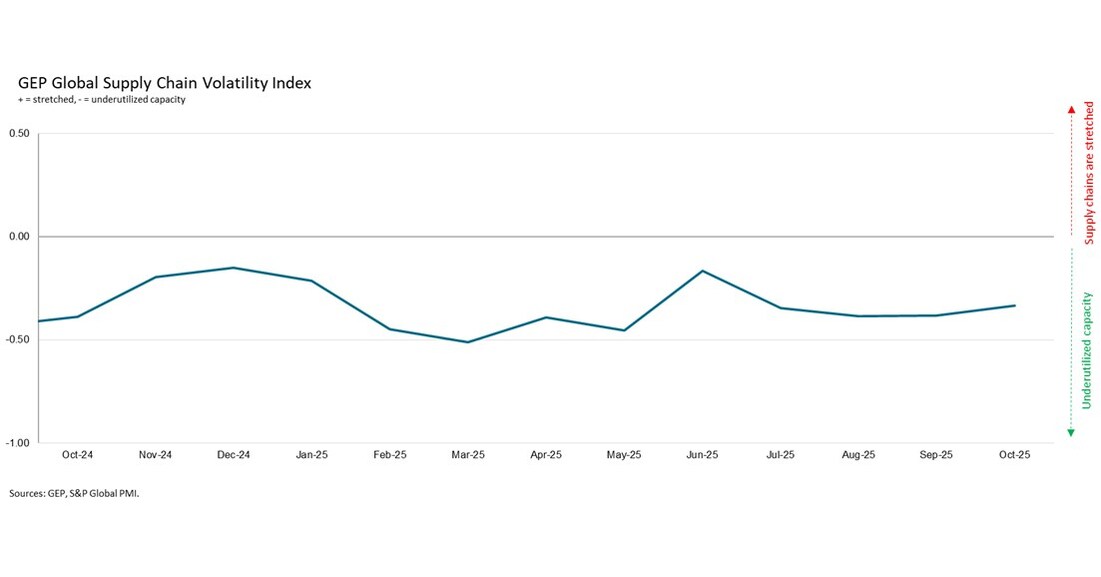
CHINA DRIVES STRONGEST GROWTH IN GLOBAL FACTORY PURCHASING SINCE MID-2022, WHILE NORTH AMERICAN MANUFACTURERS COOL IN SEPTEMBER: GEP GLOBAL SUPPLY CHAIN VOLATILITY INDEX
Prnewswire· 2025-10-10 12:06
Core Insights - The GEP Global Supply Chain Volatility Index showed little change in September, indicating that global supply chains are still operating below full capacity [1][4] - Chinese factories reported a significant increase in purchasing, leading to a rise in global manufacturing procurement activity, while North American supply chains faced challenges due to tariff-related delays and economic concerns [2][7] - European supply chains remained underutilized, with manufacturers in key countries reducing purchasing and stockpiles, marking the weakest activity level since March [3][8] Regional Key Findings - **Asia**: Chinese manufacturers increased purchasing sharply in September, resulting in the busiest level for Asia's supply chains since June 2022 [7][8] - **North America**: Manufacturers were hesitant to stockpile further due to economic outlook concerns, with tariff-related disruptions impacting manufacturing activity [8] - **Europe**: Supply chain activity in Germany, France, and Italy declined, leading to a six-month low in the region's index [8] Demand and Inventory Trends - September saw a revival in factory purchasing, particularly in Asia, driven by increased demand in China [8] - The frequency of global manufacturers stockpiling due to price or supply fears decreased, indicating reduced concerns about inflation or item availability [8] - Global supply shortages tracker showed a decrease, suggesting robust item availability for manufacturers [8][14] Transportation and Labor Insights - Global transportation costs remained in line with historically normal levels during September [14] - Staffing capacity was not a constraint for global manufacturers, with reports of backlogs due to labor shortages falling below the long-term average [14]
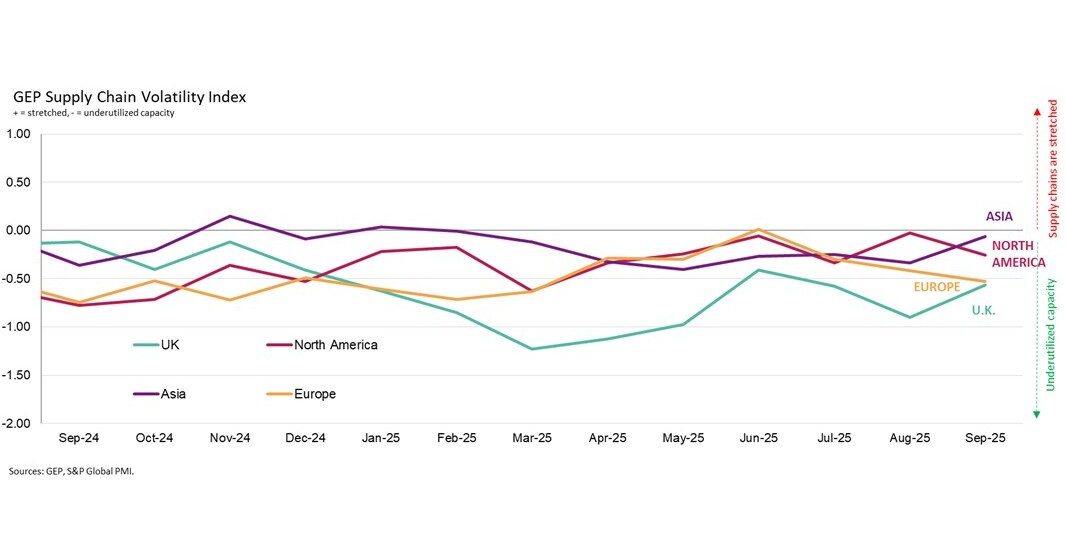
TARIFF FEARS DRIVE U.S. STOCKPILING IN AUGUST, WHILE MANUFACTURING WEAKENS IN EUROPE AND ASIA: GEP SUPPLY CHAIN VOLATILITY INDEX
Prnewswire· 2025-09-11 12:23
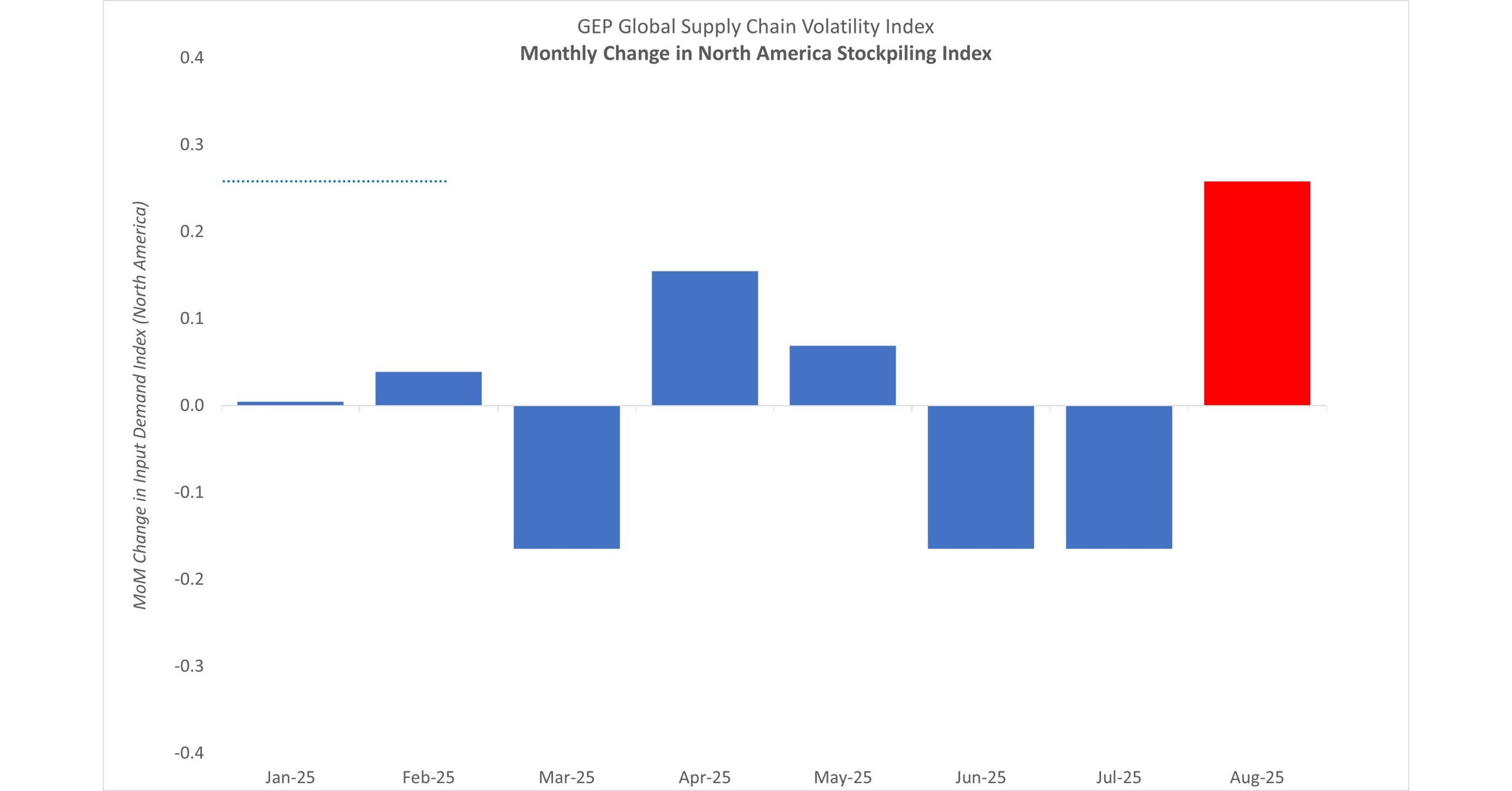
Core Insights - The GEP Global Supply Chain Volatility Index decreased to -0.39 in August from -0.35 in July, indicating rising spare capacity as global supply chain activity cooled [1][14] - North America showed strong supply chain activity, with companies stockpiling raw materials to mitigate tariff-related shortages, particularly in the US consumer goods sector [1][6] - In contrast, Asia's index fell to a three-month low, primarily due to weakened purchasing activity in China's consumer non-cyclicals sector, with Japan and Taiwan also experiencing declines [2][7] - Europe faced further deterioration, with Germany's basic materials sector struggling and UK manufacturing deepening its contraction, resulting in an index of -0.90, one of the steepest declines since 2024 [2][6] Regional Highlights - **North America**: Supply chains were nearly at full capacity as companies increased stock levels in response to recent orders and tariff concerns [6][7] - **Asia**: The index indicated rising spare capacity, with flat purchasing volumes in China, while South Korea, Indonesia, and India saw increased procurement activity [7] - **Europe**: The index continued to decline as factories reduced purchases of intermediate goods and destocked, highlighting the fragile nature of the region's industrial recovery [6][7] Expert Commentary - Michael DuVall, GEP's global head of supply chain strategy, noted that tariff uncertainty has become a structural reality, urging companies to invest in resilience, diversify suppliers, and enhance capabilities like demand sensing for better decision-making [3][6]
U.S. FACTORY PURCHASES SLOWED SHARPLY IN JULY, DRIVING GLOBAL SUPPLY CHAIN SLOWDOWN: GEP GLOBAL SUPPLY CHAIN VOLATILITY INDEX
Prnewswire· 2025-08-13 12:22
Core Insights - Global supply chain activity declined in July as U.S. manufacturers reduced purchases of materials and components after building inventories in June ahead of the end of the 'tariff pause' [1][2] - The GEP Global Supply Chain Volatility Index fell to -0.35 from -0.17 in June, indicating increased spare capacity worldwide, primarily driven by the U.S. [2][6] - U.S. manufacturers are preparing for lower demand, as evidenced by a significant reduction in input purchases [3][6] Regional Key Findings - North America's index dropped to -0.33 from -0.06, reflecting a pullback in orders [2][6] - Asian factory purchasing activity remains slightly below trend, with notable weakness in Japan and South Korea, while Taiwan's factories experienced an accelerated downturn [7] - Europe's industrial recovery stalled, with the index declining to -0.30 from 0.01, highlighting the fragile nature of the recovery, particularly in Germany [7] Inventory and Labor Insights - Safety stockpiling has eased, suggesting limited concern over supply bottlenecks or price surges [8] - Staffing capacity and transportation costs remained stable, with no signs of inflationary pressure from these sources [8]

TARIFF PAUSE SPURS GLOBAL MANUFACTURING ACTIVITY IN JUNE, WITH GLOBAL SUPPLY CHAINS NOW OPERATING CLOSE TO FULL CAPACITY: GEP GLOBAL SUPPLY CHAIN VOLATILITY INDEX
Prnewswire· 2025-07-11 12:17
Core Insights - The GEP Global Supply Chain Volatility Index increased to -0.17 in June 2025 from -0.46 in May, indicating a recovery in global supply chain activity despite ongoing tariffs [1] - European manufacturers returned to full capacity for the first time in over two years, driven by strong demand from US customers and a rebound in domestic and export demand, particularly in Germany [1][8] - North American manufacturers significantly increased their purchasing activity ahead of a potential end to the tariff pause, leading to a rise in the index to -0.06 from -0.24 [2][9] Demand Conditions - Global factory purchasing activity showed a robust upward trend in June, with North America experiencing the most significant increase [7][8] - The index for Asia rose to -0.27 from -0.40, indicating a pick-up in activity, although overall supply chains in Southeast Asia remain underutilized [9] Supply Chain Capacity - The index for Europe rose to 0.01 from -0.30, signaling full capacity utilization across European supply chains as the industrial sector recovers [9] - In the UK, the index improved to -0.41 from -0.97, indicating a reduction in slack but still reflecting underutilization [9] Inventory and Material Shortages - Reports of increased stockpiling due to price or supply concerns were at their highest in 2025, with businesses building safety buffers in warehouses [15] - The global item shortages indicator remains historically low, suggesting robust availability of materials [15] Labor and Transportation - Suppliers' workforce capacity is sufficient to handle current order loads, with stable reports of manufacturing backlogs due to staff shortages [15] - Global transportation costs aligned with long-term averages, and logistic cost pressures remained stable [15]