
Leju Robotics

Search documents
2025年卖出超5000台 智元登顶全球人形机器人出货量榜首
Zhong Guo Jing Ying Bao· 2026-01-09 04:41
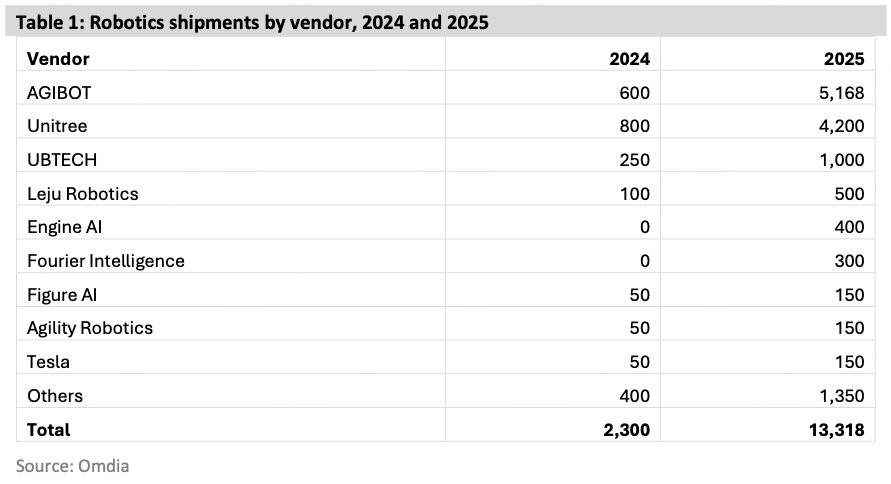
| Vendor | 2024 | 2025 | | --- | --- | --- | | AGIBOT | 600 | 5,168 | | Unitree | 800 | 4,200 | | UBTECH | 250 | 1,000 | | Leju Robotics | 100 | 500 | | Engine Al | 0 | 400 | | Fourier Intelligence | 0 | 300 | | Figure Al | 50 | 150 | | Agility Robotics | 50 | 150 | | Tesla | 50 | 150 | | Others | 400 | 1,350 | | Total | 2,300 | 13,318 | 2025年,智元(AGIBOT)机器人出货量超过5000台。Omdia/图 中经记者杨让晨张家振上海报道 2026年1月8日,全球权威市场研究机构Omdia正式发布《通用具身机器人市场雷达报告》(以下简称《报告》),系统分析了 2025年全球人形机器人的市场趋势、关键商用指标与综合技术实力。 《中国经营报》记者注意到,上述《报告》显示,202 ...


Core China's Strategic Equipment Debuts at the China Hi-Tech Fair
Prnewswire· 2025-11-19 08:48
Core Insights - The 27th China Hi-Tech Fair (CHTF) showcased over 5,000 new products and technologies, attracting more than 450,000 professional visitors and generating over RMB 170 billion in intended deals and financing, reaffirming its status as "China's No.1 Tech Show" [1] Group 1: Major Exhibits and Innovations - CNOOC presented Asia's first cylindrical floating production, storage, and offloading (FPSO) facility, Haikui 1, highlighting China's capabilities in deep-sea energy development [2] - China General Nuclear (CGN) showcased its indigenous third-generation nuclear technology, Hualong One, along with advanced new-energy equipment [3] - APT Satellite introduced groundbreaking innovations, including the world's first satellite-communication ultra-long-distance robotic surgery system and the EH216-S unmanned passenger aircraft [4] Group 2: Robotics and AI Technologies - Leju Robotics demonstrated its humanoid robot Kuavo and the GeneoX inspection robot dog, showcasing advancements in embodied intelligence and multi-brand integration [5] - Humanoid robots exhibited advanced capabilities such as front flips and L4 autonomous-driving adaptation, emphasizing technological sophistication [5] - Meituan's fourth-generation drone showcased low-altitude logistics by delivering 2.4 kg over a 5-km radius in 10 minutes [5] Group 3: Thematic Exhibitions and Ecosystem - The fair featured themed exhibitions on the OpenHarmony ecosystem and China's home-grown AI ecosystem, demonstrating how technology is reshaping everyday life [6] - Shenzhen's deep innovation ecosystem, established as a pilot SEZ in 1980, has transformed the city into a tech hub for major companies like Huawei and Tencent [7] - Policy support and industrial-chain strengths in the Greater Bay Area facilitate rapid commercialization and agile manufacturing, enabling quick prototype development [8] Group 4: Entrepreneurial Landscape - The new generation of entrepreneurs is redefining product categories, enhancing global competitiveness while avoiding IP risks [9]
X @Bloomberg
Bloomberg· 2025-10-22 09:24
Funding & Investment - Leju Robotics secured over $200 million in new funding [1] - The funding round precedes Leju Robotics' planned public listing [1] - The investment indicates continued investor confidence in China's developing humanoid robot industry [1]
人形机器人考察要点_市场展望、组件与具身人工智能-Humanoid Robot tour takeaways_ market outlook, components and embodied AI
2025-09-18 13:09
Summary of Conference Call Notes on Greater China Industrials (Humanoid Robots and Autonomous Driving) Industry Overview - The humanoid robot and autonomous driving (AD) sectors in China are expected to experience rapid expansion over the next decade, with significant growth anticipated in factory settings within 2-3 years and further opportunities in commercial and household applications in the long term [1][1] - The current bill of materials (BOM) cost for a fully-functional humanoid robot is approximately US$50-60k, with expectations for rapid cost reductions in the next five years due to improved product design and economies of scale [1][1] - Stricter regulations in the AD sector are anticipated to create more opportunities for AD components, particularly for LiDAR technology, which will benefit from new long-distance object detection requirements [1][1] Key Players and Developments Dobot - Dobot is a leading global collaborative robot (COBOT) brand, achieving a 47% year-over-year growth in 6-axis COBOT sales in the first half of 2025, indicating market share gains [8][8] - The company has entered the humanoid robot market, launching its first prototype in early 2025 and planning deployment in manufacturing and business scenarios [9][9] RoboSense - RoboSense is focusing on its new EMX LiDAR products, which offer superior precision and detection distance compared to competitors, with expectations to ship 600-700k units in 2025 and 1.5 million units in 2026 [10][10] - The company is also exploring opportunities in the lawn mower, unmanned delivery, and robotaxi industries, with significant partnerships established [11][11] Zhaowei Machinery & Electronics - Zhaowei has launched new dexterous hand models for humanoid robots and aims for a 10-15% global market share in this segment [12][12][13][13] - The BOM cost of the dexterous hand is estimated to account for 20-30% of the total BOM cost of a humanoid robot [13][13] Googol Technology - Googol Technology specializes in high-end control systems for advanced manufacturing and sees strong growth potential in humanoid robots due to its expertise in multi-degree-of-freedom (DoF) controlling [14][15] Minieye - Minieye is making progress with its smart driving solutions, including iPilot and iRobo, and anticipates significant growth in the penetration of front-view camera modules and driver monitoring systems due to new safety regulations [16][17] Leju Robotics - Leju targets to deliver over 1,000 units of robotics in 2025, focusing on stability and durability for large-scale applications [18][18] Orbbec - Orbbec is a leading player in robot vision systems, holding over 70% market share in 3D vision systems for service robots in China [21][21][22][22] UBTECH - UBTECH aims to ship 500 humanoid robots in 2025 and 2,000-3,000 units in 2026, with expectations for BOM cost reductions in the coming years [23][23][24][24] LK Tech - LK Tech is focusing on magnesium alloy technology for humanoid robots, which offers lightweighting and other advantages, and has signed cooperation agreements for R&D projects [25][26][26] Technology Insights - The competition between VLA (Vision-Language-Action) and world model technologies for embodied AI is highlighted, with data availability being a key bottleneck [3][3] - The vision system of humanoid robots is evolving, with depth cameras becoming the mainstream choice for enhancing sensing and navigation capabilities [22][22] Market Outlook - The humanoid robot market is expected to grow significantly, with projections of 3 million units shipped by 2030, leading to substantial opportunities for component suppliers [13][13] - The average selling price (ASP) of humanoid robots is expected to decline to approximately RMB150k (~US$20k) by 2026-2028 due to scale effects [20][20] Conclusion - The humanoid robot and AD sectors in Greater China are poised for significant growth, driven by technological advancements, regulatory changes, and increasing market demand. Key players are actively innovating and expanding their product offerings to capture market share in this rapidly evolving landscape.
未知机构:深度-中国机器人初创企业崛起-20250606
未知机构· 2025-06-06 06:55
Summary of the Conference Call on China's Humanoid Robot Industry Industry Overview - The conference call discusses the rapidly evolving humanoid robot industry in China, highlighting the competitive landscape and technological advancements made by local startups like EngineAI and Unitree Robotics [4][10][12]. Key Points and Arguments 1. **Technological Advancements**: EngineAI's humanoid robot demonstrated the ability to learn dance moves using computer vision and machine learning, showcasing significant progress in AI applications for robotics [8][9]. 2. **Market Potential**: Citigroup projects the market for humanoid robots and related services could reach $7 trillion by 2050, with an estimated 648 million humanoid robots potentially in use globally [18]. 3. **Government Support**: The Chinese government has been instrumental in fostering the growth of the robotics sector, with plans to invest 1 trillion yuan ($138 billion) over the next two decades [26][27]. 4. **Labor Shortages**: The development of humanoid robots is partly driven by a looming labor shortage in China, with a projected 30 million worker shortfall in manufacturing by the end of the year [34]. 5. **Competitive Landscape**: Approximately 50 to 60 companies in China are currently engaged in humanoid robot development, benefiting from the country's manufacturing expertise and government backing [14][15]. 6. **Global Competition**: Elon Musk expressed concerns that Chinese companies may dominate the humanoid market, indicating the competitive pressure faced by U.S. firms like Tesla [16][17]. 7. **Economic Viability**: Analysts suggest that humanoid robots could pay for themselves within 36 weeks based on labor cost savings, making them economically attractive for various industries [67]. Additional Important Insights 1. **Integration Across Sectors**: China aims to integrate humanoid robots into various sectors, including manufacturing, healthcare, and hospitality, with a current robot density of 470 robots per 10,000 workers, surpassing the U.S. and Japan [37][38]. 2. **Challenges in Development**: Despite advancements, the industry faces challenges, such as the need for humanoid robots to provide tangible value to justify their costs [55][56]. 3. **Future Outlook**: The growing number of startups in China is intensifying competition, driving innovation and improvements in AI capabilities and physical designs of robots [70]. 4. **Cultural Perception**: Humanoid robots have captured public imagination for decades, but their practical applications and economic sense remain under scrutiny [59][60]. This summary encapsulates the key discussions and insights from the conference call regarding the state and future of the humanoid robot industry in China, emphasizing both the opportunities and challenges present in this rapidly evolving field.