
TDK Corporation

Search documents
Global Trade and Energy Tensions Escalate: China Restricts Japan Exports as White House Pressures Big Tech
Stock Market News· 2026-02-24 05:08
Key TakeawaysChina imposes strict export bans on 20 Japanese entities, including major industrial players, to curb what Beijing describes as Japan's "remilitarization."The White House is pressuring technology companies to pledge that massive AI data center expansions will not drive up electricity prices for American consumers.TD Cowen doubled its price target for Ultra Clean Holdings (UCTT) to $70, signaling high confidence in a 2026 semiconductor "super-cycle."Panama has seized two strategic ports previous ...



TDK Ventures bets on hardware, deep-tech as it steps up India investments
BusinessLine· 2026-01-19 01:23
Core Insights - TDK Ventures, the corporate venture arm of TDK Corporation, focuses on deep-tech and hardware-led startups globally, with a significant emphasis on India as a strategic market [1][4] Investment Thesis - TDK Ventures was established in 2019 to partner with early-stage founders and startups, leveraging TDK's expertise in material science and process innovation to inform its long-term product roadmap [1] Fund Structure - TDK Ventures manages a total of $500 million across four funds, including a $50 million fund from 2019 and three subsequent $150 million funds, primarily investing at Series A with initial checks up to $5 million and potential follow-ons up to $15 million per company [2] Sector Focus - The firm invests at the intersection of deep-tech and hardware, focusing on two main themes: energy transformation (including new energy generation and storage) and digital transformation (covering semiconductors, mobility, space-tech, robotics, and industrial tech) [3] Importance of India - India is a key market for TDK Ventures, with the company operating five component manufacturing facilities and large battery plants, employing nearly 5,000 people, and having made four investments in local startups [4] Portfolio Companies - TDK Ventures' Indian portfolio includes startups such as Infinite Uptime (industrial AI), Exponent Energy (ultra-fast EV charging), Ultraviolette (electric motorcycles), and a precision agritech company focused on sensor-IoT and AI technologies [4] Views on Deep-Tech Exits - The primary challenge in deep-tech is securing intermediate capital, as monetization signals appear later, although successful IPOs like Ather and Ola Electric demonstrate that hardware-led companies can scale and exit within comparable timelines [5]

SMD热敏电阻市场细分研究报告(总体规模、主要厂商、产品&应用)
QYResearch· 2026-01-07 08:58
Core Viewpoint - The SMD thermistor market is projected to grow significantly, with a global revenue forecast of approximately $270.61 million in 2024, reaching $430.18 million by 2031, representing a compound annual growth rate (CAGR) of 6.95% from 2024 to 2031 [3]. Market Overview - SMD thermistors are electronic components that change resistance with temperature, widely used in temperature sensing, overheat protection, and temperature compensation [2]. - The global market for SMD thermistors is dominated by NTC type thermistors, which are expected to reach a market size of $181.43 million in 2024 and $265.05 million by 2031, with a CAGR of 5.67% from 2025 to 2031 [5]. Regional Analysis - In 2024, the Chinese market for SMD thermistors is estimated to be around $117.11 million, accounting for approximately 43.28% of the global market. North America and Europe are expected to hold market shares of 16.98% and 15.41%, respectively [5]. - The CAGR for the Chinese market is projected at 8.1%, while the U.S. and European markets are expected to grow at CAGRs of 4.10% and 5.28%, respectively [5]. Application Segments - The consumer electronics sector is the largest downstream application for SMD thermistors, with a market size of $95.69 million in 2024, anticipated to grow to $144.07 million by 2031, reflecting a CAGR of 6.08% from 2025 to 2031 [8]. Competitive Landscape - Major global players in the SMD thermistor market include Thinking Electronic, TDK Corporation, Murata, Shiheng Electronic, TE Connectivity, and Panasonic, with the top five companies expected to hold over 27.73% of the market share in 2024 [11]. Market Drivers - The growth in market demand is driven by the rapid development of smart appliances, automotive electronics, renewable energy, and environmental protection, which require high precision in temperature control [12]. - The expansion of application fields for SMD thermistors includes smart homes, medical devices, industrial automation, and aerospace, with increasing precision requirements [13]. - Government policies supporting environmental protection and sectors like new energy vehicles and smart homes are providing significant growth opportunities for the market [14]. Market Restraints - Intense price competition among numerous market players makes it challenging to increase product prices and profit margins [15]. - The demand for smaller and more compact electronic devices may impose higher requirements on the size and performance of SMD thermistors [16]. - Changes in market demand, such as reduced consumer spending on electronic devices, could impact the demand for SMD thermistors [18]. Development Trends - The application fields for SMD thermistors are continuously expanding, with significant growth expected in consumer electronics, automotive, home appliances, and industrial equipment [19]. - Technological advancements are enhancing the performance of SMD thermistors, enabling them to meet higher precision and wider temperature range requirements [19]. - Policy support and supply chain optimization are crucial for market development, particularly in the environmental sector [20].
TDK Corporation: ROE Expansion Would Warrant A Higher Valuation (Upgrade) (OTCMKTS:TTDKY)
Seeking Alpha· 2025-12-11 06:55
Core Insights - The article emphasizes the focus on value investing in Asia, particularly in Hong Kong, targeting stocks with significant discrepancies between market price and intrinsic value [1] - It highlights two main categories of investment opportunities: deep value balance sheet bargains and wide moat stocks, which are characterized by their strong competitive advantages [1] Group 1: Investment Strategy - The investment strategy involves seeking deep value balance sheet bargains, such as net cash stocks and low price-to-book (P/B) ratio stocks, which are available at a discount [1] - The strategy also includes identifying wide moat stocks, which are high-quality businesses with sustainable competitive advantages that can be purchased at a discount [1] Group 2: Research Service - The research service, Asia Value & Moat Stocks, provides value investors with ideas and monthly updates on potential investment opportunities in the Asian equity market [1] - The service is led by an analyst with over a decade of experience in both buy and sell sides of the market, specializing in Asian equities [1]

TDK Corporation: ROE Expansion Would Warrant A Higher Valuation (Upgrade)
Seeking Alpha· 2025-12-11 06:55
Group 1 - The article focuses on the Asia Value & Moat Stocks research service, which targets value investors looking for significant discrepancies between stock prices and intrinsic values, particularly in the Asian market [1] - The service emphasizes deep value balance sheet bargains, such as net cash stocks and low price-to-book (P/B) stocks, as well as wide moat stocks that represent high-quality businesses with strong earnings potential [1] - The author has over a decade of experience in Asian equity markets and provides monthly updates and watch lists for investors interested in the Hong Kong market [1]

Bandpass Filters Market Size to Grow USD 53.15 Billion by 2033, at 14.45% CAGR | SNS Insider
Globenewswire· 2025-11-27 07:00
Market Overview - The Bandpass Filters Market was valued at USD 18.06 billion in 2025 and is projected to reach USD 53.15 billion by 2033, with a CAGR of 14.45% from 2026 to 2033 [1][6]. Market Drivers - The market is driven by the growing demand for high-frequency wireless communication technologies, particularly due to the expansion of 5G networks and next-generation wireless technologies [1]. - Increased data rates, dense urban coverage, and strict frequency constraints necessitate sophisticated RF bandpass filters, influencing manufacturers to focus on low-loss filtering and enhanced selectivity [1]. Key Segmentation By Product Type - Passive Bandpass Filters hold a 32% market share in 2025, primarily used in telecom networks and consumer electronics [7]. - MEMS-Based Filters are experiencing the fastest growth due to miniaturization needs in IoT and mobile electronics [7]. By Material - Ceramic bandpass filters account for 46% of the market share, favored for their thermal stability and precision [8]. - Polymer filters are growing rapidly, valued for their flexibility and lightweight properties in wearable and portable electronics [8]. By Frequency Range - RF Bandpass Filters dominate with a 49% share, essential for telecom and IoT devices [9]. - Optical Bandpass Filters are gaining traction in imaging and fiber-optic networks due to advancements in wavelength selectivity [9]. By End-User - Telecommunications lead with a 43% revenue share, driven by investments in 5G and smart infrastructure [10]. - Automotive applications are expanding quickly, relying on robust bandpass filtering for advanced driver assistance and infotainment systems [10]. Regional Insights - North America is projected to hold a 52% share of the Bandpass Filters Market in 2025, supported by early 5G deployment and significant telecommunications investments [13]. - The Asia Pacific region is expected to grow at the fastest CAGR of 17.34% during the forecast period, driven by 5G rollouts and a booming electronics manufacturing sector [13]. Leading Market Players - Key players in the market include Murata Manufacturing Co., Ltd., Qorvo, Inc., Skyworks Solutions, Inc., Broadcom Inc., and Qualcomm Technologies, Inc. [4].

TDK Corporation 2026 Q2 - Results - Earnings Call Presentation (OTCMKTS:TTDKY) 2025-10-31
Seeking Alpha· 2025-10-31 21:30
To ensure this doesn’t happen in the future, please enable Javascript and cookies in your browser.If you have an ad-blocker enabled you may be blocked from proceeding. Please disable your ad-blocker and refresh. ...

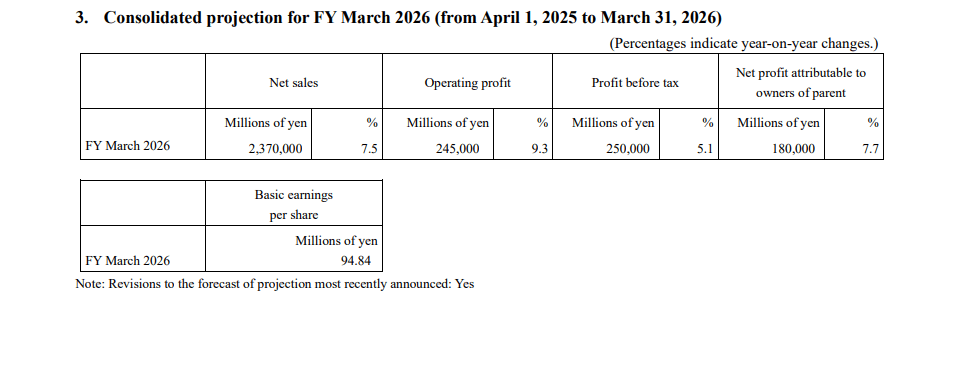
TDK Corporation GAAP EPS of ¥58.63, revenue of ¥1183.36B; updates FY outlook
Seeking Alpha· 2025-10-31 10:45
To ensure this doesn’t happen in the future, please enable Javascript and cookies in your browser.If you have an ad-blocker enabled you may be blocked from proceeding. Please disable your ad-blocker and refresh. ...
TDK Corporation (TTDKY) Q2 2026 Earnings Call Prepared Remarks Transcript
Seeking Alpha· 2025-10-31 10:06
Group 1 - The performance briefing of TDK Corporation for the first half of the fiscal year ending March 2026 is being conducted, with key participants including the President and CEO, Senior Executive Vice President and CFO, and other corporate officers [1][2] - The meeting will cover the results for the first half of the fiscal year as well as the outlook for the full year, followed by a Q&A session, and is expected to last 75 minutes [2]


Munoth-CosMX joint-venture to ramp up lithium-ion manufacturing in India
The Economic Times· 2025-10-02 18:30
Core Insights - Multiple companies are establishing lithium-ion cell manufacturing plants to meet the increasing demand from contract manufacturers in the consumer electronics sector, including smartphones and laptops [6] Company Developments - Chennai-based Munoth Industries has entered a joint venture with China's Zhuhai CosMX Battery, which supplies batteries for Apple iPhones, planning an initial investment of ₹500 crore to expand its Tirupati campus [6] - Dixon Technologies has formed a wholly owned subsidiary, Dixon Electrocorp, to manufacture various electronic products, including lithium-ion batteries, with an investment of ₹500-600 crore for a new facility [4][6] - Japan's TDK Corporation has opened a new advanced Li-ion battery plant in Sohna, Haryana, with a production capacity of 200 million battery packs annually [6] Market Demand - India's mobile phone manufacturing industry requires approximately 30 million lithium-ion cells per month for both domestic consumption and exports, with domestic demand estimated at 8-10 million cells [5][6] Government Initiatives - The Indian government has launched a ₹22,000-crore Electronics Component Manufacturing Scheme (ECMS) to promote component manufacturing, offering 4-6% incentives for lithium-ion cells based on incremental sales turnover, but no capital subsidies are available for this segment [5][6] Joint Venture Structure - CosMX will hold a 26% stake in the proposed joint venture, Munoth Lithium Battery Pvt Ltd, with Munoth Industries [6]
