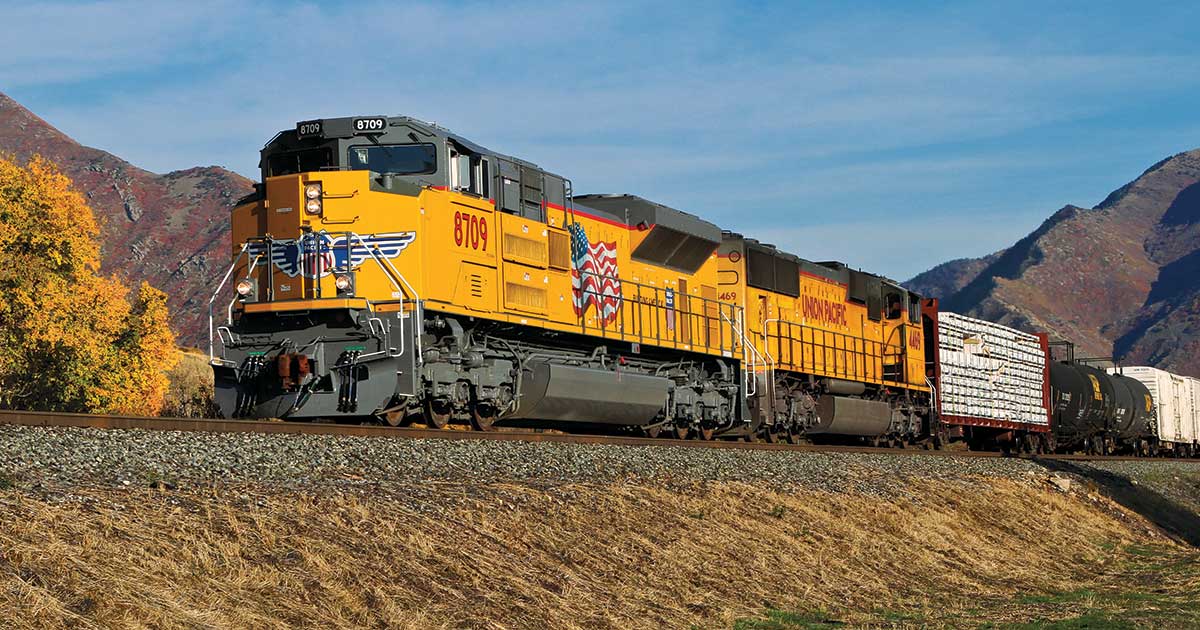
Union Pacific

Search documents
Big Boy No. 4014 Historic Coast-to-Coast Tour to Make 27 Whistle-Stops During Western Leg
Businesswire· 2026-02-24 19:00
OMAHA, Neb.--(BUSINESS WIRE)--Union Pacific's legendary Big Boy No. 4014, the world's largest operating steam locomotive, is steaming up for the western leg of its coasttocoast tour to celebrate America's 250th birthday with 27 whistle-stops and four public display days scheduled during its journey across four western states. The tour honors the crucial role railroads have played in building and unifying America while highlighting more than a century of industry innovation. Since 1862, when P. ...



CSX (NasdaqGS:CSX) FY Conference Transcript
2026-02-19 17:52
Summary of CSX FY Conference Call - February 19, 2026 Company Overview - **Company**: CSX Corporation (NasdaqGS:CSX) - **Industry**: Railroad and Transportation Key Points and Arguments Industry Insights - **AI and Automation**: The railroad industry is expected to benefit from AI and automation, particularly in proposal preparation, customer service, and asset management. Traditional industries may gain the most from these technologies [7][8][9] - **Global Growth Outlook**: The speaker expressed skepticism about growth in major global markets, noting that China is no longer a growth engine and Europe has historically not contributed significantly to growth. The U.S. is viewed as the best bet for sustained growth despite current tariff uncertainties [10][11][12] - **Reindustrialization**: There is potential for reindustrialization in the U.S., but it is not expected to manifest significantly in 2026. The speaker remains cautiously optimistic about long-term prospects [12] Company Performance and Strategy - **Cultural Insights**: The new CEO, Steve, highlighted the strong culture at CSX, characterized by long-tenured employees who are passionate about their work. This culture is seen as a positive for leadership and operational stability [20][21] - **Operational Challenges**: CSX faced significant operational challenges due to natural disasters, including the loss of a 60-mile rail corridor. Recovery efforts have been successful, with major infrastructure projects completed, leading to improved operational fluidity [23][25] - **Leadership Changes**: The CEO has made thoughtful changes to the executive leadership team, focusing on leadership skills and the ability to drive results. The importance of having the right people in critical positions was emphasized [26][28] M&A and Industry Dynamics - **M&A Landscape**: The CEO supports M&A in the industry, citing his experience with the Praxair and Linde merger. He acknowledged that consolidation can create both risks and opportunities for existing players like CSX [31][32] - **Regulatory Environment**: The merger process is lengthy and complex, with significant regulatory scrutiny. The CEO emphasized the need to focus on running CSX effectively while navigating these challenges [33][36] Financial Metrics and Performance Goals - **Financial Guidance**: CSX is targeting low single-digit revenue growth, with a focus on increasing operating margins by 200-300 basis points and free cash flow by 50%. The CEO emphasized the importance of cost management over aggressive revenue growth [51][52] - **Key Performance Metrics**: The CEO highlighted operating income growth, operating margin percentage, and safety as critical metrics for accountability. Return on capital and total shareholder return are also emphasized for long-term performance [62][65][68] Customer Feedback and Service Improvement - **Customer Engagement**: Customers are keeping their options open regarding service providers, indicating a cautious approach to commitments amid industry changes. Consistency in service is identified as a key area for improvement [42][48] - **Service Challenges**: The CEO acknowledged that while improvements have been made, there is still significant room for growth in service consistency and operational performance [46][47] Conclusion - The CEO expressed confidence in CSX's ability to navigate current challenges and capitalize on future opportunities, emphasizing a balanced approach to growth, operational excellence, and employee engagement [75][76]

Union Pacific Corporation (UNP) Presents at Barclays 43rd Annual Industrial Select Conference Transcript
Seeking Alpha· 2026-02-18 16:45
Group 1 - The discussion focuses on developments in mergers and acquisitions (M&A) and the business outlook for Union Pacific (UNP) [1] - Audience engagement is encouraged, with questions about current ownership and sentiment towards Union Pacific [2] - There is an inquiry regarding the through-cycle earnings per share (EPS) performance of Union Pacific compared to its peers [2]

Union Pacific (NYSE:UNP) FY Conference Transcript
2026-02-18 15:17
Summary of Union Pacific Conference Call Company Overview - **Company**: Union Pacific (UNP) - **Industry**: Railroad Transportation Key Points and Arguments Merger with Norfolk Southern - Union Pacific plans to refile its merger application with Norfolk Southern by April 30, 2023, which is a slight delay from previous expectations of March [8][10] - The merger is expected to enhance competition and provide benefits such as reduced inventory costs for customers by improving service efficiency [10][11] - Union Pacific believes that the merger will allow them to gain 24-48 hours in transit time by optimizing operations and reducing touchpoints [12][21] - The company emphasizes that the merger is in the public interest and will enhance competition, despite concerns from other railroads [14][23] Regulatory Process - The regulatory process for the merger is acknowledged as lengthy, with expectations for hearings and responses from constituents [17][18] - Union Pacific is confident in the merger's benefits and believes that the Surface Transportation Board (STB) will recognize these advantages [22][23] Environmental Impact - Union Pacific claims that the merger will be environmentally beneficial, as rail transport is 70% more greenhouse gas efficient than trucking [21][22] - The company aims to reduce truck traffic on highways, contributing to lower emissions [21] Revenue Synergies and Market Position - Union Pacific has reassessed the need for concessions initially estimated at $750 million, concluding they are unnecessary due to the merger's end-to-end service model [37][40] - The company anticipates that 75% of the business growth will come from shifting freight from highways to rail, rather than from competing railroads [38][40] - Union Pacific operates 27% of the total goods movement on U.S. railroads, positioning itself competitively against Burlington Northern's 39% [34] Operational Performance - The company reported a rebound in operational metrics, with car miles per day returning to 230-240 and dwell times under 20 hours [66][67] - Carloads are down 2% overall for the quarter, but there is year-over-year growth in specific sectors like grain and coal [67][68] - Union Pacific is focusing on expanding its market share in intermodal and carload segments, with new contracts and facilities expected to drive growth [73][76] Strategic Focus - Union Pacific's strategy emphasizes safety, service, and operational excellence, which are seen as critical to winning customer trust and market share [79][82] - The leadership expresses a forward-looking approach, focusing on potential growth and competition against trucks and barges [82] Additional Important Content - The call highlighted the competitive landscape, with other railroads expressing concerns about Union Pacific's merger, indicating that they view it as a threat to their market position [35][36] - Union Pacific's leadership is confident in their operational capabilities and technological integration, dismissing competitor concerns as defensive reactions [55][56] This summary encapsulates the key discussions and insights from the Union Pacific conference call, focusing on the merger, operational performance, and strategic direction of the company.
Union Pacific(UNP) - 2025 Q4 - Annual Report
2026-02-06 15:03
Revenue and Financial Performance - In 2025, the company generated total freight revenues of $23.2 billion, with Bulk shipments accounting for 33%, Industrial shipments for 37%, and Premium shipments for 30% of total revenues[35][37][40]. - Total operating revenues for 2025 reached $24.51 billion, a slight increase from $24.25 billion in 2024 and $24.12 billion in 2023[271]. - Freight revenues accounted for $23.22 billion in 2025, up from $22.81 billion in 2024 and $22.57 billion in 2023[271]. - Net income for 2025 was $7.14 billion, compared to $6.75 billion in 2024 and $6.38 billion in 2023, reflecting a year-over-year growth of 5.8%[271]. - Earnings per share (EPS) for 2025 was $12.00, an increase from $11.10 in 2024 and $10.47 in 2023[271]. - Other income increased to $629 million in 2025, up from $350 million in 2024, contributing positively to overall financial performance[271]. - Comprehensive income for 2025 was $7.27 billion, an increase from $6.64 billion in 2024, driven by improved net income and other comprehensive income factors[272]. - Total assets increased to $69.698 billion in 2025 from $67.715 billion in 2024, representing a growth of 2.9%[274]. - Total operating expenses decreased to $14.66 billion in 2025 from $14.54 billion in 2024, indicating improved cost management[271]. - Cash provided by operating activities was $9.290 billion in 2025, slightly down from $9.346 billion in 2024[275]. Employee and Safety Metrics - The company employed an average of 29,287 employees in 2025, with a retention rate of 89%[43][53]. - The personal injury rate improved by 24% to 0.68, and the derailment incident rate improved by 19% to 1.75 in 2025 compared to 2024[48]. - The median annual compensation for all employees (excluding the CEO) was $107,889 as of December 31, 2025[52]. Environmental and Safety Initiatives - The company is committed to reducing greenhouse gas emissions, with freight rail being three to four times more fuel-efficient than trucks, thus contributing to lower scope 3 GHG emissions for customers[64]. - The company maintains a comprehensive security plan and has achieved accreditation under CALEA for law enforcement standards[55]. - The company collaborates with various government agencies and trade associations to enhance safety and security measures across its operations[58][63]. Capital Investments and Shareholder Returns - Capitalized costs to properties in 2025 were $3.9 billion, reflecting significant investment in asset management and expansion[265]. - Dividends paid increased to $3.236 billion in 2025 from $3.213 billion in 2024, a rise of 0.7%[275]. - Share repurchase programs totaled $2.694 billion in 2025, up from $1.505 billion in 2024, reflecting an increase of 78.9%[275]. - The company has authorized the repurchase of up to 100 million shares of common stock by March 31, 2028, with 6.1 million shares repurchased as of December 31, 2025[416]. - The average price paid for shares repurchased in 2025 was $227.20, with a total of 11.9 million shares repurchased[417]. - The company paused its share repurchase program due to the pending acquisition of Norfolk Southern[416]. Debt and Liabilities - Total liabilities increased to $51.231 billion in 2025 from $50.825 billion in 2024, a rise of 0.8%[274]. - Total debt as of December 31, 2025, was $31.814 billion, an increase from $31.192 billion in 2024[394]. - The fair value of total debt at December 31, 2025, was estimated at $26.5 billion, approximately $5.3 billion less than the carrying value[393]. - The company maintained an adjusted debt-to-EBITDA coverage ratio allowing for up to $47.7 billion of debt, with $33.5 billion outstanding as of December 31, 2025[396]. Pension and Employee Benefits - The projected benefit obligation (PBO) for pension plans decreased to $3.275 billion in 2025 from $3.513 billion in 2024, while the fair value of plan assets increased to $3.978 billion from $4.068 billion[333]. - The funded status of the pension plans improved to $703 million in 2025 from $555 million in 2024[334]. - The net periodic pension cost for 2025 was a benefit of $14 million, compared to a cost of $3 million in 2024 and no cost in 2023[339]. - Cash contributions to the non-qualified pension plan were $33 million in 2025, slightly up from $32 million in 2024[341]. - The accumulated benefit obligation (ABO) for all defined benefit pension plans was $3.2 billion as of December 31, 2025[336]. Taxation and Compliance - Total income tax expense for 2025 was $2,028 million, a slight decrease from $2,047 million in 2024[363]. - Federal taxes for 2025 amounted to $1,925 million, maintaining an effective tax rate of 21.0% consistent with previous years[364]. - Unrecognized tax benefits at December 31, 2025, were $27 million, down from $32 million in 2024, indicating a reduction in potential tax benefits[367]. Environmental Liabilities - The company has identified 343 sites for potential environmental remediation costs, with ongoing monitoring costs included in the environmental liability[413]. - Environmental liability has an ending balance of $259 million as of December 31, 2025, with accruals of $70 million during the year[414].
Union Pacific Inks $1.2B Locomotive Modernization Deal With Wabtec
ZACKS· 2026-02-05 15:41
Core Insights - Union Pacific (UNP) has entered a $1.2 billion agreement with Wabtec Corporation to modernize its locomotive fleet, marking the largest locomotive-modernization deal in rail industry history [1][6] - The deal emphasizes upgrading existing locomotive assets to enhance network efficiency, service reliability, and asset productivity while maintaining disciplined capital deployment [1][2] - The modernization initiative aims to extend the life of AC4400 locomotives and incorporates next-generation diagnostics and control technologies, setting a benchmark for the industry [2][3] Financial and Operational Impact - The agreement is expected to deliver measurable gains, including over 5% lower fuel consumption, a 14% increase in tractive effort, and an 80% improvement in reliability [3] - Union Pacific's shares have increased by 10.1% over the past six months, outperforming the Transportation - Rail industry's growth of 5.1% [4] Strategic Partnerships - The partnership with Wabtec enhances long-term revenue visibility for Wabtec and reinforces its strategic relationship with one of North America's largest Class I railroads [3][6] - This collaboration reflects a broader industry trend towards sustainability, standardization, and lifecycle optimization in rail operations [2]

Canadian National Railway Company (NYSE:CNI) Analyst Sentiment and Market Outlook
Financial Modeling Prep· 2026-01-30 17:00
Company Overview - Canadian National Railway Company (NYSE:CNI) is a significant entity in the North American transportation sector, providing rail services across Canada and the United States, and is a vital part of the logistics and supply chain industry [1] Analyst Sentiment - The consensus price target for CNI has fluctuated, with an average target of $101 set a month ago, down from $102 in the previous quarter and $105.8 a year ago, indicating a more conservative outlook from analysts [2][6] - Wells Fargo has set a more optimistic price target of $130 for CNI, reflecting confidence in the company's potential to exceed earnings estimates, supported by expectations of earnings growth in the upcoming financial release [3][5][6] Market Conditions - The current market is perceived as expensive, with historical patterns suggesting low returns often follow market peaks, yet a consensus expectation of 15% growth in S&P 500 earnings, driven by AI advancements, supports a stable long-term market outlook [4] - The reliance on short-term debt by the U.S. government makes interest expenses sensitive to Federal Reserve policy changes, affecting market complexity and long-term yields [5]

This is Why Union Pacific (UNP) is a Great Dividend Stock
ZACKS· 2026-01-28 17:45
Company Overview - Union Pacific (UNP) is based in Omaha and operates in the Transportation sector, with a year-to-date share price change of 0.53% [3] - The company currently pays a dividend of $1.38 per share, resulting in a dividend yield of 2.37%, which is significantly higher than the Transportation - Rail industry's yield of 0.91% and the S&P 500's yield of 1.36% [3] Dividend Performance - The current annualized dividend of Union Pacific is $5.52, reflecting a 1.5% increase from the previous year [4] - Over the past five years, Union Pacific has increased its dividend three times, achieving an average annual increase of 7.19% [4] - The company's current payout ratio is 47%, indicating that it pays out 47% of its trailing 12-month earnings per share as dividends [4] Earnings Growth Expectations - For the fiscal year, Union Pacific anticipates solid earnings growth, with the Zacks Consensus Estimate for 2026 projected at $12.38 per share, representing a year-over-year earnings growth rate of 6.17% [5] Investment Considerations - Union Pacific is considered a compelling investment opportunity due to its strong dividend profile and current Zacks Rank of 3 (Hold) [6] - The company is positioned as a more secure dividend option compared to high-growth firms or tech start-ups, which typically do not offer dividends [6]
Union Pacific Corporation (NYSE:UNP) Financial Overview and Future Outlook
Financial Modeling Prep· 2026-01-28 06:10
Core Viewpoint - Union Pacific Corporation is a leading player in the railroad industry, showcasing strong financial performance and a commitment to shareholder returns, despite facing some challenges in the competitive market environment. Financial Performance - Union Pacific reported a record net income of $7.1 billion in 2025, reflecting a 6% increase from the previous year, with earnings per share (EPS) rising by 8% to $11.98 [2][6] - The company's freight revenue, excluding fuel surcharge, grew by 3%, achieving a new full-year record, while the operating ratio improved by 60 basis points to 59.3%, indicating enhanced efficiency [3] Shareholder Returns - The company distributed $5.9 billion through dividends and share repurchases, marking a 25% increase from 2024, demonstrating its commitment to returning value to shareholders [4][6] Market Challenges - In the fourth quarter of 2025, Union Pacific faced a 1% decrease in operating revenue compared to 2024, with freight revenue also declining by 1% due to a 4% drop in volume [5] - The company continues to navigate a competitive market environment but maintains a strong financial foundation and strategic initiatives for future growth [5] Price Target - Goldman Sachs set a price target of $267 for Union Pacific, suggesting a potential increase of 14.81% from its current price of $232.55, supported by the company's strong financial outlook [2][6]
Union Pacific Corporation (NYSE:UNP) Stock Update: Goldman Sachs Adjusts Rating and Price Target
Financial Modeling Prep· 2026-01-28 04:09
Core Viewpoint - Union Pacific Corporation is facing challenges in revenue growth despite maintaining a focus on operational efficiency and future investments [1][4][6] Financial Performance - Union Pacific reported earnings per share of $2.86, missing the Zacks Consensus Estimate of $2.90, representing a 1.7% year-over-year decline [2][6] - Operating revenues were $6.08 billion, below the expected $6.14 billion, reflecting a 1% decline from the previous year [2][6] Revenue Challenges - The decline in revenues was primarily due to lower volume, with a 4% year-over-year decrease in revenue carloads [3][6] - Freight revenue was impacted by a drop in Premium volumes, although there were gains in the Bulk and Industrial segments [3] Operational Efficiency - Union Pacific achieved a lower operating ratio, indicating improved efficiency [4] - The company has guided for mid-single-digit EPS growth and plans capital expenditures of approximately $3.3 billion in 2026, focusing on operational performance and future growth [4][6] Stock Performance - Union Pacific's stock is currently trading at $232.55, with a slight increase of 0.72%, and has a market capitalization of approximately $137.94 billion [5]