
Consumer Debt

Search documents
US Consumer Debt Accelerates to $18.2 Trillion in Late 2025, Report Reveals
Crowdfund Insider· 2026-02-26 21:30
US consumer debt continued its upward climb through the end of 2025, with growth gaining momentum in the final months of the year, according to Equifax’s (NYSE: EFX) National Market Pulse report released February 24, 2026. The credit analytics firm’s proprietary data shows total consumer debt balances reached $18.20 trillion by December, up 3.7% from a year earlier—the sharpest monthly acceleration compared to the same periods in 2023 and 2024.This figure aligns with broader measures from the Federal Reserv ...



Consumer Debt Is Piling Up, Data Show. A Weak Job Market Could Make That a Problem.
Barrons· 2026-02-10 19:34
Consumers Debt Is Piling Up, Data Show. A Weak Job Market Could Make That a Problem. - Barron'sSkip to Main ContentThis copy is for your personal, non-commercial use only. Distribution and use of this material are governed by our Subscriber Agreement and by copyright law. For non-personal use or to order multiple copies, please contact Dow Jones Reprints at 1-800-843-0008 or visit www.djreprints.com.# Consumer Debt Is Piling Up, Data Show. A Weak Job Market Could Make That a Problem.By [Megan Leonhardt]Shar ...
Grant Cardone Says Credit Scores Are 'A Trap To Keep You In Debt,' As Rich People Focus On Assets That Don't Require One
Yahoo Finance· 2026-02-02 16:16
Real estate investor and entrepreneur Grant Cardone stirred a debate last week by calling credit scores “a trap to keep you in debt.” He added that “the wealthy buy assets that don't require a credit score,” implying that building true financial independence means avoiding the traditional credit system altogether. Critics Say That's Easy To Claim From The Top Cardone's post on X on Thursday drew mixed reactions. “Quite easy to say that when you're wealthy enough to buy assets,” one person responded. “E ...
Rachel Cruze: 7 Common Things People Overlook When Trying To Build Wealth
Yahoo Finance· 2026-01-27 12:55
Core Insights - Financially savvy individuals may still overlook key aspects of wealth building, leading to dissatisfaction with their financial situation [1] Group 1: Savings and Debt Management - Having savings while carrying consumer debt is not optimal for wealth, as interest on debt accrues while savings earn minimal interest [2] - It is suggested to limit emergency savings to $1,000 until non-mortgage debt is cleared, allowing for flexibility in managing unexpected expenses [3] - Keeping emergency funds in a checking account is discouraged due to low interest rates, with the national average APY at just 0.07% as of November 17, 2025 [3] Group 2: Housing Expenses - Spending more than 25% of income on housing can hinder financial flexibility, making it difficult to invest and pursue other wealth-building goals [5] - Recommendations include limiting monthly house payments to 25% of income and considering options like larger down payments or smaller homes to maintain budget balance [5] Group 3: Lifestyle Management - The tendency to increase spending with pay raises, known as lifestyle creep, can hinder wealth accumulation by increasing lifestyle-related expenses [6]
'You Chose This,' 'Ramsey Show' Host Tells Caller Paying $1,600 A Month On A $75K Audi With A Blown Engine
Yahoo Finance· 2026-01-25 13:31
Core Insights - A significant financial burden arises from a $1,600 monthly car payment for a 2019 Audi Q8, which is unmanageable after an engine failure requiring a $20,000 repair [1][4] - The individual has a total consumer debt nearing $100,000, including student loans and credit card debt, which complicates the financial situation [2] - The vehicle's warranty only covers $7,000 of the repair costs, leaving the individual responsible for $13,000 out of pocket [1][4] Financial Situation - The individual earns $65,000 annually while owing approximately $65,000 on the vehicle, indicating a mismatch between income and debt obligations [1][3] - The loan for the vehicle carries a 12% interest rate, and the individual initially attempted to rent the vehicle to cover payments [3] - The previous vehicle was stolen, and insurance paid off the balance without providing any cash, adding to the financial strain [2] Options and Recommendations - Selling the Audi without repairs could yield about $30,000, but would still leave a $35,000 loan balance [5] - Repairing the engine would require $13,000 out of pocket but could allow for a sale closer to market value [5] - It is advised to avoid selling to a dealership and to involve a trusted person in the repair and sale process [6]
'You're Freaking Broke,' Dave Ramsey Tells $130K-A-Year Couple With $190K Debt And $60K In Cars — 'That Lifestyle Is Absolutely Asinine'
Yahoo Finance· 2026-01-08 01:00
Core Insights - The couple's financial situation is dire, with a combined income of $130,000 per year but nearly $200,000 in consumer debt and only $3,000 in savings [1][2] - Despite earning approximately $11,500 monthly, they feel significant financial pressure, raising concerns about stability and savings [2][3] - The couple's debt includes $140,000 in student loans, $60,000 in vehicle loans, and a mortgage of about $240,000 [4] Financial Obligations - The couple's total consumer debt is nearly $200,000, which includes $140,000 in student loans, $60,000 in vehicle loans, and a mortgage balance of approximately $240,000 [4] - Alyssa holds $90,000 of the student loan debt, while her husband is responsible for $40,000 [4] Recommendations for Improvement - Immediate and significant lifestyle changes are necessary to improve their financial situation, including selling vehicles and cutting discretionary spending [7] - The focus should be on creating cash flow to pay down the smallest debts first, rather than solely relying on increasing income [5][7] - Ramsey emphasizes that dramatic changes will lead to quicker financial recovery, urging the couple to redirect all available cash towards eliminating consumer debt [7]
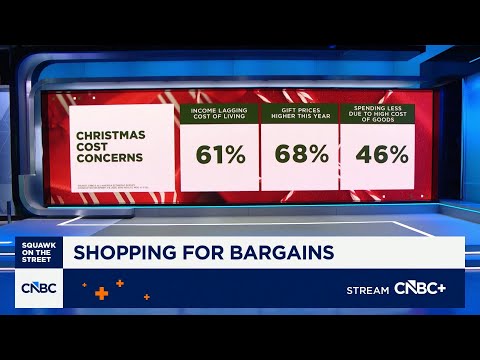
High cost of goods is causing consumers to spend less for the holidays, CNBC survey finds
CNBC Television· 2025-12-15 19:08
Steve Leeman is here at Post9 with the numbers. And Steve, this question about how inflation is impacting holiday spending. >> We're calling it inflation the red-nosed reindeer.How it's really leading spending. Uh it's factoring heavily into consumers views on spending this holiday season. The All-American Economic Survey finding it's affecting where people choose to shop and of course how much.Of the thousands people surveyed across the nation, uh here are some of the results you can see there. 61% say the ...

CNBC Survey: 57% of Americans have at least some debt going into the holiday shopping season
CNBC Television· 2025-12-15 16:23
Our senior economics reporter Steve Leeman is here at Post9 with the numbers. And Steve, this question about how inflation is impacting holiday spending. >> We're calling it inflation the red-nosed reindeer.How it's really leading spending. Uh it's factoring heavily into consumers views on spending this holiday season. The All-American Economic Survey finding it's affecting where people choose to shop and of course how much.Of the thousands people surveyed across the nation, uh here are some of the results ...
32 States Where Consumer Debt Fell the Most Since Last Year
Yahoo Finance· 2025-12-07 14:04
With inflation still squeezing household budgets and interest rates staying high for most of the year, national consumer debt continues to climb across borrowing categories — from mortgages and credit cards to auto loans and HELOCs — compared to last year. Read More: 3 Signs You’ve ‘Made It’ Financially, According to Financial Influencer Genesis Hinckley Find Out: How Middle-Class Earners Are Quietly Becoming Millionaires — and How You Can, Too In June 2025, Americans collectively owed $18.33 trillion in ...
Car Loans, Mortgages and More: See How Much Debt Americans Have in 2025
Yahoo Finance· 2025-12-07 10:00
Core Insights - The average total debt balance among U.S. consumers remained largely unchanged in 2025, with an average balance of $104,755, slightly down from $105,580 in June 2024 [1][2] - There has been an increase in average balances for common types of consumer debt, including auto loans, credit cards, and mortgages, indicating persistent debt levels among consumers [1][2] Debt Breakdown - Auto loans in 2025 averaged $24,596, up from $24,187 in 2024 [6] - Credit card debt in 2025 averaged $6,735, slightly up from $6,699 in 2024 [6] - Mortgage debt in 2025 averaged $258,214, an increase from $250,479 in 2024 [6] Financial Management Recommendations - Financial experts suggest creating a monthly budget and controlling non-essential spending as fundamental steps to manage debt [4] - Listing all balances and interest rates in one place can help consumers understand their financial situation better [4] - Using credit wisely and aiming to pay off credit card balances monthly is recommended to maintain financial health [4][5] - For those with significant debt, consolidating at lower rates or using home equity for consolidation may improve cash flow and reduce overall debt [5]