Consumer Demand

Search documents
PLTR Upgrade, ON Earnings & KO Mixed Report
Youtube· 2026-02-10 15:30
Coca-Cola - Coca-Cola reported mixed earnings, beating adjusted EPS expectations at 58 cents per share compared to the expected 56 cents, but revenue fell short at $11.8 billion against the anticipated over $12 billion [2] - The company issued a modest growth forecast, projecting organic revenue growth of 4-5% and EPS growth of 7-8%, which is seen as steady but not aggressive, contributing to an 8% decline in shares [3][4] - Analysts noted signs of slower consumer demand, with budget-conscious shoppers cutting back on discretionary spending, impacting Coca-Cola's total volume for 2025, which was flat [5] - Despite overall volume challenges, premium brands like Smart Water and Coke Zero Sugar showed growth, with Coke Zero Sugar experiencing a 13% increase in volume [7][8] Semiconductor Industry - A semiconductor company reported a sharp drop in fourth-quarter profit, with adjusted EPS beating expectations at 64 cents per share versus the anticipated 62 cents, while revenue fell 11% to $1.53 billion [11] - The company highlighted growth in its smaller intelligent sensing unit, indicating potential stabilization in key markets, which may suggest moderation in the semiconductor downturn [13] Palantir - Palantir received an upgrade from Daiwa, moving from neutral to buy, despite a 30% pullback from recent highs, with a new price target of $180, indicating confidence in its growth story [15][16] - The upgrade reflects strength in US operations and demand from both government and commercial sectors, with the analytics platform gaining traction [16]




Morgan Stanley flags 4 reasons the economy is about to boom — and 3 areas of the market for investors to cash in
Yahoo Finance· 2025-12-11 18:15
Core Viewpoint - Morgan Stanley suggests that despite some negative economic signals, the economy is in an "early cycle" environment with potential for growth ahead [1][3]. Economic Indicators - ADP private payrolls were negative in November, and layoffs are at the highest levels in two decades, indicating some economic stress [1]. - The unemployment rate is rising, but Morgan Stanley believes the worst is already behind us [1]. Earnings Growth - There has been a significant rebound in earnings revisions, with the S&P 500 earnings revisions breadth improving from negative 25% in April to positive 15% [4]. - This rebound is typically seen in early cycle environments, suggesting improving business confidence [4]. Wage Growth and Profit Margins - Wage growth has slowed to a three-month moving average of 4.1% year-over-year, down from 6.7% in July 2022, providing room for profit margins to expand [4]. - Such a decline in wage growth is often observed during recessionary periods [4]. Consumer Demand - Consumer demand is expected to accelerate, as companies are showing higher pricing power, allowing them to increase prices without significantly impacting demand [5]. Federal Reserve Actions - The Federal Reserve is cutting rates to stimulate economic activity, with expectations of two additional cuts in 2026 [6]. - Moderate weakness in the labor market is anticipated to continue, which will support these rate cuts without leading to a recession [6]. Market Outlook - Morgan Stanley forecasts a 14% rise in the S&P 500 to 7,800 by 2026, indicating a bullish outlook for the stock market [7]. Investment Recommendations - The bank recommends an "overweight" position on consumer discretionary stocks, which are expected to perform well during economic recoveries [8]. - This sector includes companies benefiting from consumer spending on non-essentials, such as apparel and hospitality [8].

Dollarama Lifts Outlook as Canadian Shoppers Boost Results
WSJ· 2025-12-11 18:02
Group 1 - Strong consumer demand has led to increased traffic and spending at Canada's largest dollar-store chain [1]

X @Bloomberg
Bloomberg· 2025-12-03 02:11
China’s services activity expanded at the weakest pace in five months, a private survey showed, adding more evidence of sluggish consumer demand that’s putting further pressure on a slowing economy https://t.co/S6RXJTq8yC ...
X @Bloomberg
Bloomberg· 2025-12-01 03:55
Weak consumer demand forced Philippine manufacturers to cut factory output and jobs in November, becoming the only nation to buck expansion in the region https://t.co/pYEbymCaCe ...
Q2 GDP: Sizzling, six-quarter high growth lights up India economic scene
The Economic Times· 2025-11-29 01:42
Economic Growth Overview - India's economy experienced a significant growth of 8.2% in the July-September period, marking a six-quarter high, driven by a surge in consumer demand and a reduction in goods and services tax (GST) [12][5][6] - The expansion was primarily led by a 9.2% growth in services and a 9.1% rebound in manufacturing [12][1] Consumer and Investment Trends - Private consumption, which constitutes nearly 60% of GDP, rose to a three-quarter high of 7.9% in the July-September period, up from 7% in the previous quarter [2][12] - Gross fixed capital formation, an investment measure, increased by 7.3%, slightly lower than the 7.8% growth in the prior quarter [2][12] - Agriculture growth was recorded at 3.5% in Q2, a slight decrease from 3.7% in Q1 [2][12] Future Growth Projections - The strong economic performance is expected to lead to upward revisions in growth estimates for FY26, with rating agency Crisil raising its forecast from 6.5% to 7% [7][12] - First-half FY26 growth was reported at 8%, an increase from 6.1% a year earlier, with gross value added (GVA) rising by 7.9% compared to 6.2% in the same period [7][12] Rural Consumption and Inflation - Strong agricultural performance and easing inflation are contributing to improved rural consumption growth, which is anticipated to continue into the first half of FY27 [8][12] - Retail inflation slowed to a record low of 0.25% in October, which, combined with strong growth, has complicated the outlook for potential rate cuts [10][12] Trade and Policy Considerations - The imposition of a 50% tariff by the US on India, including a 25% penalty for importing Russian oil, is a significant factor affecting future growth, with ongoing negotiations for a trade deal [8][12] - The GST Council's approval of a two-slab tax structure is expected to positively impact consumption by lowering taxes on various household goods [8][12]


X @Investopedia
Investopedia· 2025-11-27 15:00
Market Trends - Strong consumer demand is expected to persist this holiday season despite high prices [1]
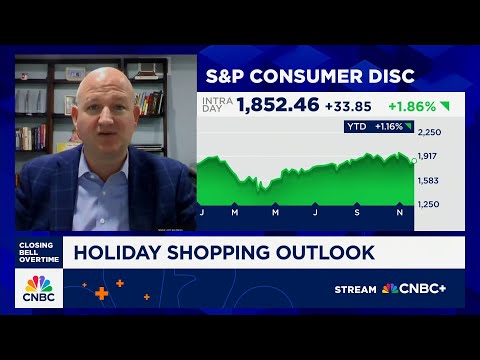
Consumer demand should be pretty normal this holiday shopping season: Neuberger Berman's San Marco
CNBC Television· 2025-11-24 22:49
All right. Well, Friday marks the stop the start of the holiday shopping season as US consumers head back out on Black Friday. And this comes after last week's earnings from a number of retailers showed a mixed picture about the state of the consumer with a growing divide between the halves and have nots.Joining us now is John San Marco, senior research analyst at New Burger B. John, good to see you. My big question heading into this season is discounting, especially given that commentary during earnings se ...
Flowers Foods(FLO) - 2025 Q3 - Earnings Call Transcript
2025-11-07 14:32
Financial Data and Key Metrics Changes - The company reported a gross margin decrease of 190 basis points and an EBITDA margin decrease of 160 basis points, despite lower ingredient costs as a percentage of sales [38][40] - The company is experiencing margin pressure primarily due to increased promotional activity and the higher-cost structure associated with Simple Mills products [39][40] Business Line Data and Key Metrics Changes - The food service business has been under pressure due to the economic environment and consumer sentiment, but profitability improvements from previous years are still evident [25][30] - The company has seen unit growth in brands like Canyon (up 6%) and Dave's Killer Bread (up 10%), indicating positive performance in certain segments [48] Market Data and Key Metrics Changes - Consumer sentiment reached a low point in Q3, but there are expectations for category demand to normalize as the economy strengthens [8][9] - The company noted that the price gaps between private label and lower-priced branded products have narrowed significantly, impacting private label performance [26] Company Strategy and Development Direction - The company is focused on redefining traditional loaf products to align with evolving consumer preferences, emphasizing value and better-for-you attributes [4][47] - There is a commitment to continue investing in consumer offerings and innovation, despite short-term margin pressures [12][47] Management's Comments on Operating Environment and Future Outlook - Management anticipates that the category will stabilize over time, although some weakness is expected to continue into 2026 [9][16] - The company acknowledges the challenges posed by economic uncertainty but expresses optimism about long-term growth due to a strong brand portfolio and team [47] Other Important Information - This earnings call marks the final appearance of the CFO, Steve Kinsey, after 18 years with the company [5] - The company is actively evaluating its cost structure and supply chain optimization to enhance efficiency [53][54] Q&A Session Summary Question: Consumer sentiment and category demand normalization - Management believes that while it is difficult to pinpoint an exact timeline, the category will stabilize over time, with ongoing consumer concerns impacting demand [9][10] Question: Offsets to margin pressure from new investments - Management acknowledges that innovation tends to pressure margins in the short term but expects improvements as scale and efficiency increase [12] Question: Performance of Simple Mills post-acquisition - Integration efforts are going well, with strong performance in line with expectations and new innovations planned for the upcoming year [20] Question: Food service and private label business performance - The food service business is under pressure, but profitability improvements are still being realized, while private label performance has been weak due to narrowed price gaps [25][26] Question: Expectations for 2026 gross margins - Management expects inflationary pressures on input costs, including volatile wheat commodities, to impact gross margins in 2026 [30] Question: Dividend and capital allocation strategy - The company is focused on delivering shareholder value and reassessing capital projects to ensure the best returns, with no immediate changes to dividend policy indicated [35][36] Question: Complexity of managing multiple brands - Management acknowledges the complexity of managing regional brands but emphasizes the importance of meeting consumer needs and optimizing cost structures [51][52]