
Economic security

Search documents
Jim Rickards Recognized as One of the “Best Financial Strategists” After Series of High-Profile Predictions Come True
Globenewswire· 2026-02-21 16:12
Baltimore, MD, Feb. 21, 2026 (GLOBE NEWSWIRE) -- Jim Rickards is being recognized by Paradigm Press for his forecasting record after a series of high-impact political, financial, and macro developments unfolded in line with projections he outlined in advance. The designation from Paradigm Press reflects his work analyzing structural changes tied to government policy, global power shifts, and financial systems—an approach that has defined his research for decades and continues to shape his latest national br ...
Global Markets Brief: SoftBank Leads $33B U.S. Energy Deal; ECB Details Digital Euro Fees
Stock Market News· 2026-02-18 09:38
Group 1: SoftBank and Energy Investment - SoftBank Group is leading a consortium to invest in a $33.3 billion gas-fired power project in the U.S., involving major players like Panasonic, Murata Manufacturing, Mizuho Financial Group, and Goldman Sachs [2] - The project aims to provide electrical capacity for AI-focused data centers and is part of a broader $550 billion investment commitment from Japan to the U.S. to enhance economic security and infrastructure [3] Group 2: Digital Euro Development - The European Central Bank (ECB) is developing a Digital Euro with a transaction fee model intended to be lower than international card costs but potentially higher than some domestic payment schemes [4] - The Digital Euro will function as "digital cash" with offline transaction capabilities, and pilot programs are set to begin in 2027, with a full launch targeted for 2029 or 2030 [5] Group 3: Geopolitical Tensions and Economic Implications - The Kremlin supports China's rejection of U.S. allegations regarding a secret nuclear test, which has heightened diplomatic tensions following the expiration of the New START treaty [6][7] - The National Bank of Romania has maintained its key interest rate at 6.5% amid persistent inflation, forecasting a drop to 3.7% by the end of 2026, but warns that this does not account for potential impacts from extended gas price caps [10]



US and Japan unveil $36bn of oil, gas and critical minerals projects in challenge to China
The Guardian· 2026-02-18 06:02
Investment Plans - Japan plans to invest approximately $36 billion in US oil, gas, and critical mineral projects as part of a trade deal with the US [1][3] - The first wave of investments includes a power plant in Portsmouth, Ohio, which is touted as the largest natural gas-fired generating facility in US history, generating 9.2 gigawatts of electricity annually [4] Strategic Importance - The investments aim to strengthen Japan's economic ties with the US amid ongoing tensions with China over Taiwan, enhancing both countries' economic security [2][6] - The projects are part of a larger commitment of $550 billion from Japan under the trade deal, which also includes a reduction in US tariffs on Japanese exports [3] Specific Projects - The investment includes a deepwater crude oil export facility off the Texas coast and a synthetic industrial diamond manufacturing site in Georgia, valued at about $600 million [3][5] - The industrial diamond project is intended to ensure domestic production of critical materials for advanced manufacturing and semiconductors, reducing reliance on foreign sources [5][8] Economic Context - Japan's exports rose nearly 17% in January, partly due to increased exports to China, despite existing tensions [9] - The trade deal and associated investments are seen as a strategic move to enhance US energy dominance and industrial capacity while providing returns to Japan [9]

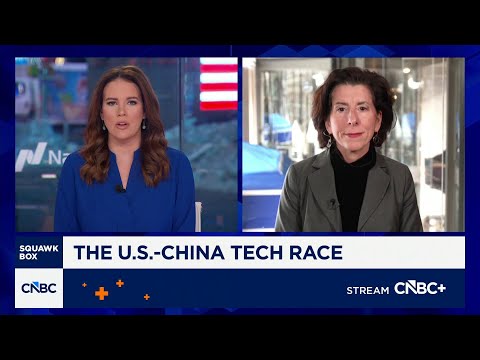
Former Commerce Sec. Gina Raimondo: Economic security is just as important as military might
CNBC Television· 2026-02-13 14:52
Our next guest will weigh in on US China tech competition on tariffs, on AI, and more. Joining us now, former US Commerce Secretary Gina Rando. She's a Council on Foreign Relations distinguished fellow.Uh you're and you're in Munich right now. Is that right. Welcome.>> I am. I am. Good morning.>> Why Munich is the new Davo. We need to see what Joe thinks about. Munich apparently is Davos for the foreign policy set.uh M madam secretary a and they say no fewer than six Democratic presidential primary candidat ...
Japan Establishes New Public-Private Council to Bolster Economic Security Amid Global Volatility
Stock Market News· 2025-12-14 17:08
Group 1 - Japan is establishing a new public-private council to enhance economic security, aiming for collaboration between government and private sector leaders in response to global volatility [2][7] - The council's formation coincides with the Tokyo Economic Security Forum, which facilitates international dialogue on economic security issues [2][7] - Prime Minister Sanae Takaichi emphasized the need for this council due to the "most severe and complex security environment since the end of World War II" [3] Group 2 - A primary objective of the council is to strengthen Japan's critical supply chains, particularly in semiconductors and essential materials, as recent global disruptions have highlighted vulnerabilities [4] - Major Japanese companies, including Toyota, Sony, and SoftBank, are investing in Rapidus Corp. to support domestic semiconductor production [4] - The council will also focus on ensuring stable supplies of critical minerals and energy, with discussions involving entities like the Japan Organization for Metals and Energy Security [5] Group 3 - The council aims to enhance "economic intelligence" through systematic collection and analysis of information on global technologies and developments [6] - A new think tank will be established to research economic security, focusing on supply chain vulnerabilities and risk scenarios [6] - International collaboration is a key aspect of Japan's economic security strategy, with the Tokyo Economic Security Forum being part of a broader initiative to foster global public-private dialogue [7][8]
X @Andy
Andy· 2025-06-28 01:26
Economic Security Myths Debunked - Delegation with slashing incentivizes careful operator selection, contrary to the belief that delegation negates security [1] - Relying solely on forking for security is impractical due to the time required, necessitating economic security for pre-fork finality [2] - Economic security can be automated through a market where users directly purchase security, addressing the issue of burnt slashed funds [3] - Economic security's failure to protect against liveness attacks stems from chain design flaws, not inherent limitations [4] Proof of Stake (PoS) vs Proof of Work (PoW) - Incentivizing stake is crucial, as committees alone resemble less secure systems like Libra [5] - While current PoS reward curves are arbitrary, market-driven security pricing can emerge through mechanisms like Stakesure [6] - PoW is essentially staking via mining devices, but PoS allows for burning or redistributing misbehaving miners' stake [7] Building Secure Chains - Security pricing is essential for resource provisioning and overall chain security [8] - Understanding economic security is crucial for building self-enforcing chains, contrasting with less robust committee chains [7]
X @Andy
Andy· 2025-06-27 13:24
Staking & Economic Security - Staking yields should be low due to rare or non-existent slashing, as high interest for risk-free activities with slight liquidity disruptions is illogical [1] - The industry should be cautious about dismissing economic security, as increasing value on chains elevates attack incentives, and relying on social layers can lead to destructive politics [2] - Crypto-economic security aims to replace human interaction with enforced protocol rules; validators fearing slashing behave differently [3] - If a native coin isn't needed for security, it has little value, highlighting the link between coin value, incentives, and security [4] Tokenomics & Protocol Design - If security doesn't rely on incentives, the coin's value is questionable; equity issuance and stablecoin fees become viable alternatives [5] - More experimentation with slashing is needed in protocol design, balancing risk with worthwhile rewards [5] - A PoS chain with more slashing and higher inflation offers a sophisticated way to incentivize validators towards desirable outcomes, benefiting DeFi with risk-adjusted yield options [6]
野村:美日第三轮关税谈判要点
野村· 2025-05-29 14:12
Investment Rating - The report does not explicitly provide an investment rating for the industry or specific companies involved in the US-Japan tariff negotiations Core Insights - The third round of US-Japan tariff negotiations did not result in significant changes, with Japan continuing to advocate for the removal of reciprocal tariffs on autos, steel, and aluminum [2] - Economic security emerged as a key theme in the discussions, reflecting its importance in both the US-Japan negotiations and the recent US-UK trade agreement [4] - The Japanese government is exploring the establishment of a "Japan-US fund for reviving the shipbuilding industry," indicating a focus on enhancing cooperation in sectors deemed critical for national security [6] Summary by Sections Trade Negotiations - The third round of negotiations on May 23 saw no major shifts in Japan's position, with a focus on achieving an agreement during the upcoming G7 summit [2] - A telephone conversation between Prime Minister Shigeru Ishiba and President Donald Trump prior to the negotiations covered various topics, including tariff negotiations and economic security [3] Economic Security - Economic security was highlighted as a significant factor in the negotiations, with implications for tariffs on key imports [4] - The discussions included Japan's interest in securing rare earth supplies and cooperation on alternative technologies, further emphasizing the strategic nature of the negotiations [3] Shipbuilding Industry - The potential establishment of a Japan-US fund for the shipbuilding industry could lead to deeper collaboration in this sector, which is viewed as vital for national security [6] - The report suggests that government initiatives aimed at enhancing economic security will impact a wide range of Japanese companies beyond just shipbuilding [6] Investment Opportunities - The trade talks are expected to encourage further investment in the US, particularly in shipbuilding and other sectors related to economic security [5] - President Trump's recent announcements regarding commercial deals in the Middle East, totaling around $2 trillion, may also serve to attract more Japanese investment in the US manufacturing sector [7]