
Retail sales

Search documents
US inflation slows as retail sales post fourth monthly rise
Yahoo Finance· 2026-02-13 23:16
Inflation Trends - The annual Consumer Price Index (CPI) in the US rose by approximately 2.4% in January 2026, indicating a deceleration from December and falling below many economists' forecasts [2] - Monthly consumer prices increased by 0.2%, influenced by lower energy costs and modest rises in services and food categories [3] - Core inflation, which excludes food and energy prices, also exhibited restrained growth, although it remains elevated compared to long-term averages [4] Retail Sales Performance - Retail sales in January showed a steady expansion, with total sales rising by 0.2% on a seasonally adjusted monthly basis and increasing by 5.72% year-on-year, marking the fourth consecutive monthly increase [5] - Core retail sales, excluding categories like restaurants, demonstrated annual strength, particularly in clothing, digital products, and health and personal care [6] - The retail data, based on anonymized credit and debit card purchases, indicates sustained consumer demand beyond the holiday peak, with overall sales remaining above year-ago levels [7] Implications for Global Retail Sector - The moderating inflation rate in the US could alleviate pricing pressures on imported goods for international retailers, potentially stabilizing input costs [8]
Stocks Are Rising Following Lackluster Retail Sales Report
Barrons· 2026-02-10 14:33
Core Viewpoint - Stocks are rising despite disappointing retail sales data for December, indicating market resilience [1] Group 1: Stock Market Performance - The Dow Jones Industrial Average increased by 180 points, or 0.3% [1] - The S&P 500 saw a rise of 0.1% [1] - The Nasdaq Composite also rose by 0.1% [1] Group 2: Retail Sales Data - December retail sales were flat compared to November, falling short of economists' expectations for a 0.4% increase [1]
Winter storm's impact on business and markets could last 'well past the weekend': G2 Weather's Walsh
CNBC Television· 2026-01-23 22:57
Well, let's get to the other big story of the day and this weekend, and that would be the massive winter storm. Americans across the country are preparing for what could be an historic weather event with freezing temperatures, ice, and heavy snow. Our next guest says the impact on businesses could last well past the weekend.Let's bring in Paul Walsh, publisher at G2 Weather Intelligence. Paul, great to have you with us. Um, and what I learned from from a meteorologist in the last hour is that it's not snow, ...


中国 - 四季度 GDP 符合预期,12 月经济数据喜忧参半 -初步分析-China_ Q4 GDP in line with expectations amid mixed December activity data – First Take
2026-01-20 03:19
Summary of Key Points from the Conference Call Industry Overview - The report focuses on the Chinese economy, specifically analyzing Q4 GDP, industrial production, fixed asset investment, and retail sales data for December 2025. Core Insights and Arguments - **GDP Growth**: Real GDP growth moderated to **4.5% year-on-year (yoy)** in Q4 from **4.8% yoy** in Q3, primarily due to a high base effect. However, there was a marginal acceleration in sequential terms, with growth increasing to **1.2% quarter-over-quarter (qoq) seasonally adjusted non-annualized** in Q4 from **1.1% qoq** in Q3 [1][2] - **Industrial Production (IP)**: IP growth rose modestly to **5.2% yoy** in December from **4.8% yoy** in November, slightly beating consensus forecasts. This suggests an improvement in manufacturing sector momentum, although auto output growth slowed further and steel output remained subdued [1][6] - **Fixed Asset Investment (FAI)**: FAI growth declined significantly to **-13.0% yoy** in December from **-10.7% yoy** in November, marking the first full-year contraction since 1990 at **-3.8% yoy** for the year. The decline is attributed to statistical corrections rather than solely fundamental factors [1][7] - **Retail Sales**: Retail sales growth moderated to **0.9% yoy** in December from **1.3% yoy** in November, with both goods sales and restaurant sales revenue slowing. Auto and home appliance sales remained weak due to funding shortages and diminishing effectiveness of consumer goods trade-in programs [1][8] - **Services Sector Performance**: The services industry output index grew by **5.0% yoy** in December, up from **4.2% yoy** in November, indicating that services consumption growth continued to outperform goods consumption growth [1][8] Additional Important Information - **Unemployment Rates**: Nationwide unemployment rates remained stable at **5.1%** in December, unchanged from November, indicating a lack of significant labor market improvement [9] - **Economic Divergence**: The data reflects a continued divergence in the economy, characterized by strong exports contrasted with weak domestic demand, highlighting potential areas of concern for future economic stability [1] - **Statistical Adjustments**: The report notes that recent declines in FAI may be influenced by statistical corrections from the National Bureau of Statistics (NBS), which have adjusted previously over-reported data [1] This summary encapsulates the key findings and insights from the conference call regarding the Chinese economy, providing a comprehensive overview of the current economic landscape and potential investment implications.
Wall Street ends mixed, healthcare and energy stocks weigh on S&P
The Economic Times· 2025-12-17 01:54
Economic Data and Market Reactions - Retail sales were flat in October, slightly below economists' expectations of a 0.1% increase, with analysts suggesting potential distortion due to slow data collection from a recent government shutdown [1][8] - Nonfarm payrolls increased by 64,000 jobs in November, following a decline in October, while the unemployment rate rose to 4.6% amid economic uncertainty linked to President Trump's trade policies [8] - Investors are anticipating interest rate cuts of at least 58 basis points next year, significantly higher than the 25 basis points indicated by the Federal Reserve [8] Stock Market Performance - The Dow Jones Industrial Average fell by 302.30 points (0.62%) to 48,114.26, while the S&P 500 lost 16.25 points (0.24%) to 6,800.26, and the Nasdaq Composite gained 54.05 points (0.23%) to 23,111.46 [8] - Eight of the 11 S&P 500 major industry sectors closed down, with energy stocks leading the decline, falling nearly 3%, and crude prices reaching their lowest level since 2021 [5][8] - Health stocks decreased by 1.28%, with Pfizer slipping 3.4% due to forecasts of challenging sales in 2026, and Humana falling 6% after announcing leadership changes [8] Notable Company Movements - Comcast shares rose by 5.4% following speculation about potential involvement from an activist investor [6][8] - B. Riley's stock surged by 53.8% after reporting a profit for the second quarter, contrasting with a loss in the previous year [8] - Nasdaq has submitted paperwork to the U.S. Securities and Exchange Commission for round-the-clock trading of stocks, following similar announcements from the New York Stock Exchange and Cboe Global Markets [6][8] Market Breadth and Trading Volume - On the NYSE, declining issues outnumbered advancers by a ratio of 1.63-to-1, with 127 new highs and 88 new lows recorded [7][8] - The Nasdaq saw 2,064 stocks rise and 2,596 fall, with a declining issues to advancers ratio of 1.26-to-1 [7][8] - Total trading volume on U.S. exchanges was 16.70 billion shares, slightly below the 20-day average of 16.99 billion shares [9]


Crude Oil Falls Sharply; SRX Health Solutions Shares Jump - Cementos Pacasmayo (NYSE:CPAC), Lightwave Logic (NASDAQ:LWLG)
Benzinga· 2025-12-16 17:02
Market Overview - U.S. stocks traded mostly lower, with the Dow Jones index falling more than 250 points, down 0.52% to 48,164.83, NASDAQ down 0.37% to 22,971.25, and S&P 500 down 0.56% to 6,778.08 [1] - European shares were lower, with the eurozone's STOXX 600 slipping 0.64%, Spain's IBEX 35 Index down 0.69%, London's FTSE 100 down 0.92%, Germany's DAX 40 down 0.85%, and France's CAC 40 declining 0.40% [5] - Asian markets closed lower, with Japan's Nikkei falling 1.56%, Hong Kong's Hang Seng down 1.54%, China's Shanghai Composite down 1.11%, and India's BSE Sensex down 0.63% [6] Economic Indicators - U.S. retail sales were flat for October compared to September, down from a revised 0.1% gain in the previous month and below market estimates of 0.1% growth [7] - The U.S. economy added 64,000 jobs in November, compared to a loss of 105,000 in the previous month and above market estimates of a 50,000 increase [9] - The U.S. unemployment rate rose to 4.6% in November from 4.3% in the previous month, marking the highest reading since September 2021 [9] - Average hourly earnings rose by 0.1% month-over-month to $36.86 in November, compared to a 0.4% rise in the previous month [9] - U.S. business inventories increased 0.2% month-over-month in September, in line with market estimates [9] - The S&P Global flash composite PMI declined to 53 in December, the lowest reading in six months, down from 54.2 in November [2][9] Commodity Market - In commodity news, oil traded down 2.9% to $55.17, while gold traded up 0.5% at $4,357.00 [4] Company News - SRx Health Solutions Inc shares surged 92% to $0.59 after announcing an agreement to acquire EMJ Crypto Technologies [8] - Rezolve AI PLC shares rose 34% to $3.12 following preliminary December revenue results [8] - Cementos Pacasmayo SAA shares increased 48% to $10.25 after Holcim signed an agreement to purchase 50.01% of the company's owner [8] - Zynex Inc shares dropped 53% to $0.31 after entering Chapter 11 court-supervised financial restructuring [8] - Lightwave Logic Inc shares fell 19% to $3.05 after announcing the pricing of an 11.67 million share common stock offering [8] - Navan Inc shares decreased 17% to $12.21 after reporting third-quarter results [8]


November non farm payrolls comes in at 64,000
Youtube· 2025-12-16 14:14
Employment Data - The non-farm payrolls for November increased by 64,000 jobs, indicating a slower job growth compared to previous months [1] - The unemployment rate rose to 4.6%, the highest level since July 2021, while the underemployment rate (U6) is at 8.7%, also the highest since July 2021 [3] - Labor force participation rate improved slightly to 62.5%, the best reading since April 2021 [4] Wage and Retail Sales - Average hourly earnings increased by 0.1% month-over-month and 3.5% year-over-year, which is below market expectations [2] - Retail sales remained unchanged in November, with a notable improvement of 0.4% when excluding auto sales, marking the best performance since August [5] - The core retail sales figure rose by 0.8%, the highest increase since June [6] Interest Rates and Market Reaction - Interest rates have decreased, with the 10-year yield dropping to around 4.14% and the 2-year yield down by five basis points [7] - Pre-opening equities showed a positive trend, with the Dow up by approximately 57 points [7]

November non farm payrolls comes in at 64,000
CNBC Television· 2025-12-16 14:14
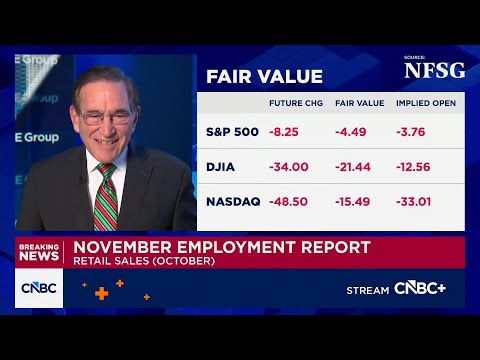
CBC team coverage uh this morning involves Steve Leeman as well as Rick Santelli. Rick Santelli, let's go to you. You're standing by at the CME.Let's get straight to the numbers. But Mike Santelli, by the way, is out the NY. But Rick, get the numbers, please.>> Yes. October and November for the big job job jobs report. The only thing is it's not Friday.Here we go. November's number comes in at 64,000. 64,000 on non-farm.And if we look at average hourly earnings, they are up onetenth up onetenth of a percent ...
Holiday shopping turnout jumps to 202.9 million people during Thanksgiving weekend, NRF says
CNBC· 2025-12-02 18:34
Core Insights - The five-day shopping period from Thanksgiving to Cyber Monday saw 202.9 million U.S. consumers participating, exceeding the National Retail Federation's forecast of 186.9 million and surpassing last year's 197 million shoppers [1][2] Group 1: Shopping Trends - This year's turnout is the largest since the NRF began tracking in 2017, surpassing the previous high of 200.4 million shoppers in 2023 [2] - NRF CEO Matt Shay described the shopping period as a "very, very solid beginning" to the holiday season, indicating strong consumer engagement [2] - Consumers are motivated by sales and promotions, with 51% purchasing clothing and accessories, followed by toys (32%), books and media (28%), and gift cards (26%) [7][8] Group 2: Consumer Spending Outlook - NRF anticipates holiday spending to reach a record between $1.1 trillion to $1.2 trillion from November 1 to December 31, marking the first time it exceeds $1 trillion [5] - This represents a projected increase of 3.7% to 4.2% from the previous year, although it is a slight decrease from last year's 4.3% growth rate [6] - Despite economic uncertainties, consumers are expected to prioritize holiday spending, with many families cutting back on other areas to maintain holiday budgets [3][8] Group 3: Online vs. In-Store Shopping - A total of 129.5 million consumers shopped in stores, reflecting a 3% year-over-year increase, while online shopping surged by 9% with 134.9 million participating [9] - Online spending on Cyber Monday reached $14.25 billion, a 7.1% increase year-over-year, contributing to a total of $44.2 billion spent online during the five-day period, which is a 7.7% increase [10][11] Group 4: Labor Market and Retail Hiring - Retailers are expected to hire between 265,000 and 365,000 seasonal workers this year, the lowest in at least 15 years, indicating a cautious approach to labor costs [4]

X @The Economist
The Economist· 2025-11-27 17:55
Consumer sentiment and retail sales have decoupled https://t.co/alFN8zboaQ ...