Stablecoin Regulation

Search documents
X @Wu Blockchain
Wu Blockchain· 2026-02-01 12:32
Asia’s Weekly TOP10 Crypto News: Hong Kong accelerates virtual asset and stablecoin regulation; Russia’s crypto rules set to take effect in 2027; South Korea considers allowing institutions to issue virtual assets; Kazakhstan plans to build national crypto reserves with seized assets; Japan launches public consultation on new crypto and payment regulations and More https://t.co/IZtlqytla0 ...
Can sterling stablecoins catch digital dollars in 2026? ‘This isn’t about competing,’ says CEO
Yahoo Finance· 2026-01-26 16:45
Core Insights - The UK's financial regulator has identified stablecoins pegged to the national currency as a key priority for 2026, aiming to establish clear regulations early in the market's development [1][2] - The Bank of England is conducting consultations to understand the impact of private sector money issuance on the economy, indicating a proactive approach to regulation [1][2] Industry Overview - The stablecoin market in the UK is currently valued at just over £5 million, significantly smaller compared to the US market, which has a total stablecoin value of $308 billion, with Tether and Circle dominating [3] - Tether's UST is valued at $186 billion, while Circle's USDC is at $72 billion, together accounting for 83% of the total stablecoin market [3] Regulatory Framework - The Bank of England has proposed five key pillars for stablecoin regulation in the UK, focusing on safety and competitiveness [5] - The first pillar requires that at least 40% of a stablecoin's backing assets be held with the Bank of England, with the remainder in higher-yielding gilts [6] - The second pillar mandates that customers should be able to redeem one stablecoin for £1 in fiat by the end of the business day [6] - A controversial third pillar proposes a cap on individual stablecoin holdings between £10,000 and £20,000, while businesses would be limited to £10 million [7]
'Banks Are Going To Get Fully Into Crypto:' David Sacks Predicts Unified Digital Assets Industry
Yahoo Finance· 2026-01-23 14:31
Core Viewpoint - David Sacks predicts that banks will fully integrate into the crypto industry, leading to a unified digital assets sector [3]. Legislative Context - Current legislation on crypto market structures is stalled due to debates over whether third-party platforms can offer rewards programs to stablecoin users, with banks arguing these programs bypass yield restrictions [2]. - A compromise is deemed necessary for legislative progress, with Sacks advocating for a solution to facilitate the passage of a market structure bill [4]. Industry Predictions - Sacks believes that once banks enter the stablecoin business, they will support offering yield payments, indicating a shift in their stance [5]. - Monica Long, president of Ripple, forecasts that by the end of 2026, half of Fortune 500 companies will have formal crypto strategies, with stablecoins becoming the standard for global payments [6]. - Mike Novogratz, CEO of Galaxy Digital, suggests that the crypto industry will need to compromise on the stablecoin rewards clause to find common ground with the banking lobby [7].
X @Decrypt
Decrypt· 2025-11-06 14:28
UK Stablecoin Regs Coming 'Just as Quickly' as US: Bank of England► https://t.co/tattV7iGce https://t.co/tattV7iGce ...
X @Wu Blockchain
Wu Blockchain· 2025-11-05 07:31
Regulatory Landscape - Canada's federal government plans to introduce stablecoin regulatory legislation in its 2025 budget [1] - Legislation will require fiat-backed issuers to maintain sufficient reserves [1] - Redemption mechanisms and risk management measures will be implemented to protect personal and financial data [1]
Crypto Crash Concerns, Zac Prince Makes Return, Institutional Adoption | Bloomberg Crypto 10/15/2025
Bloomberg Television· 2025-10-15 17:31
Market Overview & Crypto Crash Analysis - The cryptocurrency market experienced a significant downturn, with a combined market value decrease of over $150 billion [1] - Bitcoin and Ether prices fell sharply, with Ether dropping approximately 18% from its summer peak, erasing billions of dollars in value [2][3] - The selloff exposed market fragility, particularly among altcoins, leading to investor concerns about their survival [5] - Forced liquidations, triggered by margin calls, exacerbated the price collapse, with some prices momentarily dropping by 70%-80% [4] - Binance and Coinbase faced criticism for pricing issues during the selloff, requiring them to repair some of the damage caused [9][10] Galaxy Digital & GalaxyOne Platform - Zach Prince, former CEO of BlockFi, joined Galaxy Digital to lead GalaxyOne, a new banking platform [1][11] - GalaxyOne launched with products including an FDIC-insured checking account with a 4% yield and a premium yield product offering 8% on cash for accredited investors [17] - GalaxyOne aims to provide institutional-quality customer service to individual investors, focusing on the intersection of traditional finance and crypto [17][21] - Galaxy has multiple regulated entities and partnerships, such as with Cross River Bank for FDIC insurance on checking accounts [20] Regulatory Landscape & Stablecoin Regulation - The regulatory environment towards crypto is evolving, with regulators showing a willingness to engage and find solutions at both regulatory and legislative levels [27] - A significant regulatory gap exists in enforcing exchange focal points for stablecoins, particularly in ensuring they trade at $1 during times of stress [43][44] - The industry needs to acknowledge and address the risks associated with stablecoins, including the differences between primary and secondary markets [45][46] Securitize & Tokenization - Securitize, an asset tokenization company, is in talks to go public through a SPAC, potentially valuing the company at over $1 billion [28][29] - Going public would provide Securitize with greater flexibility in raising equity and further its goal of turning illiquid assets into tradable tokens [29][30]


X @Wu Blockchain
Wu Blockchain· 2025-09-19 15:32
The U.S. Treasury has begun implementing the GENIUS Act, the first federal stablecoin regulation, requiring stablecoins to be fully backed by liquid assets and subject to strict oversight. A public comment period is open until October 20, 2025, focusing on compliance, AML, and regulatory standards. https://t.co/gI0Vd7iafF ...
The GENIUS Act Won't Save the Dollar
Yahoo Finance· 2025-09-10 13:00
Group 1 - The GENIUS Act provides regulatory clarity for U.S. stablecoin operations, establishing clear reserve requirements and compliance frameworks, which alleviates uncertainty in the sector [2] - While the act is celebrated for reinforcing dollar dominance, it inadvertently offers a regulatory template that other nations are adapting for their own digital currencies, such as Japan's JPYC initiative and frameworks in Hong Kong and Latin America [3][6] - The act standardizes USD stablecoins but does not address local liquidity gaps that hinder their global adoption, as cross-border payments still incur significant foreign exchange costs [4] Group 2 - The current cross-border payment system is inefficient, requiring complex conversions that impose fees and delays, particularly for non-dollar economies, which raises questions about the necessity of using USD intermediaries [5] - The GENIUS Act's influence may lead to an unintended revolution in global digital currency regulation, as it reduces the perceived risk for sovereign stablecoin projects, encouraging countries to adopt similar frameworks [6]
X @AscendEX
AscendEX· 2025-08-01 08:00
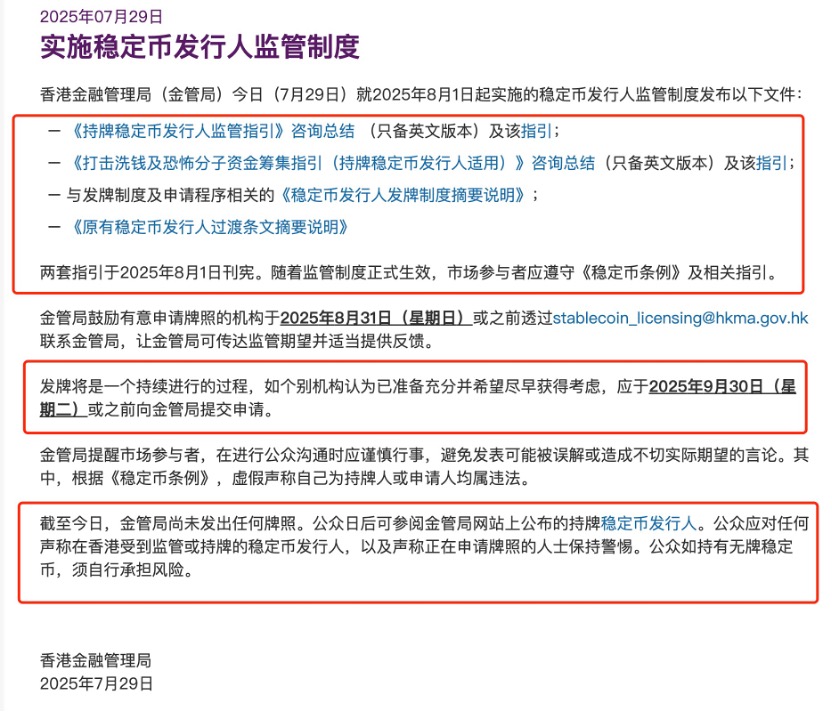
Regulatory Updates - Hong Kong's "Stablecoin Regulation" officially took effect, initiating stablecoin issuer license applications [1] Cryptocurrency Market - Real estate investment company Cardone Capital acquired an additional 100 Bitcoin [1] - Minting Ethereum's 10th Anniversary Torch Commemorative NFT incurred $584 thousand in Gas fees [1]
香港稳定币牌照申请细则落地 门槛直追银行?券商详解四大核心要点
智通财经网· 2025-07-30 13:33
Core Viewpoint - The Hong Kong Monetary Authority (HKMA) will implement the Stablecoin Regulation on August 1, with a licensing process that is ongoing and requires interested institutions to apply by September 30, 2025. The emphasis is on preventing speculation, and no licenses have been issued yet [1][7]. Group 1: Licensing Process - The licensing framework includes four key documents: guidelines for licensed stablecoin issuers, anti-money laundering guidelines, a summary of the licensing system and application procedures, and transitional provisions for existing stablecoin issuers [2]. - The first batch of license applications must be submitted by September 30, 2025, with the first licenses expected to be announced in early 2026. However, this date is not a final cutoff, as institutions can still apply later [7]. Group 2: Qualification Requirements - Applicants must be registered corporations in Hong Kong with a minimum paid-up capital of HKD 25 million or equivalent currency. They must also ensure that reserve assets fully back the stablecoins issued [8][9]. - The reserve assets must include high liquidity assets such as cash, short-term bank deposits, and government bonds, with prior approval required for using other currencies as reserves [9]. Group 3: Compliance and Reporting - Issuers are required to establish a redemption mechanism for real-time payments and must comply with anti-money laundering regulations, including ongoing monitoring of customer transactions [10]. - Information disclosure mandates include monthly financial reports and weekly asset reports to the HKMA, along with external audits to verify compliance [10]. Group 4: Market Expectations - The initial issuance of licenses is expected to be limited to a single-digit number, reflecting a cautious approach by the HKMA due to the risks associated with stablecoins [11]. - Major companies like Ant Group and JD Group are seen as strong candidates for obtaining licenses, with a focus on real-world applications such as cross-border payments [12][13]. Group 5: Industry Implications - The implementation of the Stablecoin Regulation is viewed as a significant step towards the integration of stablecoins into the traditional financial system, potentially transforming cross-border payments and asset allocation [14]. - The presence of licensed platforms is expected to reduce risks associated with virtual assets, and holding core licenses may provide competitive advantages for leading companies in the sector [14][15].