Budget Deficit

Search documents
Dalio's 3% 3 Part Solution to Decrease the Deficit
Principles by Ray Dalio· 2025-06-16 14:01
One way or another, you have to bring debt the deficit not only in the United States but other places but I'm focusing on the United States down to from a supply demand point of view down to about 3%. So that's the 3% of GDP that that's an amount that the market I think can digest. Um it will um affect also the supply demand.There are when I say three parts I think when we think of budgets we think of taxes and spending um but also interest has a huge effect. um a 1% change in the interest rate, 100 basis p ...


Gundlach on Treasuries, Gold, Fed, AI, Private Credit, Trump
Bloomberg Television· 2025-06-11 19:31
U.S. Fiscal Outlook and Treasury Market - The U.S. faces an unsustainable fiscal path, with the interest expense becoming untenable due to high budget deficits and sticky interest rates [1][4] - The average coupon on Treasuries has risen from below 2% to pushing 4%, creating a building problem as trillions of bonds mature and are re-issued at higher rates, a difference of 400 basis points [4][5][6] - The long-term Treasury bond is no longer behaving as a legitimate flight to quality asset, and is not responding to lower interest rates or an inflation rate around 25%, with potential for it to go higher [6][7] - The U.S national debt is approaching $37 trillion, requiring creative solutions, and markets are starting to acknowledge this [7][8] Investment Strategy and Market Dynamics - A paradigm shift is occurring where money is no longer flowing into the United States, and the long bond is not acting as a flight to quality asset, with gold emerging as an alternative [16] - The dollar is falling, and some of the $25 trillion net investment position that flowed into the U.S over the past two decades could potentially flow out, suggesting increased allocations to non-dollar investments [9][10] - The market environment feels similar to 1999 (dot-com bubble) and 2006/2007 (pre-credit crisis), with AI enthusiasm mirroring the dot-com boom [21][22] - A great buying opportunity is anticipated, but the timing is uncertain [21] Private Credit and Alternative Investments - There is overinvestment in private credit, and the excess reward is not as attractive as it once was, potentially leading to forced selling [32] - Gold has proven to be a source of growth, outperforming Bitcoin year-to-date, and is recommended as an asset class, with central banks accumulating gold [16][17][50] - Dollar-based investors should consider investing in foreign currencies and selective emerging market equities, as the S&P 500 is underperforming MSCI Europe year-to-date [51][52] Restructuring and Long-Term Themes - There is a need to restructure various aspects of the system, including institutions, political parties, and finances, due to wealth inequality and calcified property relations [42][46] - India is highlighted as a long-term investment theme, with a similar profile to China 35 years ago, benefiting from demographic outlook, supply chain shifts, and technology [48][49]

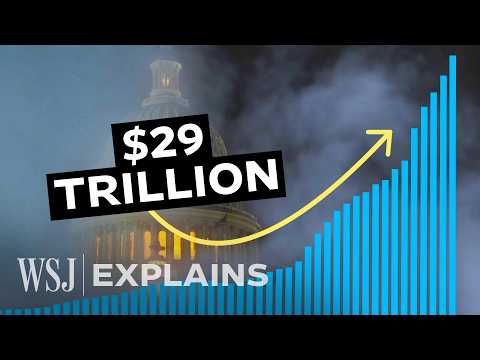
When Does US Debt Become Genuinely Bad? | WSJ
The Wall Street Journal· 2025-06-06 14:00
US National Debt Concerns - The US national debt is reaching levels comparable to World War II as a percentage of GDP, raising concerns about its sustainability [4][5] - The national debt affects basically everything in our economic lives [10] - The US has been running a budget deficit for 20 years, with the 2020s' deficit at $18 trillion [4] - The US is borrowing to pay the interest on the previous debt [11] Economic Impact - High national debt diverts investors' money from productive investments, hindering economic growth and potentially reducing incomes per person by nearly 7% by 2050 [8][9] - Increased interest rates due to rising debt can add $300 billion in borrowing a year and ripple through the entire economy, affecting mortgages and corporate bonds [12][18] - If publicly held debt exceeds 175% of GDP, it could lead to economic hardship, and 200% is considered a critical limit, potentially triggering a Greek-Portugal meltdown scenario [12][13] Potential Solutions - Experts suggest that Congress needs to reduce spending, increase tax revenue, honestly fix social security, make changes to welfare programs, look at how defense procurement programs work, put discretionary spending caps on, and raise taxes [21][22] - A grand bargain is needed where everything is on the table [22]