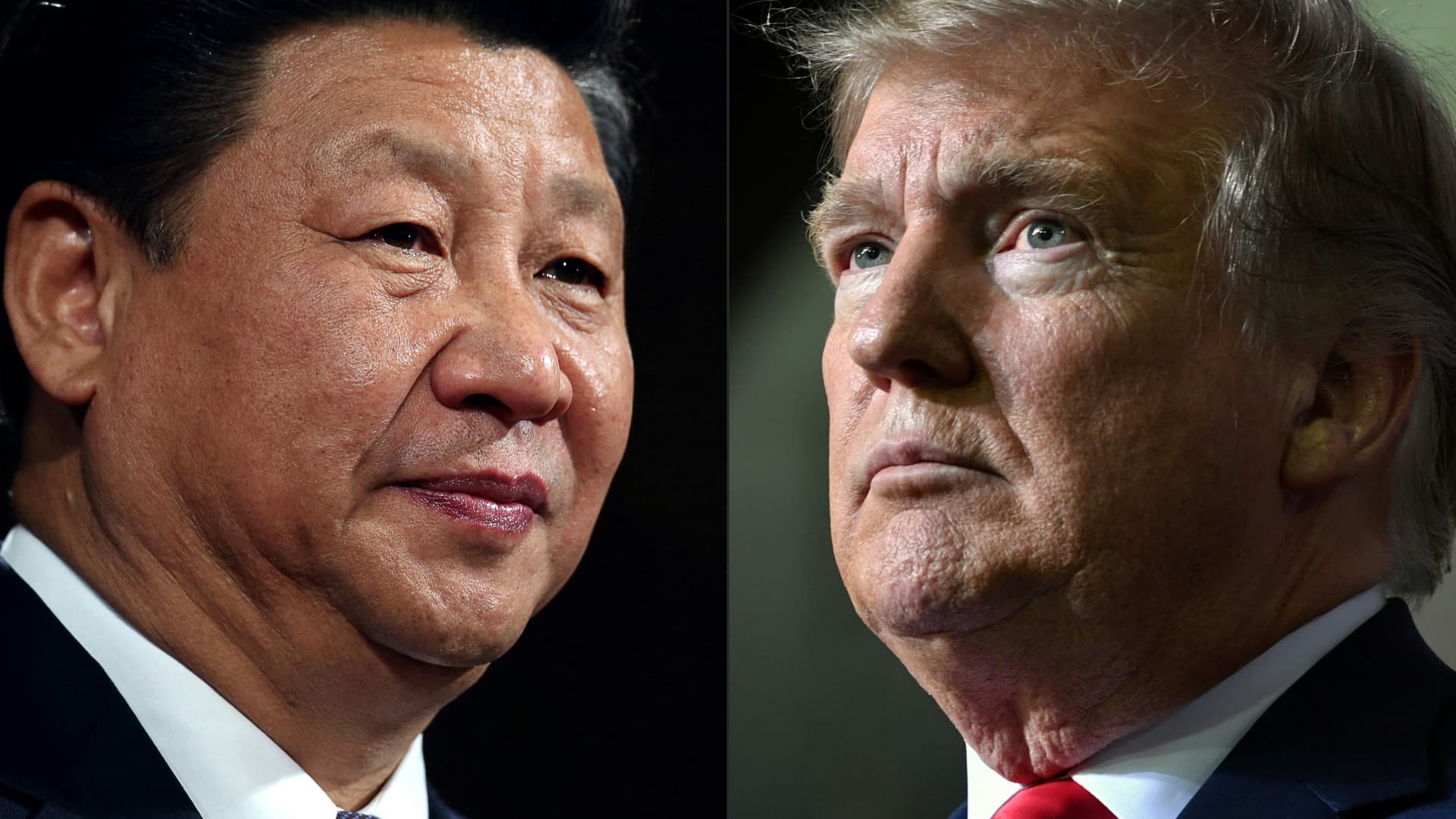
Trade war

Search documents
Bank of America Says Now’s the Moment to Buy These 2 Stocks
Yahoo Finance· 2025-10-14 10:08
Group 1: Trade Tensions - The recent market drop was triggered by renewed trade tensions between the US and China, raising concerns of a potential trade war [1] - China announced plans to impose export controls on rare earth elements, which are critical for various industries, including smartphones, electric vehicles, and military systems [2] - China currently dominates approximately 70% of the global supply of rare earths, providing it with significant leverage in this sector [2] Group 2: Market Reactions - In response to China's actions, President Trump announced new tariffs on Chinese imports, with some tariffs reaching up to 100%, causing a significant market decline [3] - The S&P 500 fell by 2.71%, and the Nasdaq dropped by 3.56% following the announcement of tariffs [3] - Trump's subsequent comments suggesting that "it will all be fine" helped to calm investors, leading to a recovery in U.S. stocks [3] Group 3: Investment Opportunities - Despite market volatility, analysts suggest that pullbacks can create attractive entry points for quality stocks [4] - Bank of America analysts have identified two stocks that they believe present solid investment opportunities [4] Group 4: Darling Ingredients Overview - Darling Ingredients operates in recycling, food technology, and agribusiness, focusing on converting waste materials into valuable products [5] - The company produces animal feeds, human food products, and renewable biofuels, making it the largest rendering company in the global feed market [6] - Darling is recognized as a global leader in gelatin and collagen solutions, with 16 factories worldwide and sales in over 80 countries [7] Group 5: Joint Venture and Revenue Projections - Darling Ingredients has formed a joint venture with Tessenderlo Group called Nextida, which will focus on their collagen and gelatin segments [7] - The joint venture is projected to generate $1.5 billion in revenue and will be 85% owned by Darling [7]

Trump Enacts Tariffs on Imported Lumber and Furniture
Nytimes· 2025-10-14 04:01
Core Viewpoint - The new taxes have been implemented, coinciding with President Trump's threats to escalate the trade conflict with China [1] Group 1 - The new taxes went into effect on Tuesday [1] - President Trump has threatened to widen the trade war with China [1]


Is the War in Gaza Over?
Bloomberg Television· 2025-10-13 21:01
Middle East Peace Agreement - Achieving the peace agreement was difficult, but ensuring its sustainability will be even harder [1][2] - Key challenges include maintaining the ceasefire, addressing Hamas' role, promoting disarmament, providing humanitarian aid, and establishing security and governance [2][3] - Establishing stability and order is a prerequisite for addressing humanitarian, economic, and political issues [3][4] - An international or Arab stabilization force with military capabilities is crucial for enforcement and deterring armed attacks [5][6][7] - Economic assistance could be tied to specific behavioral changes to incentivize desired actions [6] - The agreement was facilitated by Hamas' military weakening, Iran's economic struggles, and Arab countries' desire for stability [9] - The President leveraged pressure on both Israelis and Hamas to reach the agreement [9][10] US-China Relations - Both the US and China possess the ability to inflict economic harm on each other [13] - The US's reliance on China for rare earths and certain components poses a significant vulnerability [13] - China's Ministry of Commerce is banning the export of critical minerals to the US for military purposes, potentially impacting defense contractors [12] - China has leverage through rare earths and supply chains, while the US has leverage through technology transfers [14][17] - The upcoming meeting between President Xi Jinping and President Trump aims to address economic and military realities [14][15] - Non-tariff issues, such as rare earths, are taking center stage in US-China negotiations [16] - Geopolitical factors, including the South China Sea and Taiwan, will influence the economic relationship [18][19] - A key question is whether there will be trade-offs between economic and geopolitical issues [19][23] Argentina's Economic Situation - The US is considering guaranteeing Argentina's currency with an additional $20 billion [24] - Any financial guarantee should be conditional on Argentina implementing specific economic and potentially non-economic policy changes [25][26] - An unconditional guarantee would be imprudent unless Argentina only requires short-term financial assistance [25][26]

Crude Prices Recover as US-China Trade Tensions Ease
Yahoo Finance· 2025-10-13 15:33
Core Insights - Crude oil and gasoline prices have increased sharply, recovering from previous declines due to improved market sentiment following potential trade deal discussions between the Trump administration and China [2] - The consideration of arming Ukraine with long-range missiles by President Trump has raised concerns about further disruptions to Russian oil supplies, contributing to the price rally [2] - A recent agreement between Israel and Hamas has reduced geopolitical risk in the Middle East, which has impacted crude prices by lowering the risk premium [4] Price Movements - November WTI crude oil is up by $0.96 (+1.63%) and November RBOB gasoline is up by $0.0291 (+1.60%) [1] - Last Friday, crude prices hit a 5-month low while gasoline prices fell to a 4.5-year low due to renewed trade tensions with China [3] OPEC+ Production Decisions - OPEC+ agreed to a modest increase of 137,000 barrels per day (bpd) in crude production starting in November, which was below market expectations [5] - OPEC's crude production rose by 400,000 bpd to 29.05 million bpd in September, marking the highest level in 2.5 years [5] Russian Supply Constraints - Reduced crude production in Russia is supporting oil prices, with Ukrainian attacks on Russian refineries limiting export capabilities [6] - Russian refined-product flows have dropped to 1.94 million bpd in early September, the lowest in over 3.25 years [6]
China vows retaliation after Trump's 100% tariff threat
Youtube· 2025-10-13 15:30
Group 1 - The US-China trade tensions appear to be easing, with President Trump expressing a positive outlook on social media, stating that the USA wants to help China [1] - This optimistic tone contrasts sharply with Trump's previous threats of imposing 100% tariffs on Chinese imports, which prompted a strong response from Beijing [1] - China's recent export restrictions on rare earth minerals have reignited concerns about a potential trade war, with China asserting that it does not desire a tariff war but is prepared for one [2] Group 2 - Attention is focused on the upcoming meeting between President Trump and President Xi in South Korea, which could either advance trade discussions or lead to a stalemate [3] - US Treasury Secretary Scott Bessant confirmed that the meeting is still scheduled, which has positively influenced stock market performance amid previous volatility [3]
INTC Run "Too Far, Too Fast?" Options Front Stays Bullish
Youtube· 2025-10-13 15:30
Company Overview - Intel shares have increased over 75% this year, largely due to investments from the US government and Nvidia, reaching a new 52-week high and over 100% increase from April's low [1][5] - Bank of America downgraded Intel from neutral to underperform, citing strategic and competitive challenges as the reason for this downgrade [3][6] Market Performance - Despite the downgrade, Intel's stock performance has remained relatively strong, with a 55% increase in the last month, although it has been volatile [5][6][9] - Other semiconductor stocks, such as Nvidia and AMD, have also seen gains, with Nvidia recovering losses and AMD up over 2% [2][5] Analyst Insights - Analysts express skepticism about Intel's competitive position, noting a lack of a discernible AI portfolio, uncompetitive server CPUs, and challenges in divesting loss-making manufacturing [5][6] - The price target for Intel remains unchanged at $34, but analysts believe the stock's rapid ascent may not be justified by its fundamentals [4][5] Investment Strategies - Some analysts are exploring upside plays for Intel, suggesting potential returns of 50% to 100% if the stock remains above key price levels [10][12] - There are ongoing discussions about potential partnerships with major customers like TSMC and Apple, which could significantly impact Intel's stock performance [11][12]


Trade Wars Could Push Market Down 20%
247Wallst· 2025-10-13 13:45
Core Viewpoint - The potential trade war initiated by President Trump's tariff plans could lead to a significant downturn in the U.S. stock market, with estimates suggesting a drop of up to 20% in the S&P 500 due to heightened tariffs on major trading partners, particularly China [2][5]. Group 1: Tariff Implications - President Trump's proposed tariffs on China could reach as high as 100%, significantly impacting U.S. companies that rely on Chinese imports, such as Walmart, which sources approximately 60% of its merchandise from China [3][5]. - The initial tariff plans included raising tariffs on China to 54%, with discussions of a potential 245% tariff, which would severely affect the economies of major trade partners like Canada and Mexico [2][4]. Group 2: Economic Impact - A trade war with China is expected to have immediate and widespread effects on the U.S. economy, potentially leading to inflation rates similar to the 9% level experienced in mid-2022, which severely diminished consumer purchasing power [2][7]. - The uncertainty surrounding tariff negotiations has created volatility in the stock market, as the unpredictability of presidential decisions complicates forecasts for many companies and industries [7][8]. Group 3: Retaliation Risks - China may retaliate against U.S. companies operating within its borders, which could include major retailers like Starbucks and Walmart, further complicating the trade dynamics and impacting their operations [6][9].


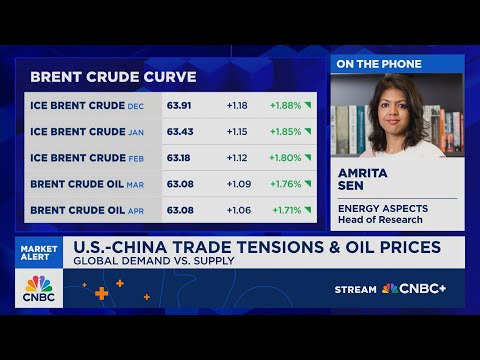
Amrita Sen: China’s stockpiling has kept the physical oil market very tight
CNBC Television· 2025-10-13 12:02
All right. So, how should we interpret this big rebound. Not huge rebound.We didn't recover all the losses, but a a a percent and a half move to the upside on oil just off a social media post and some comments is pretty significant. Does that mean that investors now don't believe that tensions are going to ramp up and they just simply don't believe we're going to see that 100% increase to tariffs. >> I do think both sides tried to deescalate the situation over the weekend.So I do think there'll be some um c ...
Gold Reaches New High on U.S.-China Trade Rift
WSJ· 2025-10-13 07:43
Core Viewpoint - Gold prices have reached a record high due to concerns over a potential renewed trade war between the U.S. and China following Trump's announcement of a new tariff increase on Beijing [1] Group 1 - The announcement of the latest tariff increase has heightened fears of escalating trade tensions [1] - Investors are flocking to gold as a safe-haven asset amid these uncertainties [1] - The increase in gold prices reflects market reactions to geopolitical risks and economic instability [1]

European markets head for mostly higher open, brushing off new U.S.-China trade spat
CNBC· 2025-10-13 05:20
Market Overview - European stocks are expected to open mostly higher, with the U.K.'s FTSE index seen opening just below the flatline, Germany's DAX up 0.3%, France's CAC 40 up 0.26%, and Italy's FTSE MIB up 0.54% [1] - The positive start follows a negative close for regional bourses last week due to U.S. President Trump's threats of new tariffs against China in response to China's export controls on rare earth minerals [2] Trade Relations - Trump suggested in a social media post that he might not follow through on his tariff threats, stating that trade relations with China "will all be fine" [3] - China responded by asserting that it is "not afraid of" a trade war and accused the U.S. of a "double standard" regarding Trump's promise of additional 100% tariffs on Chinese imports [3] Market Reactions - Asia-Pacific markets fell overnight amid concerns over renewed trade tensions, while U.S. stock futures rose, rebounding from a previous sell-off after Trump's reassurances [4] - Investors are anticipating financial reports from companies such as ASML, LVMH, and Nestle as the third quarter earnings season begins [4] Upcoming Events - Investors will be monitoring news from the IMF and World Bank annual meeting in Washington this week [5]