Consumer Spending

Search documents
X @TechCrunch
TechCrunch· 2025-12-18 19:53
ChatGPT’s mobile app hits new milestone of $3B in consumer spending https://t.co/R3zBD3sNpp ...
UK consumer spending and confidence is muted, says Currys boss
Reuters· 2025-12-18 08:52
Core Insights - British consumer confidence and spending are subdued as the Christmas season approaches, indicating a challenging retail environment for companies like Currys [1] - The recent government budget did not provide significant support to boost consumer spending, further impacting the retail sector [1] Company Insights - Currys, an electrical retailer, has expressed concerns regarding the muted consumer confidence and spending patterns, which could affect sales performance during the critical holiday season [1] - The company's leadership highlights the need for more effective government measures to stimulate consumer spending [1]



Mitrione: Energy moves don’t change our view yet, inflation is the real risk
CNBC Television· 2025-12-17 12:11
All right. Uh, you know, we don't talk a lot about oil recently. Uh, right now we're seeing oil move to the upside on on potential sanctions on Russia and sanctions on Venezuela.Does that change your view of the energy sector in any way. Yesterday, we saw every uh stock in the energy sector close lower. It closed down about 3%.Does it reshape any views for you. >> I think it's still a little bit too early to tell on that. I mean, we're certainly seeing moves, certainly seeing moves this morning on that news ...
Stock Market Today, Dec. 16: Energy Stocks Slide as Oil Drops to Multi-Year Lows
Yahoo Finance· 2025-12-17 00:02
Market Overview - The S&P 500 decreased by 0.24% to 6,800.26, while the Nasdaq Composite increased by 0.23% to 23,111.46, and the Dow Jones Industrial Average fell by 0.62% to 48,114.27, influenced by mixed jobs data and lower oil prices [1] Sector Performance - Energy stocks underperformed, with companies like APA, Diamondback Energy, and Exxon Mobil experiencing declines as crude oil prices reached multi-year lows [2] - Advance Auto Parts saw a drop due to weak auto-related retail data and specific challenges affecting consumer discretionary spending [2] Economic Indicators - The Bureau of Labor Statistics reported an increase in unemployment to 4.6%, the highest level since 2021, despite the economy adding new jobs [3] - Consumer spending remained flat, partially due to weak auto sales [3] Oil Market Dynamics - Weak jobs data may reduce oil demand, compounded by a growing surplus, with West Texas Intermediate crude oil falling below $55 per barrel, marking a four-year low, and Brent crude dropping below $60 per barrel [4] Investor Sentiment - A Bank of America survey indicates record low cash allocations and the highest equity exposure since 2022, suggesting that overly optimistic expectations may signal the market nearing its peak [5]
Pass through of tariff costs to consumer has been slow, says Mastercard's Meyer
CNBC Television· 2025-12-16 20:30
Consumer Spending Trends - Consumer spending remains engaged, with retail sales excluding autos up 41% driven by double-digit growth in e-commerce during Black Friday [2] - Overall spending is running at approximately 4% [3] - Inflation in the holiday basket is around 2%, slightly above last year's deflationary levels [6] Economic Factors and Uncertainty - The unemployment rate climbed to 46% in November, the highest in over four years [1] - Companies stockpiled inventory in advance and shifted supply chains to mitigate price adjustments [8] - Uncertainty around trade changes and the global realignment of trade impacts workforce allocation [11] - Uncertainty surrounding AI investments also influences workforce decisions [12] Labor Market Dynamics - Churn in the workforce is lower, indicating a slowdown in the hiring rate [10] - Companies are cautious in allocating dollars towards the workforce due to uncertainty [11] - There is no increase in firing, which is a positive sign [12]
Retail Sales Flat in October, Lower Than Expected
Etftrends· 2025-12-16 16:31
Core Insights - October's retail sales were flat at $732.6 billion, missing the projected 0.1% growth and ending a four-month streak of increases [1] - Year-over-year retail sales increased by 3.5% compared to October 2024, while total sales from August to October 2025 rose by 4.2% [1][2] - Core retail sales, excluding automobiles, increased by 0.4% in October, surpassing the expected 0.2% growth, and are up 4.0% year-over-year [3] Retail Sales Trends - Retail trade sales rose by 0.1% from September 2025 and are up 3.4% from the previous year, with nonstore retailers showing a significant increase of 9.0% year-over-year [1] - Control purchases, which provide a more stable view of retail sales, increased by 0.9% in October, compared to a decline of 0.1% in September, and are up 5.2% year-over-year [4][5] Market Implications - The retail sales data is expected to influence interest in various retail-focused ETFs, including SPDR S&P Retail ETF (XRT) and Amplify Online Retail ETF (IBUY) [8]

Retail sales unchanged in October hurt in part by a decline in auto sales
Yahoo Finance· 2025-12-16 13:46
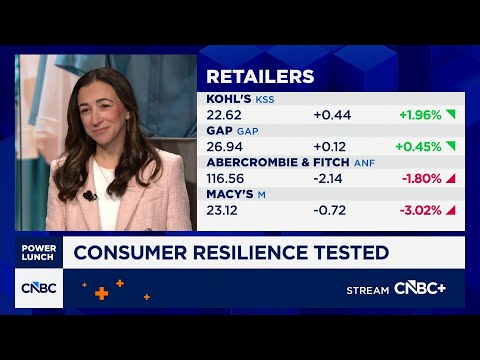
Core Insights - U.S. retail and restaurant sales remained unchanged in October compared to September, indicating a moderation in consumer spending due to concerns over rising prices and economic uncertainties following a summer spending spree [1][3]. Retail Sales Performance - A significant factor contributing to the stagnant sales was a 1.6% decline in sales at motor vehicle and auto parts dealerships, primarily due to the end of federal subsidies that had previously boosted demand for electric vehicles. Excluding this category, retail sales increased by 0.4% [2]. - The overall flat spending in October was below economists' expectations and followed a revised 0.1% increase in September. Retail sales had previously surged by 0.6% in July and August and 1% in June [3]. Consumer Behavior and Economic Indicators - The retail sales report suggests that consumers are being selective in their spending, with many households facing high prices for essentials like groceries and rent, compounded by tariffs on imported goods [5]. - The latest job report indicates a deteriorating employment situation, with a net loss of 105,000 jobs in October, which could negatively impact consumer spending and the broader economy [7]. Sector-Specific Sales Trends - Sales in clothing and accessories stores rose by 0.9%, while furniture and home furnishing stores saw a 2.3% increase, likely driven by rising prices due to tariffs. Online retailers experienced a 1.8% sales increase, and department stores reported a 4.9% rise. However, restaurant sales, a key indicator of discretionary spending, fell by 0.4% [6]. Outlook for Holiday Sales - Despite the disappointing retail sales report for October, underlying details suggest potential for improved consumer spending in the fourth quarter, particularly as retailers prepare for the holiday shopping season with extended hours and promotions [4].
Affirm CEO Max Levchin goes one-on-one with Jim Cramer
CNBC Television· 2025-12-16 00:48
[music] A little over a month ago, we got a really impressive quarter from a firm holdings. The buy now pay later powerhouse. This guy's posted a 12-cent earnings beat off an 11centent basis with much higher than expected revenue.The stock shot up more than 11% the next day, reaching a high of $79 and change a couple days later. Since then though, a firm has gradually drifted lower because of concerns about the state of the consumer to the point where it's now back to $65 and change. trading like that great ...
X @The Wall Street Journal
The Wall Street Journal· 2025-12-15 15:30
China’s economic momentum slowed broadly in November, with a marked weakening in consumer spending, adding pressure on Beijing to stabilize household and business demand in the world’s second-largest economy https://t.co/esvBVd35LV ...
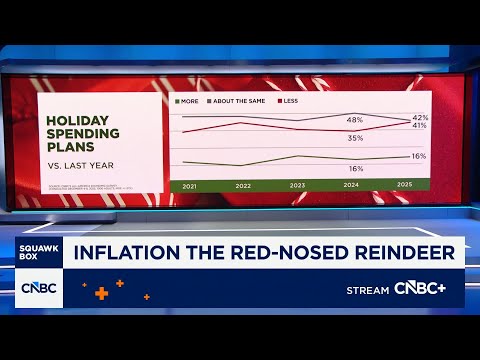
CNBC All-America Economic Survey: 41% of Americans plan to spend less this holiday season
CNBC Television· 2025-12-15 12:35
Time now for the CNBC All-America Economic Survey holiday edition. For the past 19 years, we have tracked how much shoppers are spending for Christmas and most importantly this year. What is behind the spending decisions.Senior economics reporter Steve Leeman has the details, joins us here on set. Steve, >> thank you Melissa. Uh this looks to be the Christmas where inflation is the red-nosed reindeer that is leading shopping decisions among American consumers in a way we have not seen before.The CNBC All-Am ...