Housing affordability

Search documents
降息反成噩梦?澳洲房价暴涨,83%城区普通家庭买不起
Sou Hu Cai Jing· 2025-08-10 16:40
Core Insights - The recent interest rate cuts in Australia have led to a significant increase in housing prices, making it difficult for average earners to afford homes in major cities [1][3] - A study indicates that approximately 83% of regions in Australia are unaffordable for average pre-tax income earners, which is around AUD 100,000 annually [1][3] - The minimum annual income required to purchase an average-priced home in capital cities is now approximately AUD 203,000 [3][6] Housing Affordability - National housing prices have risen by about 5% compared to the same period last year, with most increases occurring after the interest rate cuts in February [3][12] - In Sydney, the median home price is AUD 1,564,000, requiring an annual income of approximately AUD 294,615 to afford [6][7] - Brisbane's median home price is AUD 1,067,000, necessitating an annual income of around AUD 201,000 [7] - Melbourne's median home price is AUD 983,000, with a minimum income requirement of AUD 185,170 [7] Loan Repayment Burden - Housing affordability is defined as spending more than 30% of income on mortgage repayments, which is considered unsustainable in the long term [6] - Adelaide's median home price is AUD 916,000, requiring an annual income of nearly AUD 173,000 [7] - Perth's average housing affordability requires a similar annual income of about AUD 174,000 [7] Apartment Affordability - Purchasing an average-priced apartment in capital cities requires a minimum annual income of AUD 131,000, which is still above the national average income of AUD 105,000 [9][10] - In Melbourne, Perth, Canberra, and Adelaide, the minimum income needed to afford an average-priced apartment ranges from AUD 110,000 to AUD 120,000 [9] - In Brisbane, the minimum income for an average-priced apartment is close to AUD 135,000, while in Sydney, it is approximately AUD 162,000 [10] Market Dynamics - The high income levels required to enter the housing market are suppressing the rate of price increases, yet recent interest rate cuts continue to drive prices upward [12]


X @Bloomberg
Bloomberg· 2025-07-11 11:40
Housing Market & Policy - White House policies are expected to restrict workers, increase building costs, and negatively impact demand in the housing market [1] - Democratic policies aim to reduce housing costs [1]
Jam today: unleashing the power of meanwhile use | David Warr | TEDxSt Helier
TEDx Talks· 2025-06-25 16:32
Core Argument: "Jam Today" - Immediate Action & Use - The speech advocates for "meanwhile use" of underutilized spaces, urging immediate action ("jam today") instead of waiting for long-term plans ("jam tomorrow") [2][5][13] - It emphasizes prioritizing people's needs over rigid policies, advocating for creative and courageous decision-making to address immediate problems [6][20][26] - The speaker calls for a shift in mindset, encouraging governments and individuals to identify and address current needs rather than deferring to future plans [5][6][27] Housing Crisis & Vacant Homes - The speech highlights the issue of vacant homes amidst housing shortages, citing 135,000 long-term vacant homes in London alongside 55,000 homeless individuals [9] - It points out the inefficiency of having vacant homes while numerous people are on housing waiting lists, using the example of 13,790 people on the waiting list in Wandsworth, London [10] - The speaker shares an initiative in Jersey where public engagement led to the identification of 260 vacant homes in 6 months, demonstrating the potential of community involvement [12] Transitional Planning & Site Utilization - The speech proposes a "transitional planning process" that mandates alternative uses for sites if development doesn't commence within a year [16] - It criticizes the practice of leaving brownfield sites unused while developing greenfield sites, advocating for the utilization of existing spaces for parks and playgrounds [14][15] - The speaker uses Fort Regent as an example of a challenging site requiring immediate action to prevent closure and ensure continued community use [16][18][19] Call to Action & Policy Change - The speech urges governments to be brave in making decisions and to serve the economy by addressing immediate needs [24][25] - It suggests changing planning rules to allow for temporary or prefabricated homes on currently restricted sites, addressing the housing crisis [22][23] - The speaker envisions a global platform ("Jam Today" website) where individuals can highlight underutilized sites and propose solutions to their governments [27]

Haverty Furniture(HVT) - 2025 Q1 - Earnings Call Transcript
2025-05-01 15:02
Financial Data and Key Metrics Changes - Q1 2025 sales were $181.6 million, a decrease of 1.3% year-over-year, with comparable store sales down 4.8% [3][18] - Gross margins increased to 61.2% from 60.3%, reflecting improved product selection and merchandise mix [4][18] - Pre-tax profits rose to $5.3 million, with an operating margin of 2.9%, compared to $3.2 million and 1.7% in Q1 2024 [4][19] - Net income for Q1 2025 was $3.8 million, or $0.23 per diluted share, compared to $2.4 million, or $0.14 per share, in the same quarter last year [19] Business Line Data and Key Metrics Changes - The design business accounted for approximately 33% of total business, with an average ticket of over $3,300, up about 4% [6] - The designer average ticket grew to over $7,400, an increase of over 9% [6] - Weakness was noted in dining and occasional categories, while upholstery, bedroom, and mattress categories performed in line with expectations [6] Market Data and Key Metrics Changes - Written sales were down 2.6% with comparable sales down 6.3% [3] - Sales for the Presidents' Day event were disappointing, down roughly 10% over the two-week period [5] - Traffic softened but remained positive in the low single digits, with conversion rates stabilizing and showing some improvement compared to last year [5] Company Strategy and Development Direction - The company plans to roll out a new point of purchase and tagging program to enhance the in-store customer experience [7] - The strategy includes increasing inventories of best-selling products to improve service speed and mitigate tariff impacts [11][12] - The company aims to open five new stores annually, with a cautious approach due to current market conditions [13][14] Management's Comments on Operating Environment and Future Outlook - Management expressed satisfaction with Q1 results despite challenges from the housing market, high interest rates, and consumer confidence issues [4][16] - The company is well-positioned to navigate challenges due to its strong brand, debt-free balance sheet, and customer focus [17] - Future guidance includes expectations for gross margins between 60% and 60.5% for 2025, factoring in current tariffs [21][22] Other Important Information - SG&A expenses decreased by $2.2 million or 1.9% to $107.2 million, representing 59% of sales [19] - Inventory levels increased by approximately $5 million or about 6% since year-end 2024 [11][20] - The company has halted most direct shipments from China due to tariffs, which could cause temporary supply disruptions [10] Q&A Session Summary Question: Impact of winter storms on business - Management noted that January was down almost 2% in written business, February down about 5%, and March was flat, with multiple storms impacting operations [26][27][28] Question: Price increases due to tariffs - Management confirmed targeted price increases will be implemented, but they expect minimal impact on consumers due to supplier cooperation [31][32] Question: Changes in competition - Management observed aggressive promotions from competitors but did not believe promotional activity was the primary issue affecting their performance [34][35] Question: Reduction in CapEx guidance - Management explained the $3 million reduction in CapEx was due to tariff uncertainty, prompting a cautious approach to store expansion [36][37] Question: Performance of new stores - Management reported positive performance from new stores, leveraging existing distribution networks, and noted that initial traffic has been good [47][48]

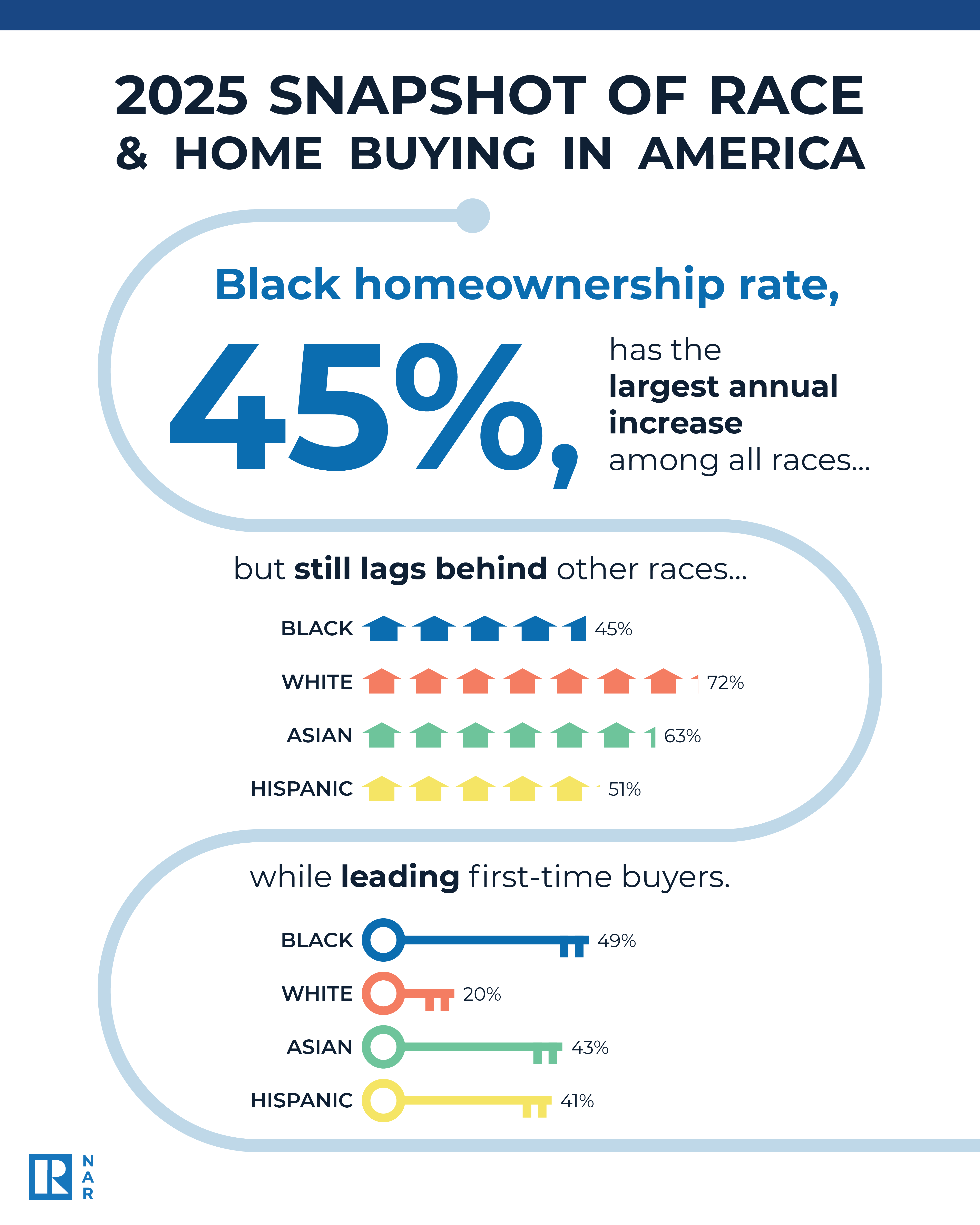
Black Homeownership Rate Sees Largest Annual Increase Among Racial Groups but Still Trails White Homeownership Rate by Almost 30 Percentage Points
Globenewswire· 2025-03-17 13:00
Core Insights - The U.S. Black homeownership rate saw the largest year-over-year increase in 2023 among racial groups, yet it remains significantly lower than the White homeownership rate [1][3] - The report provides a comprehensive analysis of homeownership trends among various racial and ethnic groups, focusing on demographics, affordability, and financing access [2][3] Homeownership Rates - The Black homeownership rate reached 44.7% in 2023, an increase of 0.6 percentage points, but is still below the rates for White (72.4%), Asian (63.4%), and Hispanic (51.0%) groups [3][5] - The overall U.S. homeownership rate increased to 65.2% in 2023, up from 63.5% in 2013, with approximately 11.8 million more homeowners [4] Demographic Trends - Hispanic Americans experienced the largest increase in homeownership rates (+5.8 percentage points or 3.5 million homeowners) since 2013, followed by Asian (+5.6 percentage points or 1.6 million homeowners) and White (+3.6 percentage points or 702,200 homeowners) [5][13] - One in three Hispanic households are in the 25-40 age group, and there has been a 34% increase in Asian households aged 25-40 since 2013 [6][13] Affordability Challenges - Nearly half of renters spend more than 30% of their income on rent, with Black renters facing greater affordability challenges than White renters in 46 states [6][7] - Black homeowners experience higher housing cost burdens in 39 states, with 21% of Black and 17% of Hispanic mortgage applicants facing higher denial rates compared to 11% for White and 9% for Asian applicants [7] Insurance Costs - The median homeowners' insurance cost rose from $860 in 2013 to $1,310 in 2023, a 53% increase, with Black homeowners paying the highest median cost at $1,360 [8] Buyer Demographics - White buyers constituted 83% of total buyers, while Black, Hispanic, Asian, and Other buyers made up 7%, 6%, 4%, and 3% respectively [9] - Among first-time home buyers, 49% are Black, 43% are Asian, 41% are Hispanic, and 20% are White, indicating a shift in demographics [9] Down Payment Sources - Black home buyers utilized 401(k)/pension (11%) and community/government assistance (5%) more than other groups, with the typical down payment being highest among Asian buyers at 21% [10] Discrimination in Home Buying - Black (47%) and Asian (33%) buyers reported the highest instances of discrimination regarding loan products offered, with 5% of Black and Asian buyers experiencing racial discrimination [11] Advocacy Efforts - The National Association of Realtors (NAR) advocates for policy solutions to close homeownership gaps, including down payment assistance and updated credit scoring models [12]