
空中丝绸之路

Search documents
民航局:一季度我国民航国际客运市场持续向好
news flash· 2025-04-27 03:22
Core Insights - The Civil Aviation Administration of China (CAAC) has reported a significant increase in international passenger flights and routes, surpassing pre-pandemic levels in many areas [1][2] - In the first quarter, Chinese airlines transported 18.925 million international passengers, marking a 34% year-on-year increase and a 4.5% rise compared to the same period in 2019 [1] - The number of international flights operated by both Chinese and foreign airlines reached an average of 6,395 per week, which is 83.9% of the 2019 levels, with peak travel during the Spring Festival reaching 6,960 flights per week, or 91.3% of 2019 levels [1] Group 1 - The number of international flights to 35 countries has exceeded 2019 levels, with flights to Belt and Road Initiative countries at 94.5% of 2019 levels, which is 10.6 percentage points above the average [1] - Passenger transport volumes to Northeast Asia, West Asia, Central Asia, Europe, and Africa have increased by 20%, 91%, 233%, 71%, and 241% respectively compared to 2019 [1] - A total of 28 Chinese airlines and 100 foreign airlines are operating international passenger routes in China, with the number of countries served increasing to 78, up by 4 from 2019 [2] Group 2 - The CAAC plans to continue promoting the increase of international passenger flights, focusing on differentiated competition among airlines in traditional markets and encouraging expansion into emerging markets [2] - The initiative aims to enhance the air route network and better serve national diplomatic and foreign trade objectives [2]
货畅其流 看郑州与世界“你来我往”
Zheng Zhou Ri Bao· 2025-04-23 00:35
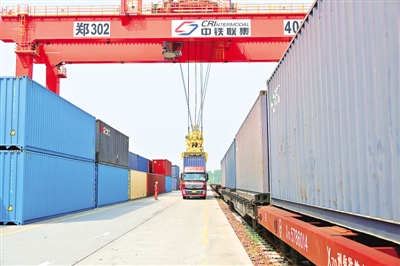
Core Insights - Zhengzhou is enhancing its international logistics capabilities through the development of air and rail routes, aiming to establish itself as a key hub in the "Air Silk Road" initiative [1][2][6][10] - The city has seen significant growth in international cargo volume, with over 130,000 tons recorded in the first quarter of the year, reflecting the increasing demand for cross-border trade [3][12] - Zhengzhou's strategic partnerships with various international airlines and logistics companies are expanding its global reach and operational efficiency [2][5][12] Air Logistics Development - Zhengzhou Airport is set to introduce 19 new cargo routes, including connections to Frankfurt, Atlanta, and Osaka, while increasing the frequency of existing routes to major cities like Luxembourg and Chicago [2][5] - The airport achieved a historic milestone by surpassing 800,000 tons in cargo throughput for the first time, indicating rapid expansion in its logistics network [2][5] Rail Logistics Expansion - The China-Laos Railway has facilitated over 200 international freight trains, enhancing trade connections between Zhengzhou and ASEAN countries [1][4] - Zhengzhou's rail logistics are complemented by the opening of new routes, including the successful launch of the Zhengzhou-Urumqi interprovincial cooperation train, which connects to Central Asia [10][11] International Trade Growth - Zhengzhou's import and export activities have surged, with the city maintaining its position as the leading region in central China for trade volume for 13 consecutive years [13] - The Zhengzhou Comprehensive Bonded Zone reported an impressive import-export value of 98.8 billion yuan in the first quarter, ranking second nationally among similar zones [13] Strategic Partnerships - Collaborations with international airlines and logistics firms, such as Lufthansa and Maersk, are pivotal in enhancing Zhengzhou's logistics capabilities and attracting more global players [2][5][12] - The city is actively engaging in trade with Southeast Asian countries, evidenced by the increasing import of Malaysian fruits and other goods [12][13]

奋斗在春天里丨“空中丝绸之路”通达世界 全球货物享受“空空中转”新模式
Yang Shi Xin Wen Ke Hu Duan· 2025-03-31 13:57
Core Insights - Zhengzhou Airport has established itself as a key hub for international cargo transport, significantly enhancing its air freight capabilities and expanding its global reach [1][2][6] Group 1: Expansion of Cargo Routes - In the first two months of this year, Zhengzhou Airport opened and intensified nine international cargo routes, including direct flights to cities like Oslo, Billund, and Madrid [1][2] - The airport has increased its cargo routes to a total of 57, connecting to 28 countries and 62 cities, with international cargo volume reaching 78,000 tons, a year-on-year increase of 54.4% [2][6] Group 2: Efficiency Improvements - The airport has implemented specialized manual channels for cross-border e-commerce products to enhance efficiency, with the number of cargo types transported now exceeding 10,000 [2][5] - The airport's cargo handling efficiency has improved significantly, with peak operations seeing over 40 flights executed in one night [1][2] Group 3: Cross-Border E-Commerce Growth - The cross-border e-commerce business at Zhengzhou Airport has seen a doubling in export volume and value, with 3.5 million orders completed in the first two months of this year [6] - The airport's strategic focus on "cargo priority" has enabled it to handle 1.1 million tons of cargo throughput capacity, meeting the demands of fast-moving e-commerce [6] Group 4: Innovative Logistics Models - The introduction of the "air-to-air transfer" model has allowed for more efficient cargo handling, reducing costs by 20% to 30% and improving transit times by 3 to 6 hours [7][8] - Zhengzhou Airport has established a network for "international to international, international to domestic, and domestic to international" transfers, enhancing cargo flow and utilization [8] Group 5: Future Development Plans - Zhengzhou aims to build a "dual hub" network by 2030, connecting with major regions along the Belt and Road Initiative, to create a self-sufficient international logistics supply chain [9] - The airport's cargo volume for "air-to-air transfer" has exceeded 5,000 tons in the first two months of this year, marking a 217% increase [9]