
中微子质量排序

Search documents
【新华社】地下700米捕捉“幽灵粒子” 我国开启中微子研究新篇章
Xin Hua She· 2025-08-26 00:28
Core Insights - The Jiangmen Underground Neutrino Observatory (JUNO) has officially begun data collection as of August 26, 2023, after over a decade of construction, aiming to address significant questions in particle physics, particularly the mass ordering of neutrinos [2][4]. Group 1: Project Overview - The JUNO facility is located 700 meters underground in Jiangmen, Guangdong, featuring a 35-meter diameter acrylic sphere designed to detect neutrinos, often referred to as "ghost particles" due to their elusive nature [2][4]. - The observatory's core detector contains 20,000 tons of liquid scintillator and is equipped with tens of thousands of photomultiplier tubes to capture faint light signals generated by neutrino interactions [4][5]. Group 2: Scientific Goals - JUNO aims to provide high-precision measurements of neutrino oscillation parameters and explore various astrophysical phenomena, including supernovae and solar neutrinos, thereby addressing unresolved mysteries in particle physics [4][5]. - The project is expected to have a lifespan of 30 years, with potential upgrades to conduct experiments on neutrinoless double beta decay, which could reveal the absolute mass of neutrinos and determine if they are Majorana particles [5]. Group 3: Collaborative Efforts - The project is led by the Institute of High Energy Physics of the Chinese Academy of Sciences, involving approximately 700 researchers from 17 countries and regions, marking a significant international collaboration in the field of neutrino research [5].

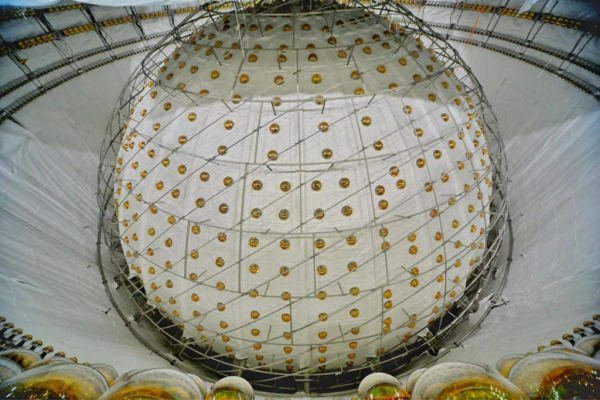
地下700米捕捉“幽灵粒子” 我国开启中微子研究新篇章
Xin Hua She· 2025-08-26 00:21
Core Insights - The Jiangmen Neutrino Experiment (JUNO) has officially commenced data collection, aiming to address significant questions in particle physics, particularly the mass ordering of neutrinos [1][2] - Neutrinos are fundamental particles that are abundant in the universe but are difficult to detect due to their weak interaction with matter [1] - The experiment is a continuation of China's efforts in neutrino research, following the Daya Bay experiment, and is expected to enhance the understanding of neutrino oscillation parameters and other astrophysical phenomena [1][2] Experiment Details - The core detector of the JUNO is a 35-meter diameter acrylic sphere filled with 20,000 tons of liquid scintillator, equipped with thousands of photomultiplier tubes to detect faint light signals produced by neutrino interactions [2] - The construction of the detector involved significant challenges, including the precise control of water levels and flow rates to ensure stability and safety [2] - The experiment is a collaboration involving approximately 700 researchers from 17 countries and regions, marking it as a large-scale scientific endeavor [2] Future Prospects - The JUNO is designed for a lifespan of 30 years, with potential upgrades to conduct double beta decay experiments, which could provide insights into the absolute mass of neutrinos and their nature as Majorana particles [2]
中国江门中微子实验正式运行 将回答物质和宇宙本质问题
Zhong Guo Xin Wen Wang· 2025-08-26 00:18
Core Insights - The Jiangmen Neutrino Experiment (JUNO) has officially commenced operations, marking the first large-scale neutrino experiment of its kind globally, aimed at addressing fundamental questions about the nature of matter and the universe [1][4]. Group 1: Experiment Overview - The JUNO detector is located 700 meters underground in Jiangmen, Guangdong Province, and is capable of detecting neutrinos from nuclear power plants located 53 kilometers away, with unprecedented precision in measuring their energy spectrum [2][4]. - The experiment has achieved key performance indicators that meet or exceed design expectations, enabling it to tackle significant questions in particle physics, such as the mass ordering of neutrinos [4][6]. Group 2: Technical Specifications - The core detector of JUNO has an effective mass of 20,000 tons of liquid scintillator, housed in a stainless steel structure with a diameter of 41.1 meters, and is equipped with numerous photomultiplier tubes to detect scintillation light produced by neutrino interactions [10][11]. - The project has stringent requirements for the purity, transparency, and low radioactivity of the liquid scintillator, all of which have been successfully met [10]. Group 3: International Collaboration - The JUNO project is a major international collaboration involving 700 researchers from 74 institutions across 17 countries and regions, highlighting the importance of global cooperation in advancing scientific research [6][8]. - The success of the JUNO experiment is attributed to effective international collaboration, particularly in pushing the limits of liquid scintillator detection technology [6]. Group 4: Future Prospects - The design lifespan of the JUNO experiment is projected to be 30 years, with potential upgrades to become the world's most sensitive experiment for neutrinoless double beta decay, which could provide insights into the absolute mass of neutrinos and whether they are Majorana particles [4][5]. - The experiment will significantly enhance the precision of three out of six neutrino oscillation parameters and open new avenues for exploring unknown physics, including searches for sterile neutrinos and proton decay [7].
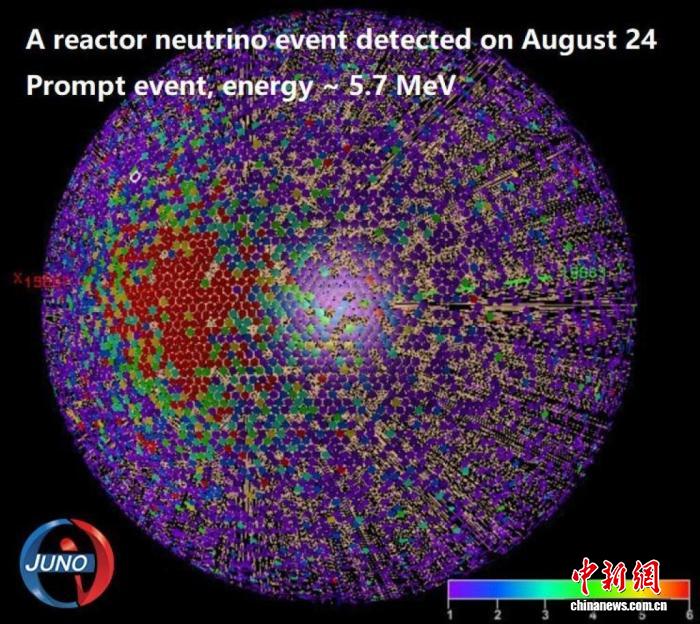
新华鲜报|地下700米捕捉“幽灵粒子” 我国开启中微子研究新篇章
Xin Hua She· 2025-08-26 00:13
Core Insights - The Jiangmen Underground Neutrino Observatory (JUNO) has officially begun data collection as of August 26, 2023, after over ten years of construction, aiming to address significant questions in particle physics, particularly the mass ordering of neutrinos [1][3]. Group 1: Project Overview - The JUNO facility is located 700 meters underground in Jiangmen, Guangdong, featuring a large organic glass sphere with a diameter exceeding 35 meters designed to capture elusive neutrinos, often referred to as "ghost particles" [1][3]. - Neutrinos are fundamental particles that are abundant in the universe but interact very weakly with matter, making them difficult to detect. The first detection of neutrinos occurred in 1956, marking the beginning of their study in physics [3][5]. Group 2: Technological Features - The core detector of JUNO contains 20,000 tons of liquid scintillator housed within the organic glass sphere, equipped with tens of thousands of photomultiplier tubes to detect faint light signals produced by neutrino interactions [5]. - The construction of this high-precision detector involved significant challenges, including the successful filling of over 60,000 tons of ultra-pure water within 45 days, ensuring the stability and safety of the detector's structure [5]. Group 3: Research Goals and Collaborations - JUNO aims not only to determine the mass ordering of neutrinos but also to measure neutrino oscillation parameters with higher precision and explore various astrophysical phenomena, including supernovae and solar neutrinos [3][6]. - The project is led by the Institute of High Energy Physics of the Chinese Academy of Sciences, with collaboration from approximately 700 researchers across 17 countries and regions, marking a significant international effort in neutrino research [5][6]. Group 4: Future Prospects - The JUNO facility is designed for a lifespan of 30 years, with potential upgrades to conduct experiments on neutrinoless double beta decay, which could provide insights into the absolute mass of neutrinos and their nature as Majorana particles [6].
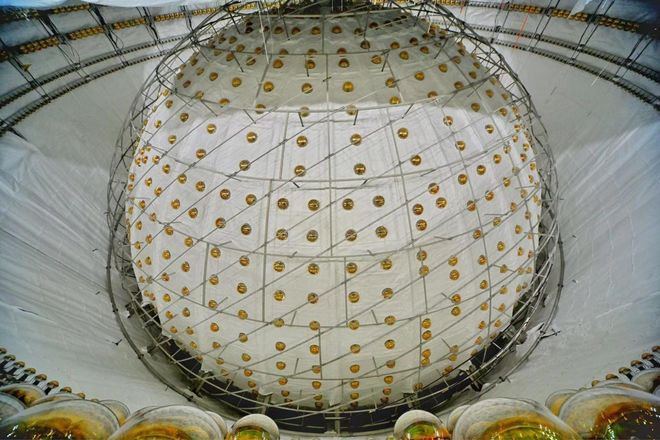
大国重器传来好消息!江门中微子实验大科学装置正式运行
Yang Shi Xin Wen· 2025-08-26 00:02
Core Insights - The Jiangmen Underground Neutrino Observatory (JUNO) has successfully completed the filling of 20,000 tons of liquid scintillator and has officially begun data collection, marking it as the first large-scale and high-precision neutrino-specific scientific facility in operation globally [1][2] Group 1: Project Overview - The JUNO project was proposed by the Institute of High Energy Physics, Chinese Academy of Sciences in 2008, receiving strategic support in 2013 and commencing construction in 2015 [2] - The detector is located 700 meters underground in Jiangmen, Guangdong Province, and is capable of detecting neutrinos from nuclear power plants located 53 kilometers away [1][2] Group 2: Technical Achievements - The initial data collected during the trial operation indicates that the key performance indicators of the JUNO detector have met or exceeded design expectations, enabling it to address significant questions in particle physics, particularly neutrino mass ordering [1][3] - The detector's design includes a 20,000-ton liquid scintillator and a complex structure with various components, including 20,000 photomultiplier tubes, ensuring high precision in measuring neutrino interactions [3] Group 3: Future Implications - The JUNO experiment has a planned operational lifespan of 30 years and can be upgraded to become the world's most sensitive experiment for neutrinoless double beta decay, which could provide insights into fundamental questions about the universe [3] - The spokesperson for the JUNO collaboration emphasized that the completion of the detector filling and the start of data collection represents a breakthrough in understanding the nature of matter and the universe [3]