增值税小规模纳税人

Search documents
问答|增值税一般纳税人和增值税小规模纳税人有什么区别?
蓝色柳林财税室· 2025-08-17 00:43
Core Viewpoint - The article focuses on providing guidance for individual businesses in Ningbo regarding tax policies and procedures, specifically addressing common questions related to value-added tax (VAT) and individual income tax [3]. Group 1: Tax Types and Filing - Individual businesses need to be aware of the main types of taxes they must declare, including VAT and individual income tax, along with their respective filing deadlines [6]. - There are specific consequences for individual businesses that fail to file their tax declarations on time [6]. - The article outlines various methods for calculating individual income tax on business income [6]. Group 2: VAT Registration and Invoicing - Individual businesses can apply to become general VAT taxpayers and are eligible to issue special VAT invoices [6]. - The process for individual businesses to apply for small-scale taxpayer status is also detailed [6]. - The article discusses the use of electronic invoices by individual businesses, including how to apply for and issue them [6]. Group 3: Tax Benefits and Exemptions - Current preferential tax policies available to individual businesses are highlighted, including those aimed at specific key groups [6]. - The article emphasizes the importance of understanding these policies to maximize tax benefits [6]. Group 4: Tax Registration and Cancellation - After obtaining a business license, individual businesses are required to register with the tax authorities [6]. - The process for tax cancellation when an individual business ceases operations is explained, including the need for tax deregistration [6].


汇算后不再是小型微利企业了,还能享受“六税两费”减免吗?
蓝色柳林财税室· 2025-07-19 10:10
Core Viewpoint - The "Six Taxes and Two Fees" preferential policy is not exclusive to small and micro enterprises, and it applies to small-scale VAT taxpayers, small micro-profit enterprises, and individual businesses from January 1, 2023, to December 31, 2027 [1][2]. Group 1: Eligibility for "Six Taxes and Two Fees" Preferential Policy - Companies that are determined to be small micro-profit enterprises after annual income tax settlement can enjoy the "Six Taxes and Two Fees" preferential policy from July 1 of the settlement year to June 30 of the following year [2][3]. - Newly established enterprises registered as general VAT taxpayers can apply for the "Six Taxes and Two Fees" preferential policy if they meet specific conditions, including having fewer than 300 employees and total assets not exceeding 50 million [4]. Group 2: Transition from Small Micro-Profit Status - If a company no longer qualifies as a small micro-profit enterprise, it must stop applying for the "Six Taxes and Two Fees" preferential policy. However, if it remains a small-scale VAT taxpayer, it can still apply for the preferential policy [2][4]. - Non-small micro-profit enterprises that transition from small-scale VAT taxpayers to general VAT taxpayers will no longer enjoy the preferential policy from the effective date of the change, but they can still benefit from the policy for the tax periods before the transition [4]. Group 3: Interaction with Other Tax Policies - Small-scale VAT taxpayers, small micro-profit enterprises, and individual businesses that have already enjoyed other preferential policies can still cumulatively benefit from the "Six Taxes and Two Fees" preferential policy [5]. - The calculation base for the "Six Taxes and Two Fees" reduction is the taxable amount after deducting any existing tax reductions [5]. Group 4: Correction of Tax Declarations - Taxpayers who fail to timely declare for the "Six Taxes and Two Fees" preferential policy can correct or void their declarations through the electronic tax bureau, but they must do so in full rather than making partial corrections [6][9].

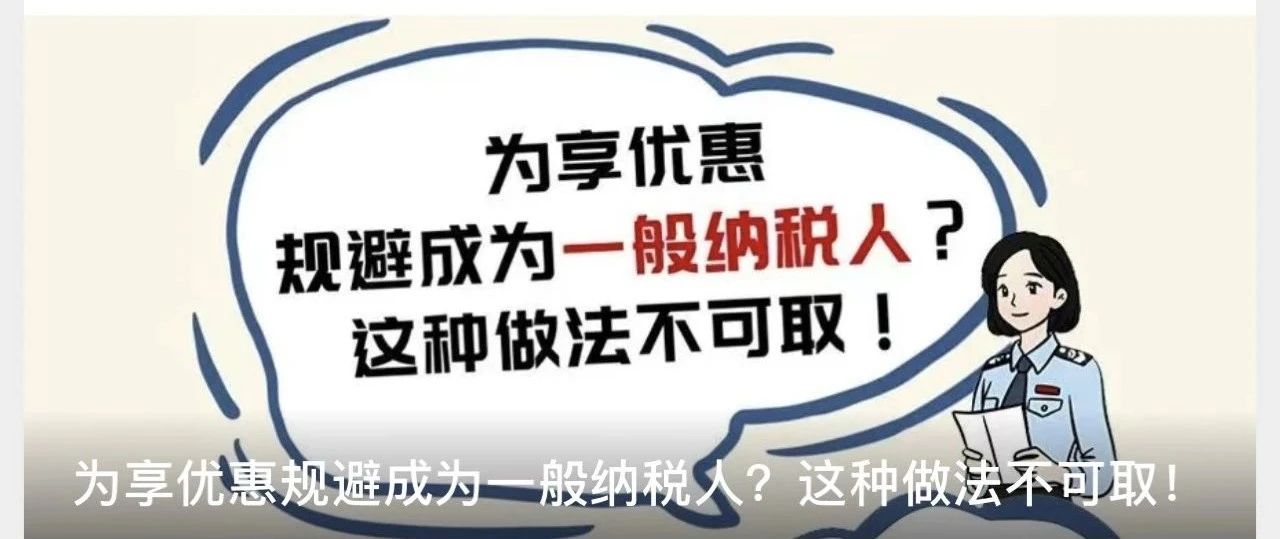
为享优惠规避成为一般纳税人?这种做法不可取!
蓝色柳林财税室· 2025-07-06 01:19
Core Viewpoint - The article discusses the implications of transitioning from small-scale taxpayer status to general taxpayer status under the VAT system, highlighting both the benefits and potential risks associated with this change [2][5]. Group 1: VAT Small-Scale Taxpayer Regulations - The standard for small-scale VAT taxpayers is set at an annual taxable sales amount of 5 million yuan or below [2]. - Small-scale taxpayers can enjoy certain tax exemptions, such as being exempt from VAT if quarterly sales do not exceed 300,000 yuan, and a reduced VAT rate of 1% instead of the standard 3% [2][3]. Group 2: Business Strategies and Risks - There are discussions about using multiple identities to register several companies to keep sales under the small-scale taxpayer threshold, thereby continuing to benefit from tax exemptions [4]. - This "splitting" strategy poses significant legal risks, as it involves misrepresenting the actual business operations and could lead to legal consequences if discovered [5][6]. Group 3: Benefits of Becoming a General Taxpayer - Upgrading to general taxpayer status can provide advantages, such as eligibility for certain project bids that require specific company qualifications [7].
“六税两费”优惠政策热点问答
蓝色柳林财税室· 2025-07-04 02:19
Group 1 - The article discusses the eligibility of companies for the "Six Taxes and Two Fees" reduction policy, indicating that small-scale VAT taxpayers and small micro-profit enterprises can enjoy this benefit even if they have already received other tax incentives [2][3]. - The order of enjoying the "Six Taxes and Two Fees" reduction is that it is an additional benefit on top of other existing incentives, with the calculation base being the taxable amount after deducting previous reductions [2][3]. - Newly established companies registered as general VAT taxpayers can apply for the "Six Taxes and Two Fees" reduction if they meet specific criteria, such as having fewer than 300 employees and total assets not exceeding 50 million [3][4]. Group 2 - Companies that are not classified as small micro-profit enterprises at the parent level cannot benefit from the "Six Taxes and Two Fees" reduction even if their branches qualify [4]. - Foreign enterprises registered as general VAT taxpayers are not eligible for the "Six Taxes and Two Fees" reduction policy [5]. - Changes in the status of small micro-profit enterprises due to corrections in corporate income tax annual reports require corresponding adjustments in the "Six Taxes and Two Fees" declarations [6]. Group 3 - When a small-scale VAT taxpayer transitions to a general taxpayer, they will no longer enjoy the "Six Taxes and Two Fees" reduction from the effective date of the change, but they can still benefit from the reduction for the tax periods prior to the transition [6]. - For taxes that are declared annually or quarterly, companies must differentiate between the periods before and after the change in taxpayer status to calculate the taxable amount accordingly [6].

“六税两费”优惠政策热点问答解答
蓝色柳林财税室· 2025-05-30 00:44
Core Viewpoint - The article discusses the "Six Taxes and Two Fees" reduction policy for small and micro enterprises, detailing eligibility criteria and application processes for various types of taxpayers [7][12][14]. Group 1: Eligibility Criteria - Newly established enterprises can apply for the "Six Taxes and Two Fees" reduction if they meet the conditions of having fewer than 300 employees and total assets not exceeding 50 million yuan [7]. - Taxpayers, including those with cross-regional tax registrations, must be assessed based on their tax registration information to determine eligibility for the reduction policy [5]. - Branch offices registered as general taxpayers must evaluate their eligibility based on the overall status of their parent company [9]. Group 2: Application Process - New enterprises that are registered as general VAT taxpayers can apply for the reduction before their first tax settlement, provided they meet the specified conditions [7]. - Enterprises that have already benefited from other tax incentives can still apply for the "Six Taxes and Two Fees" reduction, as these benefits can be combined [12]. - If a small micro enterprise or newly established enterprise submits a late or corrected tax settlement, they must adjust their "Six Taxes and Two Fees" declarations accordingly [13][16]. Group 3: Special Cases - Individual proprietorships and partnerships that qualify as small-scale VAT taxpayers can also apply for the reduction [14]. - Enterprises that have already paid the "Six Taxes and Two Fees" before their first tax settlement do not need to make corrections based on the settlement results [16]. - Taxpayers who submit their "Six Taxes and Two Fees" declarations late can still qualify for the reduction if the tax period falls within the specified range [18].