
多因子选股模型

Search documents
泓德基金【点量投资】|量化指数增强:在数据浪潮中捕捉阿尔法
Cai Jing Wang· 2025-05-15 08:37
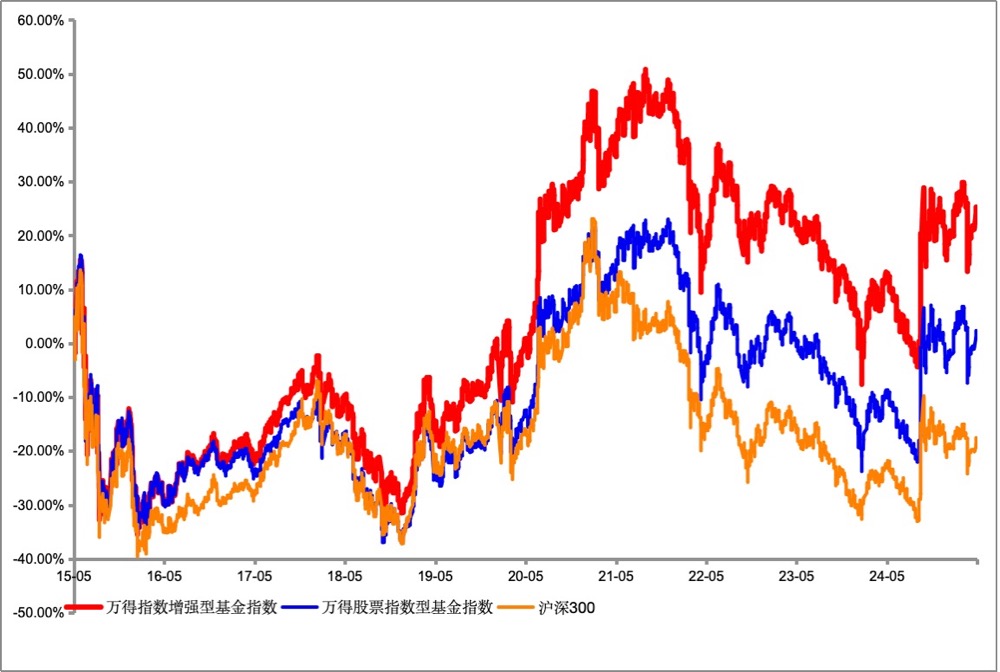
Core Viewpoint - The rapid growth of index-enhanced funds in the market is driven by the evolution of market conditions and the increasing demand from investors for more sophisticated investment tools [1] Group 1: Market Overview - As of the end of Q1 2025, there are 327 index-enhanced funds with a total scale exceeding 200 billion yuan, representing an increase of over 80% since the end of 2020 [1] - The demand for index-enhanced strategies is rising due to the maturation of investors and the deepening of capital markets [1] Group 2: Definition and Strategy - Quantitative index enhancement involves tracking benchmark indices while optimizing stock selection through quantitative models to pursue excess returns (Alpha) [2] - Index-enhanced funds combine passive tracking of indices with active management strategies, such as multi-factor models and AI stock selection, to achieve superior performance [3][4] Group 3: Performance Comparison - Over the past decade, index-enhanced funds have demonstrated significant excess returns, with the Wind index-enhanced fund index achieving a 24.88% increase, while the CSI 300 index and stock index funds saw returns of -18.05% and 2.26%, respectively [3][4] - As of May 12, 2025, the average return of CSI 300 index-enhanced funds is 25.48%, compared to 6.07% for regular CSI 300 index funds, indicating the effectiveness of the index enhancement strategy [7] Group 4: Mechanisms of Enhancement - Quantitative index enhancement typically involves two core components: modeling stock returns and optimizing the portfolio relative to the benchmark index [9] - The three main methods for achieving index enhancement include: 1. Multi-factor stock selection models that assess various factors such as value, momentum, and quality [10] 2. AI stock selection techniques that utilize machine learning and deep learning to identify patterns in historical data [11] 3. Fundamental enhancement strategies that analyze a company's financial health to optimize the investment portfolio [12] Group 5: Key Indicators for Selection - When selecting index-enhanced funds, important indicators to consider include annualized excess returns, tracking error, information ratio, maximum drawdown, and win rates [13]

穿越牛熊:行业轮动策略的反脆弱进化论
远川投资评论· 2025-04-10 05:39
当ETF赛道深陷费率战与规模焦虑时,中证A500指数却以另类姿态撕开市场——这只诞生即被贴上"新锐"标 签的宽基指数,凭借对科创属性与中小市值的倾斜性覆盖,成为近两年机构博弈"贝塔收益"的主战场。 除了密集成立的指数基金以外,截至今年4月,全市场已有26只指数增强产品参与竞逐,不同产品之间分化 剧烈:两只成立时间间隔不到一个月的A500指数增强基金,目前的超额收益差值已经接近10%。 归根结底,A500指数"市值+行业双轮筛选"的编制原则,使得成份股市值和流动性分层显著,为量化模型留 足了"翻石头"的空间。因此,在选择A500指数增强基金时,基金经理的投资能力与增强策略变得至关重 要。 华安基金量化投资部助理总监、基金经理张序的突围密码,藏在八年磨一剑的"行业轮动+多因子"双擎模型 里。通过对行业轮动的深度理解和持续迭代,其管理的华安事件驱动量化基金自2020年执掌以来,连续五 年跑赢偏股混基指数,年化超额收益达9.3%,无论在公募量化还是主动股基均排名前1%。 而当市场还在争论主动量化与被动投资的边界时,华安基金已悄然完成中证A500产品线的战术合围。继 2024年精准卡位A500ETF之后,再次推出了由张 ...