
智能手机出货量

Search documents
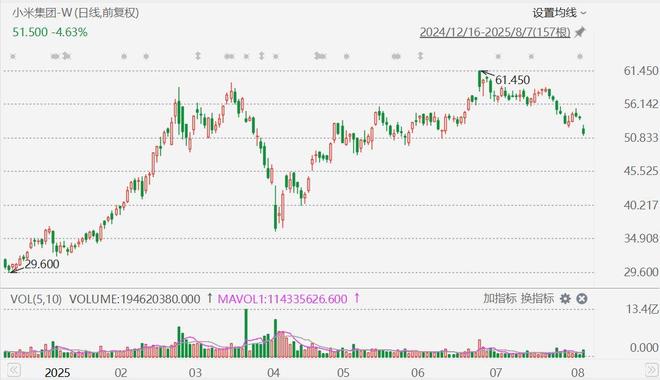
小米大跌!创近两个月新低
Shen Zhen Shang Bao· 2025-08-07 08:04
Core Viewpoint - Xiaomi Group's stock price has recently declined, reaching a two-month low, primarily due to downward revisions in smartphone shipment forecasts, particularly in the Indian market [1][2] Group 1: Smartphone Market Performance - Xiaomi's smartphone shipment volume for Q2 2025 is expected to be slightly lower than previous forecasts, with a 25% year-on-year decline in the Indian market impacting overall performance [1] - The global smartphone market experienced a 1% decline in shipments compared to the same period last year, marking the first drop in six consecutive quarters [1] - Despite a stable performance, Xiaomi achieved a historical high of 15% market share globally in Q2 2025, although this was accompanied by a decrease in gross margin [1] Group 2: Financial Projections - Total revenue for Xiaomi in Q2 2025 is projected to be 112.6 billion RMB, slightly below market expectations, while adjusted net profit is forecasted at 10.2 billion RMB, aligning with market expectations [1] - Forecasts for IoT revenue in the second half of 2025 have been revised downward due to changes in national subsidy policies [1] Group 3: Electric Vehicle Business - Xiaomi's electric vehicle deliveries are expected to reach 82,000 units in Q2 2025, benefiting from the delivery of the SU7 Ultra, with an average selling price of 242,000 RMB and an improved gross margin of 25% [1] - The company has initiated deliveries of the YU7 in July, with the second-phase factory expected to commence production by the end of September [1] Group 4: Analyst Ratings and Price Targets - Due to downward revisions in smartphone gross margin forecasts, analysts have lowered Xiaomi's earnings per share estimates for 2025 to 2027 by 2% to 7%, and reduced the target price from 78 HKD to 72 HKD [2] - Nomura has raised Xiaomi's target price by 79% to 61 HKD based on SOTP valuation but downgraded the rating from "Buy" to "Neutral" due to limited upside potential [2] - Analysts expect Xiaomi to face challenges in the coming quarters, including lower-than-expected smartphone shipments and high market expectations for its electric vehicle business [2]
港股异动丨小米一度跌超5%,大和预计Q2智能手机出货量或低于预期
Ge Long Hui· 2025-08-07 03:37
Core Viewpoint - Xiaomi Group's stock price fell over 5% to HKD 51.2, marking a new low since June 13, 2023, ahead of its Q2 2025 earnings announcement on August 19, 2023 [1] Group 1: Earnings Forecast - Daiwa forecasts Xiaomi's Q2 2025 smartphone shipments to be slightly below previous estimates, primarily due to a 25% year-on-year decline in the Indian market [1] - Despite achieving a historical high global market share of 15% in Q2 2025, this was at the cost of declining gross margins [1] - Total revenue for Q2 2025 is projected at RMB 112.6 billion, slightly below market expectations, while adjusted net profit is expected to be RMB 10.2 billion, in line with market expectations [1] Group 2: Adjustments and Ratings - Daiwa has revised down its IoT revenue forecast for the second half of 2025, reflecting changes in national subsidy policies [1] - Due to the downward revision of smartphone gross margin forecasts, Daiwa has lowered Xiaomi's earnings per share estimates for 2025-2027 by 2%-7% [1] - The target price has been adjusted from HKD 78 to HKD 72, based on an average P/E ratio of 36 times for 2025-2026, down from 38 times, while maintaining a "Buy" rating [1] Group 3: Risks - Key risks include macroeconomic headwinds and slower-than-expected ramp-up in electric vehicle production capacity [1]

机构:二季度美国智能手机市场出货量同比增长1%
Di Yi Cai Jing· 2025-07-29 08:57
Core Insights - The research by Canalys indicates a 1% year-on-year growth in smartphone shipments in the U.S. for Q2 2025, driven by manufacturers preemptively stocking up due to tariff concerns [1] Group 1: Market Trends - The share of smartphones assembled in China for the U.S. market has significantly decreased from 61% in Q2 2024 to 25% in Q2 2025 [1] - The majority of the lost market share has been taken over by India, with "Made in India" smartphones experiencing a remarkable year-on-year shipment increase of 240%, now accounting for 44% of total U.S. smartphone imports, up from just 13% in Q2 2024 [1]
机构:二季度美国智能手机出货量同比增长1%,三星出货量同比大增38%
news flash· 2025-07-29 08:38
Core Insights - Canalys' latest research indicates that U.S. smartphone shipments are expected to grow by 1% year-on-year in Q2 2025, as manufacturers continue to stock up amid tariff concerns [1] Company Performance - iPhone shipments declined by 11% year-on-year, falling to 13.3 million units, showing a significant pullback [1] - Samsung experienced a substantial year-on-year increase of 38%, with shipments reaching 8.3 million units [1] - Motorola continued its steady expansion in the U.S. market, achieving a 2% year-on-year growth, with shipments totaling 3.2 million units [1]

Counterpoint Research:2025年Q2中国智能手机出货量同比下降2%
智通财经网· 2025-07-24 01:23
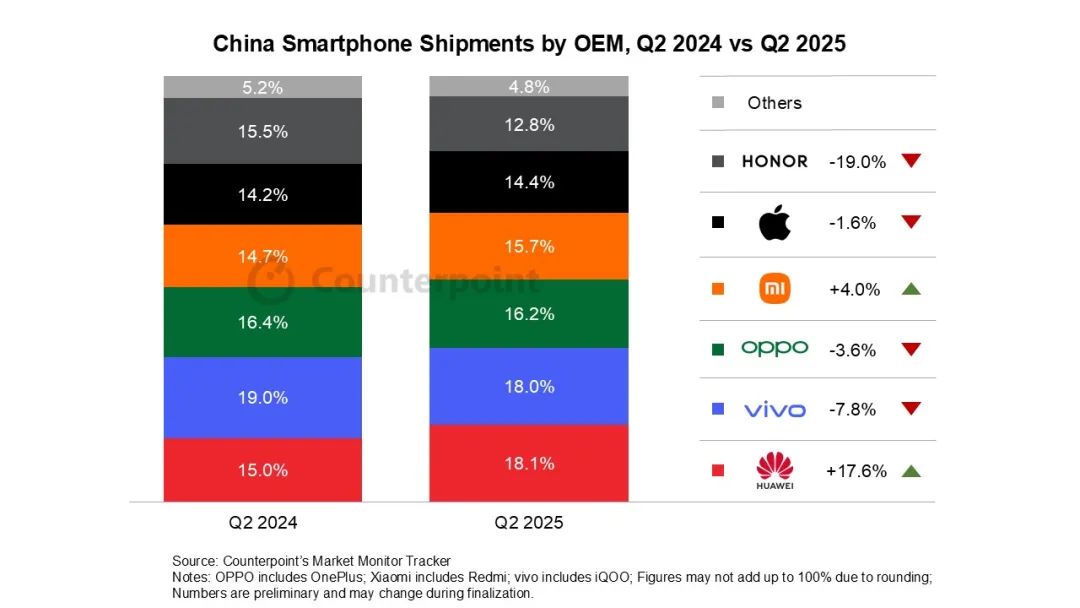
Core Insights - In Q2 2025, China's smartphone shipments declined by 2.4% year-on-year, attributed to seasonal factors and demand front-loading due to subsidies [1] - Huawei maintained its leading position for the second consecutive quarter, increasing its market share from 15% to 18.1% year-on-year, driven by strong sales of the mid-range nova 14 series and significant price reductions on high-end models [1] - Vivo ranked second in shipments, supported by its strong offline channel network and the successful performance of its Y series in lower-tier cities, along with a surge in demand for the newly launched S30 series during back-to-school promotions [4] - OPPO successfully launched the Reno 14 series before the 618 shopping festival, continuing the strong sales momentum of the Reno 13 series, while its sub-brand OnePlus achieved notable growth by focusing on the gaming experience [4] - Xiaomi recorded the second-fastest growth rate in Q2 2025 with a market share of 15.7%, maintaining growth through price reductions on popular models like Redmi K80 and Xiaomi 15, despite not launching new mid-range products during promotions [5] - Apple performed strongly during the 618 shopping festival due to unprecedented price cuts on the iPhone 16 series, particularly the Pro models, although this may pressure sales of the iPhone 17 base model in the second half of the year [5] - Honor is responding to intense market competition by expanding its product lineup, with the mid-range HONOR 400 series launched at the end of May showing promising initial results [5] Industry Outlook - The demand for smartphones in China remains weak, aligning with previous expectations from Counterpoint, although promotions and subsidies have provided some support for stable sales [6] - Counterpoint anticipates a year-on-year growth in the Chinese market for 2025, albeit at a slower pace, with summer promotions and the early release of flagship products in Q3 expected to boost sales and lay a solid foundation for Q4 performance [6] - The industry will continue to monitor the evolving global market landscape, particularly regarding tariff policies, rising component costs, and changes in consumer demand [6]

IDC:初步数据显示二季度中国智能手机出货量6900万部,华为以18.1%市场份额居首
news flash· 2025-07-16 05:15
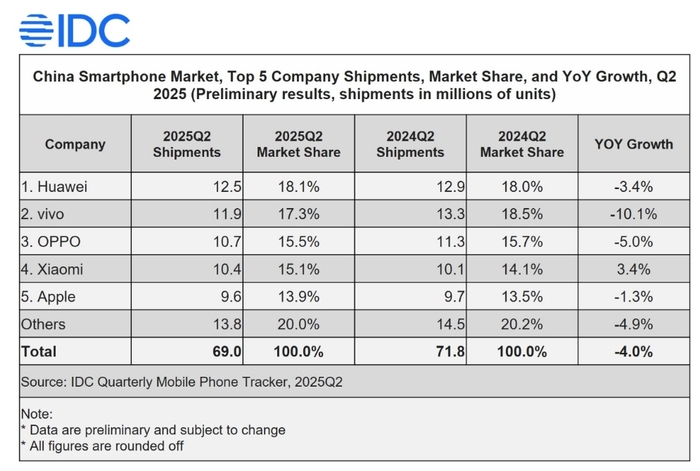
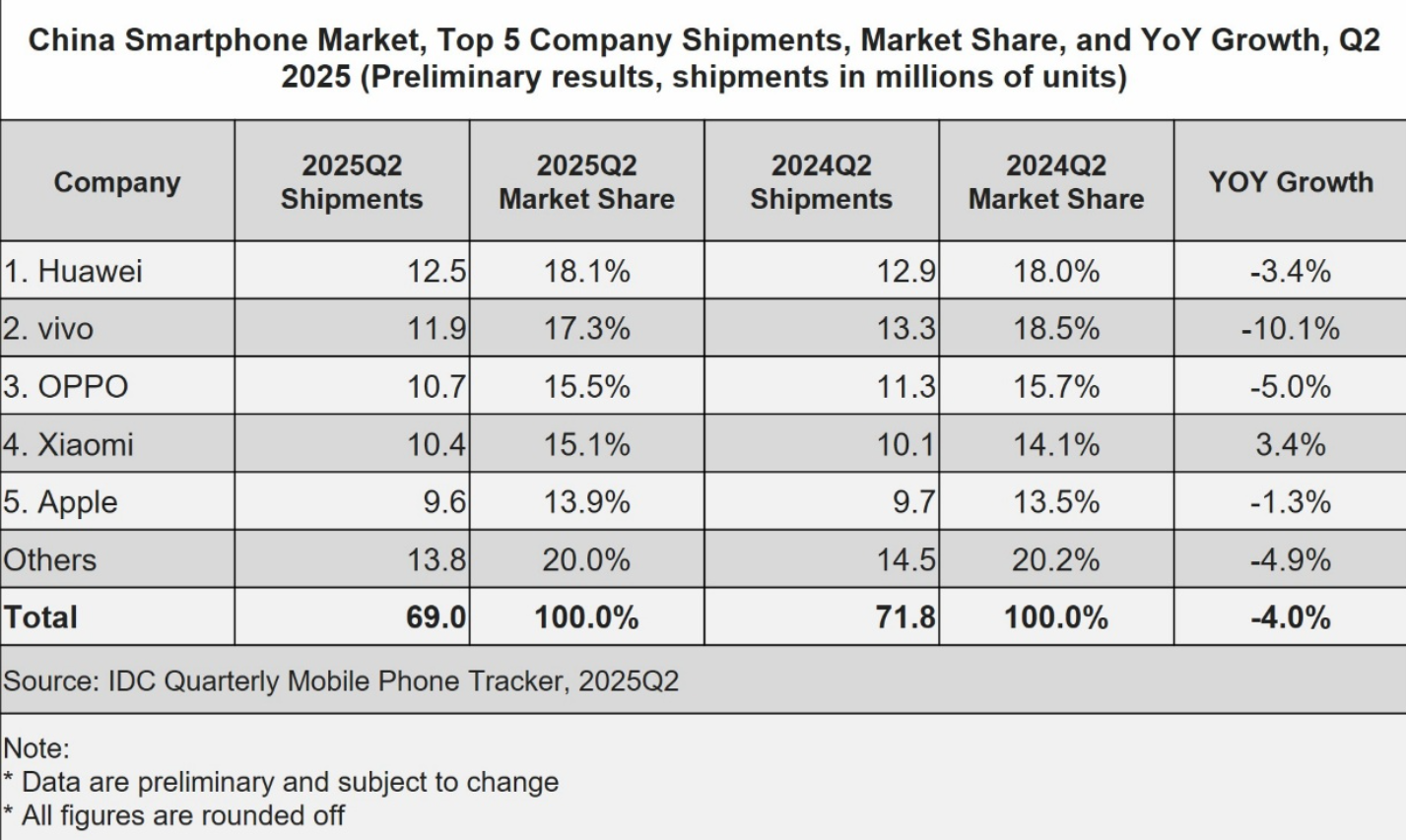
Core Insights - The Chinese smartphone market is experiencing a decline, with Q2 2025 shipments at 69 million units, a year-over-year decrease of 4.0% [1][2] - Huawei regained the top position in the market with a shipment of 12.5 million units, capturing an 18.1% market share [1][2] - Other major players include vivo, OPPO, Xiaomi, and Apple, with respective shipments of 11.9 million, 10.7 million, 10.4 million, and 9.6 million units [1][2] Market Performance - The total smartphone shipments in China for Q2 2025 were 69 million units, down from 71.8 million units in Q2 2024, reflecting a 4.0% decline [2] - The market share distribution for Q2 2025 shows Huawei leading with 18.1%, followed by vivo at 17.3%, OPPO at 15.5%, Xiaomi at 15.1%, and Apple at 13.9% [2] - Year-over-year growth rates for major companies indicate a decline for Huawei (-3.4%), vivo (-10.1%), OPPO (-5.0%), and Apple (-1.3%), while Xiaomi experienced a growth of 3.4% [2] Year-to-Date Performance - In the first five months of 2025, smartphone shipments totaled 109 million units, a decrease of 4.9% compared to the same period in 2024 [1] - The domestic market's performance in May 2025 showed shipments of 22.5 million units, marking a significant year-over-year decline of 21.2% [1]
IDC:中国第二季度智能手机出货量同比下降4.0%
news flash· 2025-07-15 10:10
Core Insights - The smartphone market in Q2 2025 shows a shift in market share among leading companies, with Huawei leading at 18.1% [1] - Total shipments in Q2 2025 decreased to 69 million units from 71.8 million units in Q2 2024, indicating a decline in overall market activity [1] Company Summaries - **Huawei**: Achieved 12.5 million shipments in Q2 2025, maintaining a market share of 18.1%, slightly up from 18.0% in Q2 2024 [1] - **vivo**: Reported 11.9 million shipments, with a market share of 17.3%, down from 18.5% in the previous year [1] - **OPPO**: Recorded 10.7 million shipments and a market share of 15.5%, a decrease from 15.7% in Q2 2024 [1] - **Xiaomi**: Had 10.4 million shipments, holding a market share of 15.1%, up from 14.19% in the previous year [1] - **Apple**: Achieved 9.6 million shipments with a market share of 13.9%, slightly increasing from 13.5% in Q2 2024 [1] - **Others**: Combined shipments of 13.8 million, representing 20.0% market share, down from 20.2% in the previous year [1]
2025年第二季度,全球智能手机出货量下降1%,TOP5厂商份额揭晓
Canalys· 2025-07-15 05:57
Core Insights - The global smartphone market is projected to decline by 1% year-on-year in Q2 2025, marking the first drop in six consecutive quarters, reflecting cautious consumer sentiment and macroeconomic uncertainties [1][2][4] - Samsung maintained its market leadership with a 19% share, followed by Apple at 16% and Xiaomi at 15%, while Transsion and OPPO each held 9% [1][5] Market Performance - Despite a slight decrease in shipments, major manufacturers demonstrated stability and resilience amid a slowing market due to the waning replacement demand from the pandemic and ongoing weak consumer demand [2][4] - The U.S. market is an exception, where manufacturers like Apple, Samsung, and Motorola maintained high inventory levels in response to geopolitical and regulatory uncertainties [2] Consumer Behavior - Many consumers who delayed upgrades in early 2025 are expected to make purchases during year-end shopping festivals and promotional events, with effective pricing strategies and promotions being crucial for success [4] - Price-sensitive consumers remain the primary drivers of upgrade demand, preferring to replace old devices at reasonable prices [4] Market Share Data - The preliminary market share data for Q2 2025 shows: - Samsung: 19% - Apple: 16% - Xiaomi: 15% - Transsion: 9% - OPPO: 9% - Others: 33% [5] Industry Outlook - The smartphone industry is anticipated to stabilize in 2025, with manufacturers prepared to address the expected flat market, leveraging new product launches that emphasize design, ecosystem innovation, and privacy features [4][6]


韩媒:苹果iPhone 17e沿用京东方OLED面板
WitsView睿智显示· 2025-07-08 09:36
Core Viewpoint - Apple plans to release the iPhone 17e in spring next year, aiming to maintain annual iPhone shipments between 220 million and 230 million units [1][3]. Group 1: iPhone 17e and OLED Display - The iPhone 17e will continue to use the 6.1-inch OLED display from the iPhone 16e, which itself reused the display from the iPhone 14 [3]. - BOE, Samsung Display, and LG Display are involved in the OLED screen development for the iPhone 17e, with BOE having the highest shipment share for the iPhone 16e's OLED screen [1][3]. Group 2: iPhone SE Series and Market Strategy - The iPhone SE series has historically reused components from previous models while incorporating the latest application processors to compete in the market [3]. - The first-year shipment of the iPhone SE series was approximately 20 million units, and the iPhone 16e series is expected to have similar shipment figures this year [3]. Group 3: Market Dynamics and Future Releases - Apple increased its annual iPhone shipments to 230 million units during the home office period in 2020, while Samsung's Galaxy smartphone shipments fell to the same level [3]. - Analysts predict that Apple will continue to release iPhone E series models annually after the iPhone 17e, reflecting a consistent market strategy [4].
Canalys:Q1欧洲智能手机出货量同比下降2%
news flash· 2025-05-28 03:45
Core Insights - In Q1 2025, smartphone shipments in Europe decreased by 2% year-on-year, totaling 32.4 million units, primarily due to weak demand for entry-level devices [1] - Demand for high-end models remains strong, driven by Apple and Samsung, with devices priced above €800 accounting for a record 32% of shipments in the first quarter [1]