清洁供热

Search documents
京能热力(002893) - 2025年7月30日投资者关系活动记录表
2025-07-30 09:46
Group 1: Financial Performance - The net profit for the first quarter of 2025 increased significantly compared to the previous year, attributed to the seasonal nature of the heating supply business, with major revenues concentrated in the first and fourth quarters [1] - The total operating costs and financial expenses for 2024 decreased significantly due to improved financing management and optimized capital structure [4] Group 2: Industry Challenges and Strategic Responses - The heating industry is undergoing rapid innovation, with significant market potential and increasing market competition, necessitating a shift towards intelligent and green heating solutions [2] - Energy conservation and emission reduction remain critical directions for the heating industry, with a focus on technology research and application promotion [2] - The transition to clean heating is becoming a guiding principle, emphasizing the integration of new energy sources with traditional energy [2] - Digitalization is emerging as a core competitive advantage, with data accumulation and algorithm iteration capabilities being crucial for long-term success [2] - Technological innovation is essential for industry development, with a focus on renewable energy and sustainable practices to meet growing energy demands [2] Group 3: Cooling Technology and Services - The company provides comprehensive energy services, including heating and cooling, utilizing various energy coupling methods to enhance efficiency and environmental benefits [3][4] - The cooling projects utilize ground-source heat pumps and other new energy sources, offering higher cooling efficiency compared to traditional central air conditioning [4] - Pricing for cooling services is determined through a market adjustment mechanism based on negotiations between supply and demand [4]

【行业深度】洞察2025:中国城市供热行业竞争格局(附竞争梯队、市场集中度等)
Qian Zhan Wang· 2025-06-15 07:29
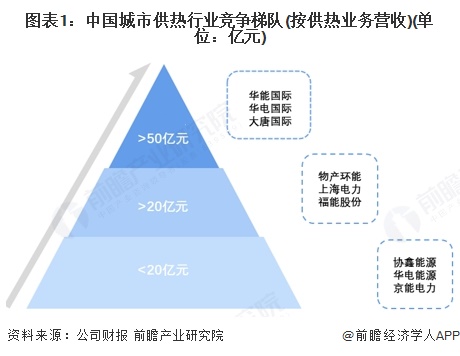
Group 1 - The core viewpoint of the article highlights the competitive landscape of China's urban heating industry, categorizing companies into three tiers based on their revenue from heating services [1][4]. - The first tier includes companies like Huaneng International, Huadian International, and Datang Power, each with heating revenue exceeding 5 billion yuan [1]. - The second tier consists of companies such as Wuchan Zhongda and Shanghai Electric, with heating revenue between 2 billion and 5 billion yuan [1]. - The third tier includes companies like GCL-Poly Energy and Jingneng Power, with heating revenue below 2 billion yuan [1]. Group 2 - The entry process of urban heating companies in China has evolved, with early entrants like GCL-Poly Energy and Ningbo Energy establishing a strong market presence due to their early market entry and capital support [3]. - Mid-tier companies like Lianmei Co. have significant capital backing, enhancing their competitive edge in the urban heating sector [3]. - Late entrants such as Ruina Intelligent and Chuncheng Heating have improved their financing capabilities, focusing on smart heating solutions [3]. Group 3 - The market concentration of the urban heating industry in China is currently low, with CR3 at 6.54%, CR5 at 7.34%, and CR10 at 9.49%, indicating a fragmented market [4]. - The industry is expected to see further consolidation as resources are integrated among providers capable of delivering comprehensive energy-saving solutions [4]. Group 4 - Companies like Jingneng Power and Ruina Intelligent are fully focused on urban heating, with Jingneng Power operating entirely in North China [5][8]. - Shanghai Electric's heating business is primarily concentrated in Shanghai, while Huitian Thermal Power serves the Liaoning province exclusively [5][8]. - Most companies operate in the Northeast and North China regions, indicating a strong regional focus in their service areas [8]. Group 5 - The competitive state of the urban heating industry in China is influenced by national policies and rising demand, presenting opportunities for new entrants [13]. - Significant fixed asset investments and technological advancements are required for companies in this sector, creating high barriers to exit [13]. - Established players in the renewable and traditional thermal power sectors possess advantages in operational and profit models, while smaller firms face intense competition in the low-end market [13].