
离岸金融体系

Search documents
构建“六位一体”离岸金融体系
Guo Ji Jin Rong Bao· 2025-10-13 10:11
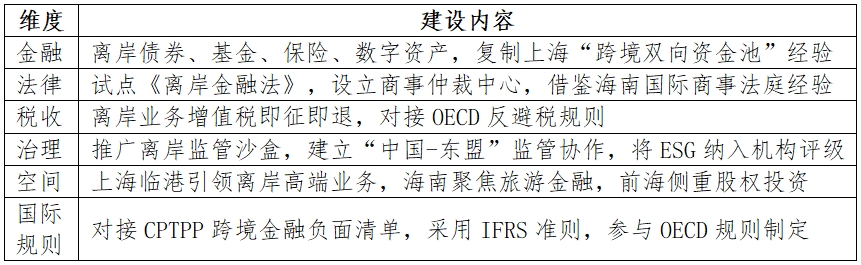
Core Viewpoint - The article emphasizes the strategic direction for the development of China's offshore financial system, aligning it with the Shanghai International Financial Center, highlighting its role in enhancing national financial competitiveness and supporting the internationalization of the Renminbi [1][22]. Summary by Relevant Sections Offshore Financial System - The offshore financial system is not merely a combination of "overseas accounts + foreign currency business," but a comprehensive institutional ecosystem that integrates five dimensions: financial, institutional, governance, spatial, and strategic [3][6]. Financial Dimension - This includes offshore accounts such as OSA (Offshore Accounts), FT (Free Trade Accounts), and NRA (Non-Resident Accounts), as well as offshore bonds, funds, banks, and insurance services [3]. Institutional Dimension - It encompasses applicable laws, judicial arbitration, regulatory rules, tax policies, and compliance standards [4]. Governance Dimension - This involves cross-border regulatory cooperation, data governance, anti-money laundering, anti-tax avoidance, and ESG (Environmental, Social, and Governance) standards [5]. Spatial Dimension - It relies on offshore financial functional zones, international financial centers, and cross-border cooperation platforms [6]. Strategic Dimension - The system aims to serve the internationalization of the Renminbi and the Belt and Road Initiative, aligning with high-standard rules such as CPTPP and DEPA, and requires pilot verification through free trade experimental zones [6]. Core Functions of the Offshore Financial System - The system's core functions are reflected in three aspects: establishing institutional pricing power for Renminbi-denominated assets, optimizing global capital efficiency, and transforming domestic regulatory experiences into international rules [7][8]. Challenges in the Current System - The current offshore financial system faces challenges such as institutional supply lagging behind strategic demand, fragmentation of regulations, and a lack of a unified legal framework [9][10][11]. Proposed Institutional Framework - A proposed "1+N+X" framework includes the establishment of an Offshore Financial Law, specialized business regulations, and local differentiated pilot programs to enhance the system's effectiveness [13][14]. Legal and Taxation Improvements - Recommendations include creating an "offshore legal applicability zone," upgrading the account system to integrate both domestic and foreign currency functions, and optimizing the tax system to attract more offshore entities [14][17]. Integrated Innovation - The article advocates for a "six-in-one" integrated innovation approach that combines finance, law, taxation, governance, spatial planning, and international rules to create a robust offshore financial ecosystem [15][18]. Future Direction - The construction of a Chinese offshore financial system should focus on institutional confidence, avoiding the mere replication of models from Hong Kong and Macau, and instead, aim to be a rule-setting entity in the global financial landscape [20][21].

高规格划定时间表路线图,上海国际金融中心建设能级跃升
Di Yi Cai Jing· 2025-06-23 13:12
Core Viewpoint - The central government has issued a significant document outlining a strategic plan to establish Shanghai as an international financial center within five to ten years, emphasizing the need for a modern financial system and enhanced global influence [2][3]. Strategic Goals - The document sets six strategic goals for the development of the Shanghai International Financial Center, aiming for a comprehensive enhancement of its capabilities and functions, including becoming a global hub for RMB asset allocation and risk management [3][4]. - The plan indicates a shift in leadership, with the Central Financial Office and Shanghai municipal government jointly overseeing the initiative, highlighting the importance of high-level attention and coordination [3][4]. Key Tasks - The document outlines six core tasks aimed at deepening financial market construction, enhancing financial institutions, improving financial infrastructure, expanding high-level financial openness, increasing service quality for the real economy, and ensuring financial security under open conditions [5]. - Specific focus areas include creating a high-quality development demonstration zone for listed companies and enhancing the international pricing influence of Shanghai's financial markets [6]. Offshore Financial System - The establishment of an offshore financial system is highlighted as a breakthrough strategy, aiming to connect domestic and international markets and support Chinese enterprises in global expansion [9][10]. - The offshore financial system will primarily operate in RMB and include various financial services such as offshore banking, bond issuance, and insurance, with a focus on creating a more flexible policy environment to attract foreign investment [10][11]. Financial Technology and Regulation - The document emphasizes the importance of financial technology innovation and regulatory collaboration, advocating for advancements in digital currency and blockchain applications while ensuring a prudent regulatory framework [8].