美国两党分歧

Search documents
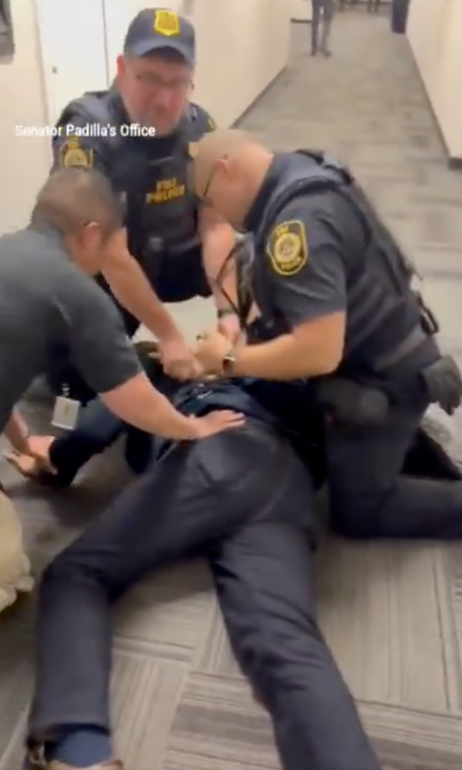
民主党强烈质疑,共和党全力辩解,美参议员被暴力驱赶引两党骂战
Huan Qiu Shi Bao· 2025-06-13 23:06
Core Points - The incident involving Senator Alex Padilla being forcibly removed from a press conference has sparked a heated debate between the Democratic and Republican parties [1][7][8] - The press conference, led by Homeland Security Secretary Kirstjen Nielsen, focused on immigration enforcement actions in California, particularly in response to protests related to illegal immigration [4][6] - Padilla's attempt to question Nielsen about the government's "increasingly extreme" immigration actions was met with force, leading to his being handcuffed despite identifying himself as a senator [6][8] Group 1 - The press conference lasted approximately six minutes, during which Nielsen discussed the deployment of National Guard and Marine Corps personnel to address protests in Los Angeles [4] - Padilla entered the conference stating his identity and intention to ask a question, but was ignored by Nielsen, leading to his removal by law enforcement [4][6] - Following the incident, Padilla expressed concern over the treatment of a senator and implied that such actions could reflect how the government treats ordinary citizens [6][7] Group 2 - California Governor Gavin Newsom and other Democratic leaders condemned the actions taken against Padilla, highlighting the severity of the situation [7] - The Department of Homeland Security defended the actions of law enforcement, claiming Padilla did not identify himself properly and was perceived as a threat [8] - The incident reflects broader partisan divisions regarding immigration policy and the use of military force in domestic protests, with a recent poll indicating a split in public opinion on these issues [9]

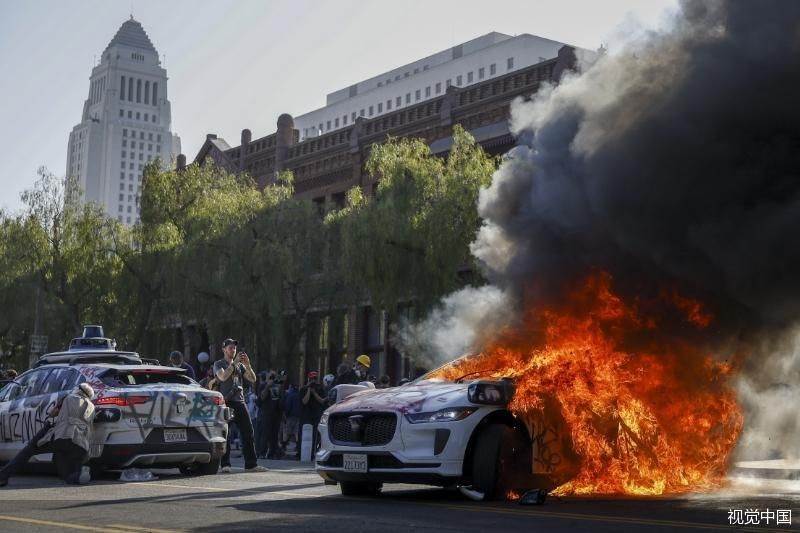
失控的洛杉矶:非法移民围捕战升级
Bei Jing Shang Bao· 2025-06-09 14:27
Core Viewpoint - The ongoing conflict in Los Angeles regarding illegal immigration enforcement is escalating, with significant protests against federal actions, highlighting deep societal divisions in the U.S. [2][3][8] Group 1: Conflict Escalation - Federal agencies, including ICE, have intensified raids on illegal immigrants, leading to public unrest and confrontations with local communities [3][4] - On June 6, federal agents conducted raids in at least seven locations in Los Angeles, resulting in 44 arrests, which sparked protests from local residents [3][4] - The deployment of 300 National Guard personnel by the military to Los Angeles aimed to control the protests, but the number of demonstrators grew from dozens to over 200 [3][4] Group 2: Political Responses - California Governor Gavin Newsom and Los Angeles Mayor Karen Bass have called for peaceful protests, while President Trump criticized them for their inability to manage the situation [4][5] - Trump signed a memorandum to deploy 2,000 National Guard troops to Los Angeles without a request from the state governor, marking a significant shift in federal-state relations [4][5] - Legal experts noted that this is the first time since 1965 that a president has mobilized state National Guard without a governor's request [4] Group 3: Historical Context - The conflict in Los Angeles is seen as a culmination of ongoing tensions between California, a Democratic stronghold, and the federal government under Trump, which has historically opposed immigration [5][6] - California's long-standing tradition of supporting immigration contrasts sharply with the Trump administration's policies, leading to increased friction on various issues [5][6] Group 4: Societal Implications - The protests reflect a broader societal divide in the U.S., particularly regarding immigration policies, with significant implications for social cohesion [7][8] - The presence of Mexican flags among protesters indicates a strong cultural and political response to federal actions, emphasizing the need for comprehensive immigration reform [7][8] - Experts argue that Trump's aggressive immigration enforcement strategies are unlikely to change immigration trends and may exacerbate societal divisions [8]