AI选股

Search documents
四类荐股“套路”曝光!深圳证监局揭露非法证券期货活动“骗局”
2 1 Shi Ji Jing Ji Bao Dao· 2025-06-05 01:15
Core Viewpoint - The article highlights the rise of illegal securities and futures activities in China, particularly through social media and private groups, which mislead investors and disrupt market order [2][9]. Group 1: Types of Illegal Stock Recommendations - The Shenzhen Securities Regulatory Bureau has identified four main types of illegal stock recommendation schemes that are increasingly deceptive and intertwined with fraud [3]. Scheme 1: High-Priced Product Purchase for Stock Recommendations - Fraudsters create a persona of investment experts through social media, luring victims to purchase high-priced products like wine or tea to gain access to VIP groups where stock tips are shared, often leading to significant losses [4]. Scheme 2: Illegal Stock Recommendations Under the Guise of Education - Unsanctioned entities offer high-priced courses under the pretext of financial education, later promoting stock recommendations within social media groups, resulting in substantial financial losses for participants [5]. Scheme 3: Fraudulent Use of Big Data and AI for Stock Selection - Scammers promote fake stock selection tools claiming to use big data and AI, enticing investors to follow their recommendations, which often leads to severe financial losses [6]. Scheme 4: Impersonation of Licensed Institutions - Fraudsters use forged credentials to impersonate licensed financial institutions, gaining victims' trust and charging fees for stock recommendations, ultimately leading to financial scams [7][8]. Group 2: Regulatory Response - The China Securities Regulatory Commission (CSRC) has been actively conducting special operations to combat illegal stock recommendations and related activities, aiming to protect investors' rights [9]. - The CSRC emphasizes a combined approach of prevention and punishment, enhancing monitoring of illegal stock recommendation information online, and promoting public awareness to curb the spread of such activities [9].
泓德基金【点量投资】|量化指数增强:在数据浪潮中捕捉阿尔法
Cai Jing Wang· 2025-05-15 08:37
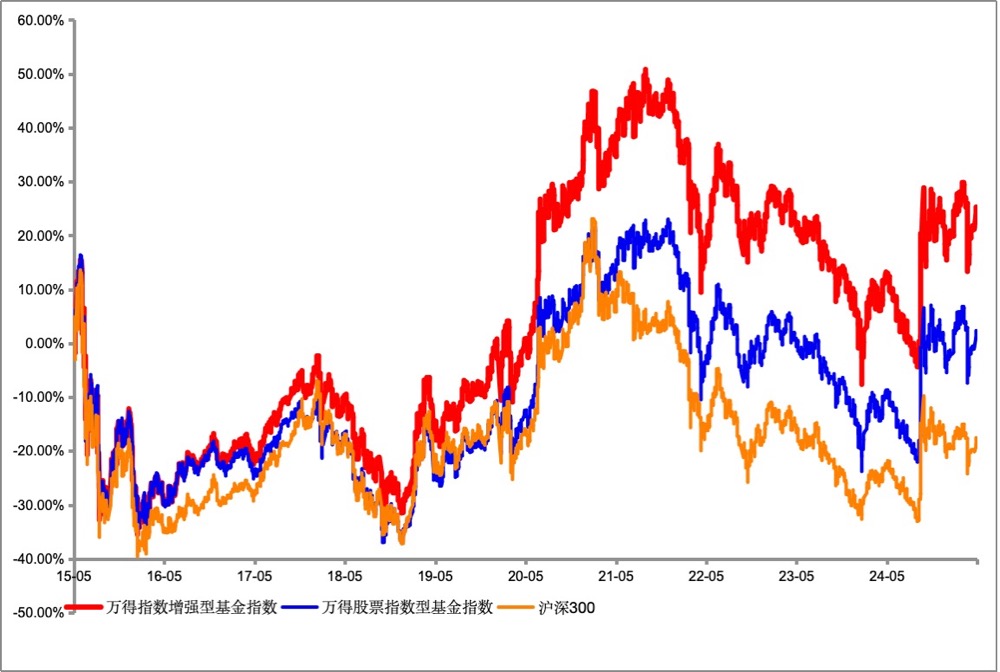
Core Viewpoint - The rapid growth of index-enhanced funds in the market is driven by the evolution of market conditions and the increasing demand from investors for more sophisticated investment tools [1] Group 1: Market Overview - As of the end of Q1 2025, there are 327 index-enhanced funds with a total scale exceeding 200 billion yuan, representing an increase of over 80% since the end of 2020 [1] - The demand for index-enhanced strategies is rising due to the maturation of investors and the deepening of capital markets [1] Group 2: Definition and Strategy - Quantitative index enhancement involves tracking benchmark indices while optimizing stock selection through quantitative models to pursue excess returns (Alpha) [2] - Index-enhanced funds combine passive tracking of indices with active management strategies, such as multi-factor models and AI stock selection, to achieve superior performance [3][4] Group 3: Performance Comparison - Over the past decade, index-enhanced funds have demonstrated significant excess returns, with the Wind index-enhanced fund index achieving a 24.88% increase, while the CSI 300 index and stock index funds saw returns of -18.05% and 2.26%, respectively [3][4] - As of May 12, 2025, the average return of CSI 300 index-enhanced funds is 25.48%, compared to 6.07% for regular CSI 300 index funds, indicating the effectiveness of the index enhancement strategy [7] Group 4: Mechanisms of Enhancement - Quantitative index enhancement typically involves two core components: modeling stock returns and optimizing the portfolio relative to the benchmark index [9] - The three main methods for achieving index enhancement include: 1. Multi-factor stock selection models that assess various factors such as value, momentum, and quality [10] 2. AI stock selection techniques that utilize machine learning and deep learning to identify patterns in historical data [11] 3. Fundamental enhancement strategies that analyze a company's financial health to optimize the investment portfolio [12] Group 5: Key Indicators for Selection - When selecting index-enhanced funds, important indicators to consider include annualized excess returns, tracking error, information ratio, maximum drawdown, and win rates [13]

洪灏时隔三年重回卖方:将于4月履新华福国际,担任行政总裁
Peng Pai Xin Wen· 2025-03-25 14:18
Group 1 - Hong Hao will return to the sell-side as the CEO of Huafu International starting in April [1] - Hong Hao has extensive experience in the financial industry, having worked at various international financial institutions including Citigroup and Morgan Stanley [3] - Huafu International is a wholly-owned subsidiary of Huafu Securities, which was established in 1988 and has a registered capital of 4.491 billion yuan [4][5] Group 2 - Huafu Securities has seen a decline in revenue and net profit over the past two years, with 2022 total revenue at 3.476 billion yuan, down 34.32% year-on-year, and net profit at 1.102 billion yuan, down 42.58% [6][7] - In 2023, Huafu Securities continued to face challenges, reporting total revenue of 2.221 billion yuan, a decrease of 36.09%, and net profit of 436 million yuan, down 60.42% [6][7] - However, in the first three quarters of 2024, Huafu Securities showed signs of recovery, with total revenue of 2.194 billion yuan, an increase of 37.70%, and net profit of 427 million yuan, up 85.19% year-on-year [6][7]