Credit Cycle

Search documents
Golub Capital(GBDC) - 2025 Q4 - Earnings Call Transcript
2025-11-19 16:00
Financial Data and Key Metrics Changes - For Q4 2025, adjusted net investment income (NII) per share was $0.39, with an adjusted NII return on equity (ROE) of 10.4% [4] - Adjusted net income per share was $0.36, resulting in an adjusted ROE of 9.6% [4] - Cumulative distributions for fiscal year 2025 totaled $1.65 per share, representing 10.9% of end-of-year net asset value per share [4] - The net asset value (NAV) per share at the end of fiscal year 2025 was $14.97, which is 34 cents above the IPO NAV in 2010 [5] Business Line Data and Key Metrics Changes - Approximately 90% of GBDC's investment portfolio remains in the highest-performing internal rating categories [11] - The investment income yield was 10.4%, a sequential decline of 20 basis points [12] - The weighted average rate on new investments was 8.9%, a decline of 30 basis points from the prior quarter [18] - The investment portfolio decreased to just under $8.8 billion at fair value, with $371 million in repayments and exits [13] Market Data and Key Metrics Changes - The private credit direct lending market is facing headwinds, including narrowed spreads and a credit cycle with elevated defaults [6][26] - The default rate in the broadly syndicated market is currently about two and a half times historical average levels [26] - GBDC's effective borrowing costs decreased to 5.6% annualized, which is considered industry-leading [13] Company Strategy and Development Direction - GBDC's investment strategy focuses on providing first-lien senior-secured loans to middle-market companies backed by strong private equity sponsors [3] - The company aims to maintain a stable NAV per share, minimize excise taxes, and adjust its base distribution level infrequently [9] - GBDC plans to revisit its dividend policy early next year based on the outlook for rates and asset spreads [8] Management's Comments on Operating Environment and Future Outlook - The U.S. economy shows resilience, but there are signs of weakness, particularly among lower-end consumers [25] - Elevated credit stress is expected to persist, impacting different BDCs in varying ways [26] - The company believes that the current environment may allow private credit specialists to outperform [10] Other Important Information - GBDC's liquidity position remains strong, ending the quarter with approximately $1.2 billion in liquidity [24] - The company repurchased 368,000 shares during the quarter, totaling 2.9 million shares for the fiscal year [16] Q&A Session Summary Question: Availability of co-invest - GBDC has not seen any meaningful change in the availability or quality of equity co-invest opportunities over the past years [31][32] Question: Themes in the economy - There is optimism regarding capital spending due to tax provisions, but concerns exist about the subprime consumer facing stress [39] Question: Spread compression risks - The compression of spreads is widespread across various debt categories, and a change in investor sentiment would be necessary for spreads to move higher [40][41]

AI Stocks: JPMorgan's Daniel Pinto Sees Likely Correction in Valuations
Bloomberg Television· 2025-11-18 10:34
What we are now seeing is a deterioration between more respected in the credit cycle in any of our portfolio. So I think that's credit remains solid for on credit cards in the US all the way to corporates, but we will see how it plays and continues once the economy. I don't think that the economy will go into recession.It's likely to slow down and the credit cycle will continue to normalize. But I don't think that in the credit cycle we see that the duration beyond what we were expecting if the economy slow ...


The most worrying and reassuring signals in the US economy
Bloomberg Television· 2025-11-16 05:00
Private Credit Market Concerns - Investors are concerned about private credit due to recent collapses like Tricolor Holdings and First Brands [1] - Jamie Dimon's "cockroaches in the economy" comment raised concerns about hidden risks in the credit market, not specifically an attack on private credit but a point about the credit cycle [1][2] - The rapid growth of private credit compared to banks raises questions about regulatory balance; either banks are over-regulated, or private credit is under-regulated [3] Systemic Risk & Regulation - The systemic risk of large private credit issuers is unknown, and the industry is not predicting a repeat of the 2008 financial crisis [4] - The credit cycle may be near its peak, but current pricing doesn't reflect this, creating a risk of a significant downturn [4]

Oracle Red Bull Racing's Schwartz and Mekies Speak on F1 Partnership and Success
Youtube· 2025-10-19 15:04
Core Insights - The partnership between Carlyle and Red Bull Racing represents a significant evolution in the finance industry, particularly in the context of private markets and their growing influence in sports sponsorships [3][4][50] - The collaboration emphasizes performance excellence, aligning the values of both organizations in their pursuit of success [5][10][12] Group 1: Partnership Dynamics - Carlyle's involvement in Formula One marks a notable shift as it becomes the first global investment firm to partner with the sport, highlighting the increasing intersection of finance and sports [50] - The partnership is characterized by a shared obsession with performance and a data-driven approach, fostering a natural connection between the two entities [9][10] - The collaboration aims to reach a broader global audience, capitalizing on the rapid growth of Formula One and its appeal to younger demographics [14][15] Group 2: Market Trends and Growth - The private markets have become a primary source of capital for many companies, reflecting a broader trend in the financial landscape over the past 30 years [3][22] - Formula One has experienced significant growth, with 40% of its global audience being female and under 35 years old, indicating a successful outreach strategy [14][15] - The influx of institutional money into sports, including sponsorships from firms like Carlyle, is reshaping the financial dynamics within the industry [13][46] Group 3: Leadership and Cultural Shifts - The leadership transition at Carlyle coincides with a cultural evolution in how the firm engages with retail and wealth clients, emphasizing performance as a core value [16][20] - The focus on talent and performance is paramount, with leaders encouraged to create environments that foster success and innovation [24][25] - The competitive landscape necessitates constant self-analysis and adaptation to better serve clients and maintain relevance in a changing market [17][18]



The Weakness in US Regional Banking Now May Be Another Silicon Valley Bank Opportunity
Investment Moats· 2025-10-17 23:02
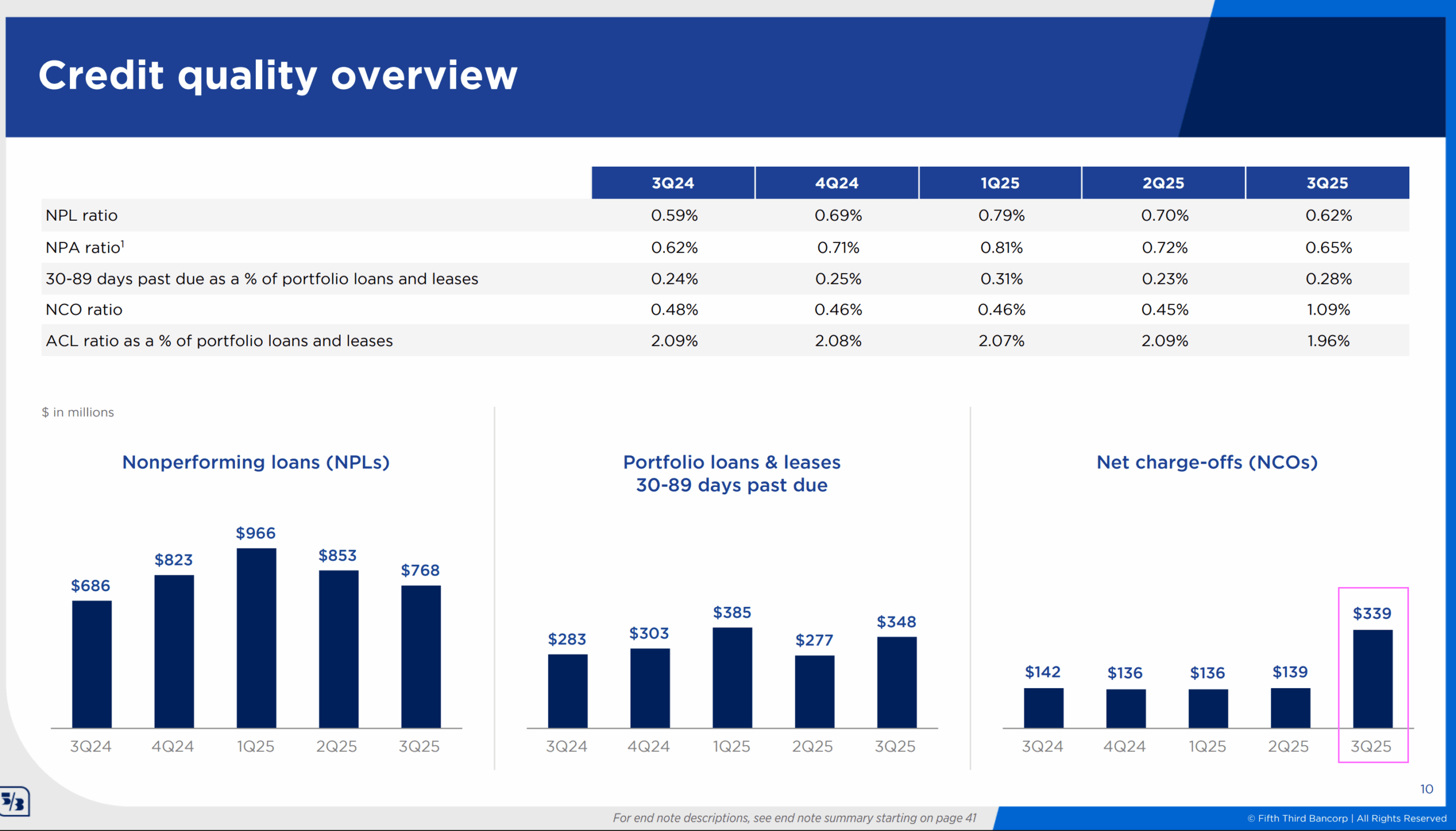
Group 1: Portfolio Performance - The portfolio did not benefit from the small-cap run due to a lack of companies with earnings, particularly in sectors like uranium and quantum computing, and was negatively impacted by the bankruptcies of First Brands and Tricolor [1][2] - The portfolio experienced a positive shift when Fed Chair Jerome Powell indicated a likely path towards lower interest rates [1] Group 2: Bankruptcy Impact - First Brands, an auto-parts company, filed for bankruptcy protection, while Tricolor opted for Chapter 7 liquidation, revealing issues with collateral that may have been fraudulently double-pledged [2] - The bankruptcies have adversely affected the banking sector, especially small regional banks, as the weak economy has led consumers to be more selective in their spending, impacting the auto sector [2] Group 3: Financial Sector Analysis - Fifth Third Bancorp had to write off 100% of a $200 million asset-backed loan to Tricolor, yet reported strong third-quarter results despite this write-off [5] - Concerns exist regarding potential systemic issues in the banking sector, with fears of fraud and lax underwriting standards being highlighted [6][18] Group 4: Credit Cycle and Economic Outlook - The current situation is not expected to lead to a financial crisis similar to 2008, as the banking system is fundamentally sound, and the issues are seen as isolated rather than systemic [10][13] - The performance of major banks has been strong, with robust investment banking and trading results, indicating a potential M&A boom [12] Group 5: Fiscal Stability and Interest Rates - Recent data suggests an improvement in U.S. government finances, with a budget surplus of $198 billion in September 2025, indicating a more sustainable financial path [19] - This fiscal improvement is expected to exert downward pressure on U.S. Treasury rates, potentially lowering the 10-year Treasury rate to around 3.5% by the end of 2026 [19]

Moody's says the banking system, private credit markets are sound despite worries over bad loans
CNBC· 2025-10-17 12:45
Core Viewpoint - Concerns over bad loans at midsize U.S. banks exist, but there is little evidence of a systemic problem that could lead to a broader financial crisis according to a senior analyst at Moody's Ratings [1][2]. Group 1: Credit Cycle and Asset Quality - The credit cycle does not show signs of turning negatively, with no evidence found to support market fears [3]. - Asset quality numbers have shown very little deterioration over the last several quarters, indicating stability in the banking sector [3]. Group 2: Market Reactions and Sentiment - Bank stocks experienced a significant sell-off due to concerns over bad loans, particularly after disclosures from Zions Bancorp and Western Alliance Bancorp [3][4]. - Market sentiment improved following a sell-off, with the SPDR S&P Regional Banking ETF rising 2% in premarket trading after a 6.2% drop [6][7]. Group 3: Default Rates and Economic Outlook - Default rates on high-yield debt remain low, under 5% this year, and are expected to decline to below 3% by 2026, contrasting sharply with the high double-digit defaults during the 2008 financial crisis [5]. - The U.S. economy is performing better than anticipated, with GDP growth exceeding expectations and credit quality appearing stable or potentially improving [5][6].




Credit quality is in a good place today and could improve further, says Moody's Marc Pinto
Youtube· 2025-10-17 12:42
Core Insights - JP Morgan's CEO Jamie Dimon expressed concerns about the private credit market, suggesting that the presence of one bankruptcy could indicate more issues to come [1] - Moody's Mark Pinto noted that while there are questions about credit standards, current asset quality remains stable, with no significant deterioration observed [5][6] Private Credit Market Concerns - Dimon highlighted the potential for more bankruptcies in the private credit market, indicating a need for caution [1] - Pinto emphasized that while there may be concerns about credit standards loosening, there is no evidence of a systemic credit cycle downturn at this time [4][5] Default Rates and Economic Outlook - Current default rates in the global high yield market are just under 5%, with expectations that they will drop below 3% next year [6][12] - The overall economic outlook appears resilient, with GDP growth better than anticipated, which may positively influence credit quality [9][11] Regulatory Environment - There are concerns regarding the shift of credit risk from regulated banks to less regulated non-bank institutions, which may lead to less transparency in the market [13] - The dialogue around deregulation, termed as modernization, has raised concerns about potential deterioration in credit quality, but forecasts have since improved [11]

RBC’s Cassidy: Tailwinds growing for banks into earnings season
CNBC Television· 2025-10-13 22:23
Market Focus & Investment Opportunities - Investors are highly interested in banks with strong investment banking and trading operations due to anticipated strong performance in Q3, driven by robust capital markets [2] - Consumer credit trends, particularly within banks holding large credit card portfolios like Wells Fargo, will be a key area of investor focus [3] - M&A activity is expected to increase in 2025-2026, with the Fifth Third's acquisition of CoAmerica for $11 billion potentially marking the start of a consolidation trend [7] Bank Valuations & Rerating Potential - Banks, on average, are still valued slightly below the cyclical highs of January 2018, with some like JP Morgan at very high valuations [6] - A full credit cycle needs to be observed to determine if banks deserve a permanent rerating, as credit performance is crucial to bank profitability and is tested during economic downturns [5] - Regional banks could outperform money center banks in 2026 if the economy grows at 15%-2%, the Fed cuts rates by another 50 basis points, and the yield curve steepens [11][12] Regional Banks & Net Interest Income - Net interest income, a strength of regional banks, is expected to grow faster than anticipated under a scenario of healthy economic growth, Fed rate cuts, and a steeper yield curve [11] - Loan growth, fueled by a resilient economy and increased capital expenditures financed by commercial loans, could further boost the performance of regional banks [12] M&A Considerations - Fifth Third's acquisition of CoAmerica was unique because it was not dilutive to tangible book value per share, a key focus for Fifth Third's CEO [8] - Expect more deals over the next 12-24 months [8]

摩根士丹利-企业与消费者信贷状况:未来走向何方-Morgan Stanley Global Macro Forum-State of Corporate and Consumer Credit – What’s Next
摩根· 2025-10-09 02:00
Investment Rating - The report indicates a positive outlook on the corporate credit cycle, suggesting a shift in momentum with increased M&A and LBO activity, although it starts from a benign point [5][9]. Core Insights - US consumer spending growth is slowing but remains solid, supported by elevated net worth and asset growth outpacing liabilities [43]. - The credit cycle is gaining momentum with busy issuance in both investment-grade (IG) and high-yield (HY) markets, with September IG issuance reaching $227 billion, significantly above seasonal averages [6][43]. - Delinquencies are rising in subprime credit while stabilizing in prime credit, indicating a bifurcation in credit quality [43][23]. Summary by Sections Corporate Credit - The credit cycle is moving up a gear with significant M&A and LBO announcements, although current activity levels are below historical trends [5][9]. - High-yield issuance in September exceeded $55 billion, marking it as the third-largest month on record [7][8]. - Defaults remain elevated despite tighter spreads, with a trailing 12-month default rate for high-yield loans at 4.2% [12][11]. Securitized Credit - There is a notable divergence in delinquency rates between prime and subprime segments, with prime delinquencies stabilizing while subprime delinquencies are on the rise [43][23]. - Transition rates do not indicate further deterioration in credit quality, suggesting a potential stabilization in the market [28]. Economic Overview - Real personal consumption expenditure growth is slowing, but remains robust, particularly among high-income cohorts whose net worth is significantly higher [34][43]. - Labor income growth has decelerated, which may impact real spending in the future [38][43].
Private markets brace for cycle test, Asia exits remain tight
Reuters· 2025-10-02 06:36
Core Insights - The private credit and private equity sectors are expected to face challenges as the current credit cycle is untested and coincides with weak exit options in Asia's public markets [1] Group 1 - The boom in private credit and private equity is under scrutiny due to the potential impact of an untested credit cycle [1] - Fragile exit routes in Asia's public markets may exacerbate the challenges faced by private credit and private equity [1]