Critical thinking

Search documents
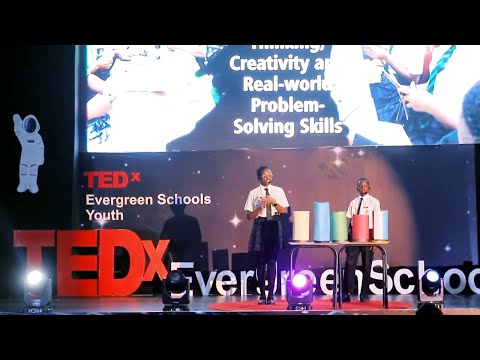
One Thing Schools Should Teach (But Don’t) | Kayla Odah & Elekwa Chima | TEDxEvergreen Schools Youth
TEDx Talks· 2025-09-15 15:06
[Music] Make a dream because we're about to go a roller coaster. Now, I need you to close your eyes and imagine a world where education isn't just about memorizing fact. It's about igniting minds.A world where every classroom is a launchpad for critical thinkers, problem solvers, and innovators. This isn't a distant utopia. It is a world we can create by changing the way we think about education.For too long, we have focused on cramming knowledge into young minds, producing graduates who know a whole lot bu ...

Mind in the Noise: Fighting Brain Rot | Marlistya Citraningrum | TEDxJakarta
TEDx Talks· 2025-09-12 15:31
[Musik] Terakhir kali saya berdiri di panggung ini adalah untuk menarik, untuk pentas. Tetapi pada siang hari ini saya ingin mengajak teman-teman semua untuk refleksi. Saya akan mulai dengan tiga pertanyaan sederhana.Yang pertama, pernah enggak teman-teman tuh membaca sesuatu bukan dalam bahasa yang tidak teman-teman ketahui, tetapi enggak sanggup untuk menangkap maknanya. Baca sesuatu enggak nangkap, udah terus tinggalin. Kita enggak berusaha membaca lagi atau mencari tahu.Atau berapa banyak sih informasi ...
Digital Age of Political Influence | Luna Fast & Helin Turhan | TEDxYouth@BerlinCosmopolitanSchool
TEDx Talks· 2025-08-29 16:29
Social Media & Political Discourse - Social media algorithms prioritize engagement over truth, rewarding outrageous posts and contributing to the spread of misinformation [5][6] - Echo chamber effect on social media reinforces existing beliefs, creating polarized realities and potentially provoking action based on misinformation [7][8] - Misinformation spread through social media can fuel real-world aggression and fragment society, posing a threat to democracy [10][11] Government Influence & Manipulation - Governments may utilize social media to control dissenting voices and manipulate narratives, even in seemingly democratic countries [11][12] - State-controlled media intertwining with social media platforms allows ruling parties to control public discourse and suppress opposition [12] - Governmental powers can manipulate social media to their advantage by providing only their own perspective, leading to polarizing opinions and misinformation [13][14] Counteracting Misinformation & Polarization - Media literacy programs, like those in Finland, are crucial for teaching critical analysis of news sources and identifying misinformation [17] - Individuals should verify information through lateral reading, checking multiple reputable sources to combat misinformation [18][19] - Combating misinformation and political polarization requires demanding accountability, prioritizing education, and fostering critical thinking [19] Examples of Social Media's Impact - The January 6th, 2021 attack on the US Capitol was fueled by false claims of election fraud and conspiracy theories propagated online [9][10] - The German far-right party AFD has gained support through social media marketing, using hashtags, bots, video content, and slogans to spread their ideology [15][16] - Following the October 7th, 2023 Hamas attack on Israel, the Israeli Foreign Affairs Ministry used online ads to shape opinion about the war [13] - By 2026, Europol predicts that 90% of online content may be synthetically generated using artificial intelligence, increasing the potential for misinformation [6]

Competence in the Age of LLMs | Peter Danenberg | TEDxCSTU
TEDx Talks· 2025-08-18 16:11
LLMs and Cognitive Impact - LLMs may lead to neurological inertia and impact long-term competence and mastery [6] - Over-reliance on LLMs can cause engineers to outsource critical thinking, becoming verifiers instead of thinkers [15] - Microsoft's study suggests tool creators have a responsibility to challenge users and promote growth [16] Poetic vs Parastic LLMs - LLMs excel at the "poetic" art of generation (rhetoric), producing fluent text and compilable code [10] - The industry needs to explore "parastic" LLMs (dialectic) that challenge users to develop their own ideas [11][15] - Current LLMs are fundamentally poetic and may require retraining to become parastic [15] Achieving Competence in the Age of LLMs - Users should actively ask LLMs to challenge them and demonstrate mastery [17] - AI tool builders need to align models to challenge users, even if it impacts engagement metrics [17][18] - The goal is to create tools that "enkindle the soul" by fostering growth and lifelong learning [18]
ChatGPT Is MELTING Your Brain – The Scans Prove It!
Coin Bureau· 2025-08-06 14:01
Cognitive Impact of AI - MIT research indicates that using ChatGPT is associated with weaker neural connectivity across brain regions, reduced alpha, theta, and beta waves, and diminished attention spans [4] - Regular ChatGPT use is correlated with cognitive decline, with users exhibiting deficits even before testing began [10][11] - AI-assisted work can lead to memory failure, with users struggling to recall their own AI-generated content minutes after writing it [7] - Homogenization of output is observed, with AI-written essays exhibiting uniformity and lacking originality [12] - Users may experience a diminished sense of intellectual ownership over AI-generated content, potentially reducing critical scrutiny and ethical responsibility [14][15] Historical Context and Counterarguments - Historically, concerns about new technologies melting brains have been common, but humanity has adapted and evolved [17][18][19][20] - The Flynn effect, which documented rising IQ scores throughout the 20th century, has reversed in recent decades in some countries [23][26][27] - Some argue that reduced brain activity in AI users may indicate efficiency, not decline, and that AI can enhance intelligence when properly implemented [47][49] Global Responses and Strategies - China is making AI education mandatory while also emphasizing traditional cognitive training [31] - Singapore is providing credits to workers over 40 to teach them how to use AI without becoming dependent [32] - The EU is taking a cautious approach to AI in education, emphasizing transparency, human oversight, and data protection [34] AI's Impact on Skills and Industries - AI coding assistants may lead to "vibe coders" who can tweak existing code but struggle to build from scratch [43] - For complex work, AI use may actively slow down experienced developers [44] - The IMF estimates that 40% of all jobs globally face AI exposure, jumping to 60% in wealthy market economies [40] Types of AI and Their Effects - Large language models like ChatGPT are associated with neural decline, memory failure, and homogenization of output [41] - Image generators may lead to prompt dependency, where artists lose the ability to create without algorithmic assistance [42] - Educational AI that enhances rather than replaces learning shows more promise, with potential for 20-40% improvements in learning outcomes [45]
Why AI Needs Limits | Vansh Chelani | TEDxWahaha Schools Youth
TEDx Talks· 2025-06-24 15:25
AI Safety Concerns - The industry emphasizes the need for correct precautions and boundaries to ensure AI safety [5] - The industry highlights the risk of over-reliance on AI, potentially leading to a loss of critical and creative thinking [7] - The industry stresses the importance of controlling AI, as surpassing human intelligence is not the primary concern [8] AI Regulation and Control - Strict safety measures are necessary to regulate AI access and usage, preventing ethical issues, privacy violations, and bias [9] - A 100% responsible and trustworthy individual should handle the majority of AI to prevent unrestricted access and other problems [9][10] - AI should not handle private data to prevent leaks or manipulation of sensitive information [9] - Only responsible individuals, authorities, companies, and governments should be allowed to use AI to prevent misuse [10] Potential Risks of AI - AI systems can be designed to steal personal information through tricking, data extraction, and hacking [6] - AI-powered weapons can lead to increased violence and large-scale destruction [10] - Failure to regulate AI properly can result in large-scale destruction or the loss of society [11]
Education Beyond The Curriculum | Ananya Agarwal | TEDxYouth@AbbeyParkHS
TEDx Talks· 2025-06-17 16:06
Core Argument - The report addresses the issue of "tunnel vision" in education, where students focus solely on grades and rote memorization, leading to disinterest and a disconnect from learning [3][6][7] - The report suggests that this narrow focus hinders true learning and personal growth [5][8][19] Solutions to Overcome Tunnel Vision - The report advocates for eliminating the pursuit of perfection, accepting that struggles and imperfections are normal [10][11][12] - The report emphasizes learning from every experience, both positive and negative, to break out of the "black and white" thinking fostered by a focus on grades [14][15][21] - The report encourages reflection on the real-world value and skills gained from school subjects, such as critical thinking, problem-solving, and understanding the world [22][23][24][25] Call to Action - The report calls for a broader conversation about student disengagement and encourages students to actively engage with their education out of genuine interest [27][28] - The report suggests that overcoming tunnel vision can lead to a more fulfilling educational experience and a better future for education as a whole [30][31]

5 Transformations that will Reshape Learning | Dr. Kavita Sharma | TEDxThaltej Youth
TEDx Talks· 2025-06-16 16:32
Core Argument - The future of education requires a shift from content memorization to competency development, focusing on critical thinking, creative thinking, collaboration, communication, and compassion [1] - Education should embrace personalization, catering to individual learning styles and needs, aided by technology but not replacing teachers [1] - Integrated learning, breaking down subject silos, is crucial to address real-world problems that span multiple disciplines [1] - Technology should be used to empower students to become creators, not just consumers, while preserving human relationships in learning [1] - Schools need to foster innovation by creating an ecosystem that encourages inquiry, curiosity, collaboration, teamwork, digital literacy, global perspectives, resilience, and adaptability [1] Key Recommendations for Stakeholders - Teachers should focus on developing students' potential beyond knowledge acquisition [1] - Parents should advocate for education that nurtures their child's potential, not just test scores [1] - Policymakers should create assessment systems that measure what matters, not just what is easy to measure [1] - Students should understand that education is something they create for themselves [1] - Society should encourage educational innovations that cultivate wisdom, not just knowledge [1]