
Jobless claims

Search documents
Jobless claims — and layoffs — are still low. Unofficially, that is.
MarketWatch· 2025-10-09 14:08
Core Insights - The most accurate tool for tracking job losses has been postponed for the second consecutive week, indicating potential delays in labor market data [1] - Despite economic uncertainties, layoffs remain surprisingly low, suggesting resilience in the job market [1] Summary by Categories Job Market Trends - Layoffs are currently at low levels, which is unexpected given the prevailing economic uncertainties [1] Data Reporting - The postponement of the job loss tracking tool for two weeks may affect the timeliness of labor market insights [1]
Jobless claims tumble to 218,000, well below estimate despite fears of labor market weakness
CNBC Television· 2025-09-25 15:39
Labor Market - Initial jobless claims surprisingly low at 218,000, the lowest since the third week of July [1] - The market expected initial jobless claims around 234,000 [1] - Continuing claims also on the light side, at 1.926 million [1] Interest Rate Implications - The unexpectedly low jobless claims are likely to put upward pressure on interest rates [1]

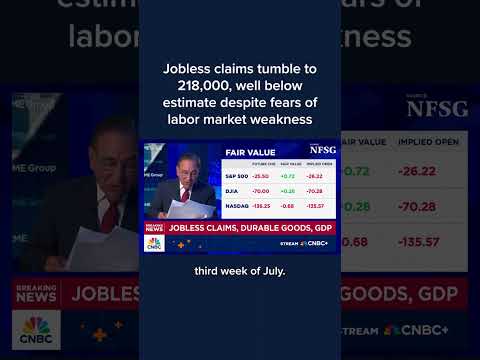
Econ Data Surprisingly Good: Jobless Claims, Q2 GDP, Durable Goods & More
ZACKS· 2025-09-25 15:36
Economic Data Summary - Q2 GDP was revised up from +3.3% to +3.8%, marking the strongest quarter of growth since Q3 2023 [2] - Consumption saw a significant increase from +1.6% to +2.5%, indicating a stronger appetite among U.S. consumers [3] - The Price Index increased by 10 basis points, with headline at +2.1% and core at +2.6% [3] Job Market Insights - Initial Jobless Claims fell to 218K, down 17K from estimates and 14K from the previous week, reaching the lowest level since mid-summer [4] - Continuing Claims rose slightly to 1.926 million, remaining below 1.94 million for the third consecutive week [5] Durable Goods Orders - August Durable Goods Orders increased by +2.9%, significantly better than the prior month's -2.7% and the consensus estimate of -0.5% [6] - Excluding Transportation orders, the increase was +0.4%, down from +1.0% in the previous month [6] Trade and Inventory Data - The Advanced U.S. Trade Balance for August improved to -$85.5 billion from -$102.8 billion [7] - Advanced Retail Inventories remained unchanged at +0.2%, while Advanced Wholesale Inventories decreased to -0.2% [7] Company Performance Expectations - Costco is expected to report fiscal Q4 results with a projected earnings growth of +12.8% year over year and revenue growth of +8.1% [10] - Costco has outperformed earnings expectations in three of its past four quarters [10]

Allianz's Mohamed El-Erian: Firings have a way of spreading through the economy
CNBC Television· 2025-09-18 20:53
Market Reaction to Fed Rate Cut - Treasury market experienced volatility, with the 10-year yield initially dropping below 4% following the rate cut decision, then rising to 4116% [2] - Market's upward yield adjustment is attributed to strong jobless claims data and a reassessment of the support for further rate cuts [2][3] Fed's Policy and Economic Outlook - The Fed's rate cut is viewed as a risk management measure, prioritizing employment risks over inflation risks [4] - The Fed is perceived to be placing greater emphasis on the employment side of its mandate compared to inflation [4][6] - The Fed is projected to miss its inflation target for seven consecutive years, with inflation exceeding the target by more than 50 basis points (05%) in six of those years [7] Risks and Concerns - The primary risk to the economy is on the employment side, with concerns about companies transitioning from hiring hesitancy to layoffs [5] - There are concerns about the potential for a "cliff effect" if companies begin firing employees, which could spread through the economy [5]
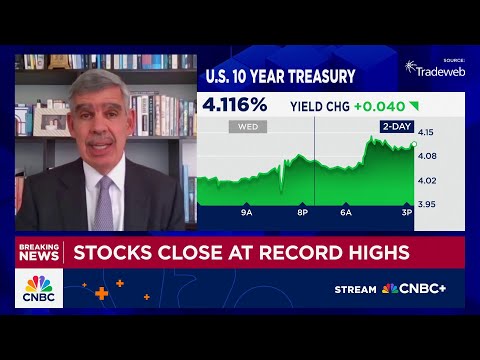
Jobless Claims "Solid" & Philly Fed "Strong" Following FOMC Rate Cut
Youtube· 2025-09-18 13:30
Core Insights - Markets are showing positive trends with E-Minis up 0.5% and NASDAQ up 0.9% following the Federal Reserve meeting [1][2] - Jobless claims have decreased from 263,000 to 231,000, indicating a moderation back to normal levels [2][3] - Continuing claims are at 1.92 million, slightly below estimates of 1.95 million, reflecting solid employment data [3] - The Philadelphia Fed manufacturing index saw a significant increase of 23.2%, indicating strong expansion in manufacturing [4][6] - The Federal Reserve's recent meeting revealed a wide range of opinions among members regarding future rate hikes and cuts, with some members suggesting up to five cuts through 2025 [5] Economic Indicators - Jobless claims decreased to 231,000 from a previous high of 263,000, showing improvement in the labor market [2][3] - Continuing claims are reported at 1.92 million, which is lower than the expected 1.95 million, suggesting stability in employment [3] - The Philadelphia Fed manufacturing index increased by 23.2%, a notable rise compared to previous expectations [4][6] Federal Reserve Insights - Jerome Powell described the recent Fed meeting as a "maintenance cut," indicating a cautious approach to monetary policy [4] - There is significant volatility in Fed opinions, with some members advocating for rate hikes while others foresee multiple cuts in the coming years [5]
Jobless claims return to norm after one-week spike
Youtube· 2025-09-18 13:14
Group 1 - Initial jobless claims in the Philadelphia Fed manufacturing data came in at 231,000, lower than the expected 240,000, marking the smallest number of initial claims since the third week of August [1] - Last week's claims were revised upward to 264,000, which was unexpected and attributed to an error in Texas, leading to a reassessment of the labor market [2] - Continuing claims decreased to 1,920,000, down from a revised figure of 1,927,000, indicating a slight improvement in the labor market [3] Group 2 - The Philadelphia Fed business outlook for September showed a strong reading of 23.2%, the best level since January and the second-best number of the year [4] - The increase in jobless claims and the strong business outlook suggest mixed signals in the economy, with rates moving higher [4]
As jobless claims rise, unemployment benefits aren't keeping up with inflation. Here's what to know.
MarketWatch· 2025-09-11 20:54
Core Insights - Newly unemployed workers are experiencing higher inflation rates without an increase in jobless benefits to compensate for the rising costs [1] Group 1 - The current economic environment is characterized by elevated inflation levels impacting the purchasing power of unemployed individuals [1] - Jobless benefits have not been adjusted to reflect the increased cost of living, leading to financial strain on newly unemployed workers [1]
摩根大通:美国_持续申领失业金人数仍预示着失业风险
摩根· 2025-07-07 15:44
Investment Rating - The report does not explicitly provide an investment rating for the industry or sector discussed Core Insights - The labor market shows low layoffs but a potential weakening in hiring rates, with initial jobless claims decreasing to 233,000 for the week ending June 21 from 237,000 the previous week, indicating stability in the labor market [1] - Continuing claims remain at a cycle-high of 1.964 million, suggesting an upward trend in unemployment, contrary to the reported decrease in the unemployment rate to 4.1% from 4.2% in May [2] - The four-week average of continuing claims has risen to 1.954 million, indicating persistent unemployment risks despite a drop in the unemployment rate [2] Summary by Sections Jobless Claims Overview - Initial jobless claims fell to 233,000 for the week ending June 21, showing a slight decrease compared to the previous week [1] - Continuing claims held steady at 1.964 million, marking a cycle-high, with the four-week moving average climbing to 1.954 million [2][9] Labor Market Analysis - The unemployment rate unexpectedly fell to 4.1%, but participation rates also declined, indicating potential risks for future employment stability [2] - The labor market differential from the Conference Board consumer confidence survey has been deteriorating, suggesting a weakening outlook [2]