
PPI(生产者物价指数)

Search documents
德国9月PPI同比下降1.7%
Mei Ri Jing Ji Xin Wen· 2025-10-20 06:09
Core Insights - Germany's Producer Price Index (PPI) decreased by 1.7% year-on-year in September [1] - Month-on-month, the PPI fell by 0.1% in September [1] Group 1 - The year-on-year decline in PPI indicates a potential easing of inflationary pressures in the German economy [1] - The month-on-month decrease suggests a slight contraction in producer prices, which may impact profit margins for manufacturers [1]
欧元区8月PPI环比下降0.3%,预期下降0.1%,前值由增长0.4%修正为增长0.3%
Mei Ri Jing Ji Xin Wen· 2025-10-03 09:21
Core Insights - Eurozone's Producer Price Index (PPI) decreased by 0.3% month-on-month in August, which was worse than the expected decline of 0.1% [1] - The previous value was revised from a growth of 0.4% to a growth of 0.3% [1]
德国8月PPI环比下降0.5%,前值为下降0.1%
Mei Ri Jing Ji Xin Wen· 2025-09-19 06:07
Group 1 - The core point of the article is that Germany's Producer Price Index (PPI) decreased by 0.5% month-on-month in August, compared to a previous decline of 0.1% [1]
美国8月PPI同比增长2.6%
Xin Lang Cai Jing· 2025-09-10 13:43
Core Viewpoint - The U.S. Bureau of Labor Statistics reported that the Producer Price Index (PPI) increased by 2.6% year-over-year in August [1] Group 1 - The PPI data indicates inflationary pressures in the economy, which could impact pricing strategies for companies across various sectors [1] - A year-over-year increase of 2.6% suggests that producers are facing higher costs, which may be passed on to consumers [1] - This PPI growth rate is a key indicator for analysts to assess future inflation trends and potential impacts on monetary policy [1]
美国8月PPI同比升2.6%
Di Yi Cai Jing· 2025-09-10 13:43
Group 1 - The core point of the article indicates that the U.S. Producer Price Index (PPI) for August increased by 2.6% year-on-year, down from a previous value of 3.3% [1] - The month-on-month PPI for August showed a decrease of 0.1%, compared to an increase of 0.9% in the prior month [1] - The core PPI, which excludes food and energy, rose by 2.8% year-on-year, down from a previous value of 3.7% [1] Group 2 - The month-on-month core PPI also decreased by 0.1%, consistent with the overall PPI trend, which had a prior increase of 0.9% [1]
美国8月PPI同比 2.6%,预期 3.3%,前值 3.3%
Hua Er Jie Jian Wen· 2025-09-10 12:30
Core Insights - The U.S. Producer Price Index (PPI) for August decreased by 0.1% month-over-month, which was below the expected increase of 0.3% and significantly lower than the previous value of 0.9% [1] - The year-over-year core PPI for August was reported at 2.8%, which also fell short of the expected 3.5% and decreased from the prior value of 3.7% [1] - The month-over-month core PPI for August also showed a decline of 0.1%, again below the expected 0.3% and down from the previous 0.9% [1]
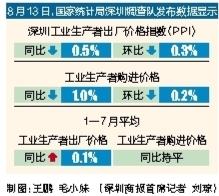
深圳1至7月PPI平均同比上涨0.1%
Shen Zhen Shang Bao· 2025-08-13 17:01
Core Viewpoint - The article discusses the recent financial performance of a specific company, highlighting significant growth in revenue and net profit, driven by increased demand in its sector [1] Group 1: Financial Performance - The company reported a revenue increase of 25% year-on-year, reaching 5 billion [1] - Net profit surged by 30%, amounting to 1 billion, indicating strong operational efficiency [1] - The gross margin improved to 40%, up from 35% in the previous year, reflecting better cost management [1] Group 2: Market Trends - The industry is experiencing a robust demand surge, with a projected growth rate of 15% over the next five years [1] - Increased consumer spending and technological advancements are key drivers of this growth [1] - Competitors are also reporting similar growth trends, indicating a healthy market environment [1]

大摩:中国反内卷运动能否取得成功
2025-08-12 15:05
Summary of Conference Call Records Industry Overview - The discussion revolves around the **Chinese economy**, particularly focusing on the **real estate market** and the phenomenon of **involution** which has intensified due to a declining real estate market and supply incentive systems [1][2]. Core Points and Arguments - **Involution Defined**: Involution is described as an uncontrolled competitive phenomenon where too many participants chase the same prices, leading to price collapse and significant profit margin compression without productivity improvements. This is evident in sectors like electric vehicles and solar energy [2]. - **Economic Downturn**: The real estate market's downturn has resulted in weakened demand, exacerbated by a supply incentive system that rewards output and capacity rather than efficiency. This has led to deeper deflationary pressures in the first half of 2025 [2]. - **Policy Shift**: Since September 2024, policymakers have shifted focus to combat deflation, aiming to oppose industrial upgrades. This shift is seen as a positive macroeconomic move, although its execution is challenging [2]. - **Profit Margin Improvement**: To improve profit margins, companies need supply-side reforms alongside demand-side stimulus measures. Current measures include policies like vehicle trade-in incentives and subsidies for childbirth and preschool fees, indicating a gradual shift towards a consumption-driven economy [5]. - **GDP Growth Projections**: Actual GDP growth is expected to be below 4.5%, with nominal GDP growth around 3.5%. The U.S. GDP deflator is projected to remain between -0.8% and -0.9% over the next 12 months [5]. Important Metrics for Success Evaluation - **Key Indicators**: The success of reforms should be evaluated based on changes in the Producer Price Index (PPI) and Core Consumer Price Index (CPI), particularly if the service sector CPI reaches the 2% target. Other indicators include corporate profits, employment metrics, and stability in profit margins [6]. - **Risks**: There are potential risks if companies drastically cut capacity without stimulating demand, which could worsen downstream conditions. Additionally, external factors like U.S. tariff increases could negatively impact China's export growth and inflation [6]. Additional Insights - **Reform Needs**: There is a call for reforming local government incentive mechanisms to focus on living standards, social welfare, and environmental issues rather than just output. Tax reforms are also suggested to reward direct tax efficiency over indirect transaction taxes [3][7]. - **Competition and Innovation**: The concept of reverse elimination is posited to promote competition by preventing destructive price barriers and subsidies, thus avoiding vicious competition. Transparent national rules are necessary to maintain effective competition [7][8]. Conclusion - The overall sentiment indicates a cautious optimism regarding the Chinese economy's transition towards a consumption-driven model, with significant emphasis on the need for structural reforms and careful monitoring of key economic indicators to navigate the challenges posed by involution and external pressures.
法国6月PPI同比 0.2%,前值 0.2%。
news flash· 2025-07-31 06:51
Core Insights - France's Producer Price Index (PPI) for June showed a year-on-year increase of 0.2%, consistent with the previous value of 0.2% [1] Group 1 - The PPI data indicates stability in producer prices in France, suggesting no significant inflationary pressures at the producer level [1] - The unchanged PPI figure may reflect broader economic conditions, potentially influencing investment decisions in related sectors [1] - Monitoring PPI trends is essential for understanding future consumer price movements and overall economic health [1]
法国6月PPI环比 -0.2%,前值 -0.8%。
news flash· 2025-07-31 06:51
Core Viewpoint - France's Producer Price Index (PPI) for June decreased by 0.2% month-on-month, compared to a previous decline of 0.8% [1] Group 1 - The current PPI indicates a slight improvement in the manufacturing sector's pricing pressures, as the rate of decline has lessened from the previous month [1]