Quality

Search documents
Consumer sentiment falling will hurt value stocks, says Barclays' Venu Krishna
Youtube· 2025-11-12 18:42
Core Viewpoint - The company has downgraded its outlook on value to negative due to concerns over cost pressures in certain segments, particularly staples, while maintaining a positive stance on growth driven by technology [2][3]. Sector Analysis - Growth is primarily dominated by technology, which continues to show strong profitability and earnings beats, contrasting with value sectors facing cost pressures [2]. - Consumer sentiment is declining, which is expected to negatively impact value sectors [3]. Momentum and Quality - Momentum has been adjusted to neutral, indicating a cautious approach, while quality remains neutral as well [4][6]. - The company has shifted its focus from large-cap stocks to big tech within the large-cap category, reflecting a change in strategy [5]. Economic Outlook - There is a low probability of a recession, with robust consumption despite a weakening labor market [7]. - The primary concern in the market is the scale of AI spending and the uncertainty regarding returns on that investment [8]. AI Investment Concerns - If AI spending decelerates, it could lead to significant market implications, particularly if it becomes reliant on credit markets for capital expenditures [8][9]. - A potential macroeconomic slowdown could coincide with a pullback in AI capital expenditures, which would have negative consequences, although this scenario is not considered the base case [10]. Earnings Performance - Current earnings reports show strong performance, with over 90% of companies reporting nearly 50% growth in earnings and approximately 6.5% growth in sales, indicating good operating leverage in the system [10].



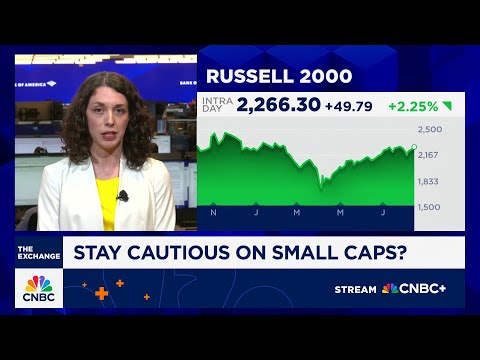
Focus on high quality among mid and small caps, says BofA's Jill Carey Hill
CNBC Television· 2025-08-12 17:48
Market Sentiment & Performance - Bank of America's flow data indicates net selling of small-cap stocks by clients last week, while large and mid-cap stocks saw net buying [1] - 44% of fund managers surveyed believe large-cap stocks will outperform small-cap stocks this year, an increase from the previous reading [1] - The Russell 2000 is up only 1.5% year-to-date, indicating continued underperformance of small caps [1] Concerns & Cautions - B of A remains near-term cautious on the Russell 2000 index and does not expect any Fed rate cuts this year [2][4] - Tariff risk poses a greater threat to small caps due to their thinner margins [3] - Inflation remains sticky, leading to the expectation that the Fed will remain on hold, potentially negatively impacting the Russell 2000, which is sensitive to interest rates [4][5] - Small-cap earnings recovery has been slower than expected compared to large caps, with lofty expectations for the second half of the year [6][7] Opportunities & Recommendations - It is advisable to be selective within small caps, favoring mid-caps due to cleaner balance sheets and lower risk from tariffs and refinancing [8] - Despite risks, small caps offer wider performance spreads and alpha opportunities, with relatively cheap valuations compared to large caps [8] - Focus on higher quality areas within small and mid-caps, prioritizing stocks with positive revisions and stronger margins [9][10]
Ford CEO: I would expect recalls potentially go up at Ford because we want to protect the costumers
CNBC Television· 2025-07-31 14:45
Quality & Recalls - Ford's initial quality is now highly competitive, recognized as the most awarded company and brand in JD Power's Initial Quality Study (IQS) [1] - Launch quality has surpassed competitors [2] - Recalls primarily affect vehicles engineered in 2015 and 2016, often involving software updates (OTAs) that are not significantly expensive [2] - Ford anticipates potential increases in recalls as a proactive measure to protect customers, with more inspectors and engineers focused on identifying quality issues in the field [3] Warranty & Cost - Base coverages account for 60% of Ford's warranty costs, which are expected to decrease as quality improvements are implemented [2] - Warranty coverages are already declining, indicating positive progress in quality improvements [4] - Recalls are considered the slowest metric to improve in terms of quality enhancements [4]


“I Wouldn’t Sell For $100BN”
20VC with Harry Stebbings· 2025-07-21 14:01
Company Strategy & Vision - The company emphasizes quality as its top priority, surpassing all other considerations [1] - The company aims for significant growth, targeting a valuation of $30 billion to $100 billion [1] - The company is profitable and has complete control over its future direction [2] - The company possesses all the necessary resources to pursue its objectives [2] Competitive Landscape - The company distinguishes itself from competitors, viewing many as "body shops" or disguised as technology companies [1]