
Supply and Demand Imbalance

Search documents
This Aircraft Supply Company Is Soaring Under the Radar
The Motley Fool· 2025-09-16 08:30
Core Viewpoint - The airline industry is experiencing a supply-demand imbalance, benefiting FTAI Aviation, a company specializing in aircraft maintenance, repair, and leasing [1][4]. Company Overview - FTAI Aviation is based in New York City and operates in two main divisions: asset ownership and leasing, and manufacturing, refurbishing, and repairing aircraft engines and components [1]. - The company focuses on two key engines: the CFM56 and the V2500, which are widely used in commercial aviation [3]. Industry Challenges - The airline industry faces significant equipment supply issues, including a shortage of aircraft and components due to pandemic-related production halts, a lack of skilled labor, and an aging fleet requiring repairs or replacements [4]. - Aircraft engine maintenance and repair has become a critical bottleneck, with turnaround times increasing by 35% for legacy engines and 150% for new engines, with peak issues expected by mid-2026 [5]. Financial Performance - FTAI's second-quarter results showed a 53% year-over-year revenue increase to $676 million, with earnings per share (EPS) of $1.57, a significant recovery from a loss of $2.26 the previous year [9]. - The company's stock price has risen 47% since the July 29 results announcement, with a 19% increase this year and over 1,100% growth in the past five years [9]. Future Outlook - Wall Street forecasts a 47% revenue increase for FTAI this year to $2.55 billion, with further growth expected to $3.03 billion in 2026. EPS is projected to rise 160% this year to $4.75 and another 41% next year to $6.70 [10]. - The market cap of FTAI is approximately $17.2 billion, with a forward price-to-earnings (P/E) ratio of about 22, indicating it is relatively inexpensive compared to peers [11]. Demand Dynamics - Demand for air travel has returned to pre-pandemic levels and is expected to continue growing rapidly through 2040, further supporting FTAI's business model [11]. - FTAI is well-positioned to capitalize on ongoing supply chain issues in the aviation industry, as it provides essential engines and parts that are currently in high demand [12].

Fresh Del Monte Produce (FDP) - 2025 Q2 - Earnings Call Transcript
2025-07-30 16:00
Financial Data and Key Metrics Changes - Net sales increased by 4% to $1.183 billion compared to $1.14 billion in the prior year [14] - Gross profit rose by 6% to $120 million from $113 million in the prior year, with gross margin expanding to 10.2% from 9.9% [6][15] - Net income attributable to Fresh Del Monte was $57 million, up from $54 million in the prior year, with adjusted diluted earnings per share increasing to $1.23 from $1.16 [18] Business Segment Data and Key Metrics Changes - Fresh and value-added products segment net sales increased by 4% to $723 million, driven by higher selling prices in the pineapple product line [19] - Banana segment net sales also rose by 4% to $410 million, primarily due to higher selling prices across regions [21] - Other products and services segment saw a slight decrease in net sales to $50 million from $51 million, attributed to lower selling prices in poultry and meats [22] Market Data and Key Metrics Changes - Consumer spending on tropical fruit has risen by 58% since February 2017, indicating a growing market relevance [8] - The company launched PingGlow in the UAE, marking its first sustained market entry for a variety in the Middle East [8] Company Strategy and Development Direction - The company is transitioning from legacy break box shipping vessels to container vessels in the Asia Pacific region to enhance operational efficiency [27] - There is a focus on expanding production capacity in Costa Rica and other regions, including Brazil and Africa, to meet growing demand [36][38] Management Comments on Operating Environment and Future Outlook - Management anticipates a continued shortage of pineapple supply into 2026, with strong market dynamics expected to persist [35][36] - The company remains confident in its ability to deliver on full-year objectives, expecting net sales growth of 2% year-over-year [28] Other Important Information - The company declared a quarterly cash dividend of $0.30 per share, equating to an annualized yield of 3.3% based on current share price [26] - The effective tax rate for the second quarter was 20%, reflecting increased earnings in higher tax jurisdictions [23] Q&A Session Summary Question: Update on pineapple supply and growth expectations - Management expects a continued shortage of supply through the end of the year and into next year, with strong market conditions for premium varieties [35][36] Question: Distribution growth for Pink Glow - Supply is currently constrained due to regulatory issues, but management anticipates increased acreage and supply in about 18 months [40][41] Question: Demand sources for fresh cut fruit - Demand is primarily coming from retail and convenience stores, with growth observed globally, not just in North America [45][46] Question: Impact of black sigatoka on banana supply - Costa Rica's export volume is down over 20% due to black sigatoka disease, which is expected to worsen [52] Question: Foreign exchange impact on revenue - The strengthening of the euro, British pound, and Japanese yen positively impacted net sales, while the Costa Rican colon presented headwinds [62][65]
OPEC+战略重大转变,“愤怒的沙特”=“长期低油价”?
华尔街见闻· 2025-05-05 12:26
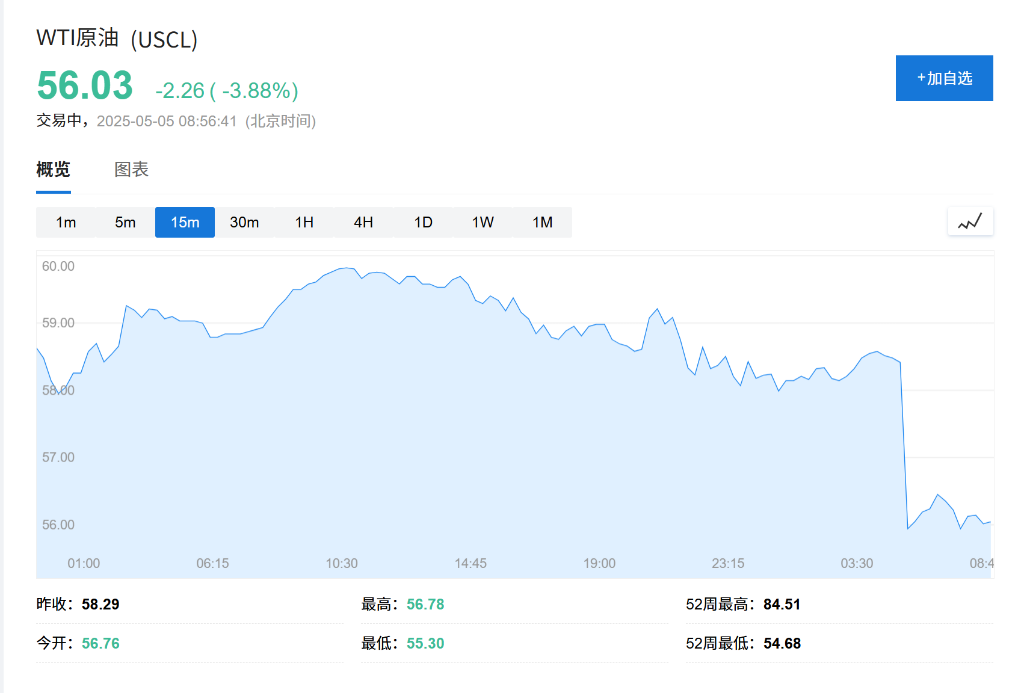
Core Viewpoint - OPEC+ has unexpectedly increased production for two consecutive months, leading to a significant drop in international oil prices, with Brent crude falling over 20% this year [1][3][11] Group 1: Production Increase - OPEC+, led by Saudi Arabia, agreed to increase production by 411,000 barrels per day in June, nearly three times higher than Goldman Sachs' initial forecast of 140,000 barrels per day [5] - Over the past two months, OPEC+ will add more than 800,000 barrels per day to the market, severely impacting an already fragile market [5][8] - The decision to increase production reflects a strategic shift within OPEC+, prioritizing production discipline over price stability [6][10] Group 2: Market Reaction - On Monday, U.S. crude futures fell by 4.27%, dropping to $56.30 per barrel, while Brent crude dropped 3.9% to $59.09 per barrel [2][3] - The increase in supply has caught the market off guard, especially following a similar production increase announced just a month prior [8] - The oil market is facing downward pressure due to a mismatch between supply and demand, exacerbated by concerns over economic recession stemming from U.S. tariff policies [9] Group 3: Compliance and Challenges - OPEC+ is facing compliance issues, particularly from Iraq and Kazakhstan, which have not adhered to production agreements [8] - The financial breakeven points for member countries vary significantly, with Russia needing $62 per barrel and Saudi Arabia requiring $81, creating a high-stakes "game of chicken" among members [9] - The long-term threats to OPEC+ include the resurgence of U.S. shale oil production and the global energy transition, which could further complicate their strategy [10] Group 4: Future Outlook - Analysts are revising their forecasts downward due to the unexpected supply surge, with Goldman Sachs' previous price predictions for U.S. and Brent crude potentially facing adjustments [11] - Oilfield service companies like Baker Hughes anticipate a reduction in exploration and production investments due to the oversupply outlook and geopolitical uncertainties [12] - The current data indicates a bearish outlook, with OPEC+ prioritizing short-term supply over price stability, suggesting further price declines may occur before compliance improves or geopolitical risks diminish [13][14]

OPEC+战略重大转变,“愤怒的沙特”=“长期低油价”?
Hua Er Jie Jian Wen· 2025-05-05 02:20
Core Viewpoint - OPEC+ has significantly increased oil production for two consecutive months, leading to a sharp decline in international oil prices, with U.S. crude futures dropping over 4% and Brent crude falling nearly 4% [1][2]. Group 1: OPEC+ Production Decisions - OPEC+, led by Saudi Arabia, agreed to increase production by 411,000 barrels per day in June, nearly three times higher than Goldman Sachs' initial forecast of 140,000 barrels per day [5]. - The total additional supply from OPEC+ over the two months exceeds 800,000 barrels per day, posing a severe impact on an already fragile market [5]. - This decision marks a strategic shift for OPEC+, prioritizing production discipline over price stability, indicating a planned long-term low oil price environment [5][6]. Group 2: Market Reactions and Predictions - The unexpected increase in supply has led analysts to revise their forecasts downward, as the market was caught off guard by the consecutive production hikes [6]. - The increase in production is attributed to non-compliance by key member countries, particularly Iraq and Kazakhstan, raising concerns about OPEC+'s ability to maintain discipline [6]. - The disparity in fiscal breakeven points among member countries, with Russia needing $62 per barrel and Saudi Arabia requiring $81, creates a high-risk scenario for compliance [6]. Group 3: Economic and Geopolitical Factors - The oil market is facing downward pressure due to concerns over economic recession triggered by U.S. tariff policies, which may lead to reduced oil demand [6]. - The potential resurgence of U.S. shale oil production in response to falling prices poses a long-term threat to OPEC+, complicating their strategy of prioritizing compliance over price stability [6][7]. - Geopolitical factors, including trade tensions and sanctions on Russian oil, may also influence supply dynamics, while resilient demand could help absorb excess supply if the global economy avoids recession [8].
JinkoSolar(JKS) - 2024 Q4 - Earnings Call Transcript
2025-03-26 15:30
Financial Data and Key Metrics Changes - The company's annual module shipments increased by 18.3% year-over-year to approximately 93 gigawatts, ranking first in the industry [9] - Gross margin dropped to 10.9% in 2024 from 16% in 2023, while net income fell by 98% year-over-year to $7.9 million [10] - In Q4, gross margin was 3.6%, down from 15.7% in Q3, with a net loss of $64.9 million compared to net income of $3.2 million in Q3 [11][33] Business Line Data and Key Metrics Changes - Total module shipments for Q4 were approximately 25.2 gigawatts, with over 50% shipped to domestic markets where prices were lower [11] - The proportion of higher-priced overseas orders declined sequentially, leading to decreased average selling price (ASP) and profits [11] - The N-type Tiger Neo series accounted for over 95% of shipments in Q4 and nearly 90% for the full year [28] Market Data and Key Metrics Changes - Newly added installations in China reached 277 gigawatts in 2024, a 28% increase year-over-year, setting a record high [12] - China's module exports reached 236 gigawatts in 2024, an increase of 13% year-over-year [12] - The global PV industry maintained fast growth momentum, with expectations for newly added installations in China to be around 270 gigawatts or higher in 2025 [29] Company Strategy and Development Direction - The company is committed to maintaining technology leadership through continuous R&D investments and mass production of innovative products [15] - A cautious approach to capacity expansion is being taken, with no new capacity added aside from upgrades to TOPCon technology [24] - The company aims to optimize its asset and liability structure while maintaining healthy cash reserves to strengthen resilience to risks [25][32] Management's Comments on Operating Environment and Future Outlook - Management noted that the industry may have entered a deep adjustment period, with companies lacking competitive costs likely to be phased out [21] - In the medium to long term, renewable energy is expected to supply half of global electricity demand by 2030, highlighting the growth potential of the PV industry [22] - The company expects module shipments to be between 16 to 18 gigawatts for Q1 2025 and between 85 and 100 gigawatts for the full year [24] Other Important Information - The company received a BBB rating for the second consecutive year in the MSCI ESG ratings, reflecting its commitment to ESG [18] - A strong patent portfolio was built, including 462 granted TOPCon patents, making the company a leading holder of such patents globally [19] - The company is actively responding to patent infringement claims from competitors, asserting that the allegations lack merit [20] Q&A Session Summary Question: Impact of increased import tariffs from Vietnam on margins and pricing strategy - Management indicated that they have prepared solutions for AD/CVD tariffs and do not expect a significant negative impact on margins [45] Question: Expectations for U.S. shipments and potential pullback due to higher tariffs - Management stated it is too early to define shipment volumes to the U.S. due to uncertain policies [48] Question: Q1 margin expectations - Management expects Q1 margins to be lower than Q4 due to lower prices from previous orders [58] Question: CapEx expectations for 2025 - Management expects CapEx to be much lower than the previous year, approximately RMB4 billion to RMB5 billion [65] Question: Updates on Saudi capacity and operational timeline - The Saudi Super Factory is in early preparation, with ground-breaking targeted by the end of Q2 and full operational status expected by the end of next year [82] Question: Market share expectations for 2025 - Management anticipates a slight decrease in market share this year due to industry consolidation but expects to be in a good position for future growth [89]
