
Tariff costs

Search documents
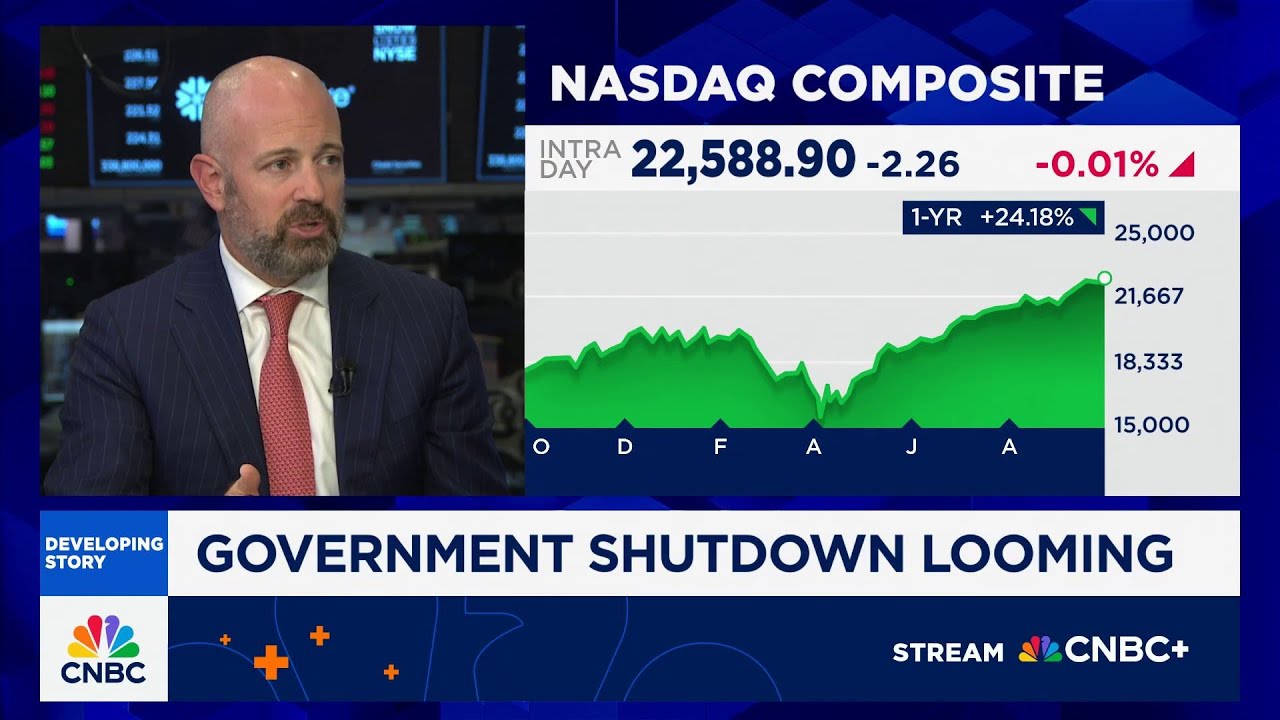
Not too worried about government shutdown from market perspective, says Morgan Stanley's Zezas
Youtube· 2025-09-30 16:20
Group 1 - The baseline expectation is a government shutdown, with prediction markets indicating over a 75% probability of occurrence [2][3] - Average shutdown duration is typically a few days, but can range from a few hours to several weeks, with a notable past instance lasting 35 days during Trump's first term [2][7] - Market impacts from the shutdown are expected to be muted, although potential layoffs could have a more significant effect on GDP [3][5] Group 2 - The estimated GDP impact from a shutdown is about 0.1% per week, which may diminish over time as government employees return to work [5] - There is uncertainty regarding the permanence of layoffs, as historical patterns show that courts often intervene to reinstate employees [4][6] - Sector-specific impacts may arise, particularly in industries like airlines and economic assistance programs, which could face disruptions [6][8] Group 3 - Despite potential growth risks from higher tariffs, the equity outlook remains constructive, indicating that earnings may perform well even if overall growth slows [8][9] - There is a disconnect between expected equity performance and broader economic conditions, suggesting that stocks could thrive despite economic challenges [9]

CarMax stock crashes after 'challenging' second-quarter earnings
Youtube· 2025-09-25 22:26
Core Insights - CarMax reported disappointing earnings, with revenue and vehicle sales falling short of analyst expectations, leading to a nearly 20% drop in stock price, reaching levels not seen since March 2020 [1] - The CEO indicated that performance worsened month by month during the quarter, highlighting a significant increase in loan loss provisions by 26% compared to the same quarter last year, indicating deteriorating loan quality [1][1] - The auto delinquency rate in the industry is currently at 2.54%, raising concerns about consumer strength and potential future delinquency rates reminiscent of the 2008-2009 financial crisis [1][1] Company Performance - CarMax's vehicle sales, both retail and wholesale, declined, contributing to the overall poor performance in key metrics [1] - The increase in loan loss provisions suggests a growing concern regarding delinquencies and defaults, particularly for loans issued in 2022 and 2023 [1][1] Industry Context - Despite CarMax's struggles, auto suppliers have performed well since early April, particularly after tariff announcements, as they have successfully passed on costs to automakers [1] - Stocks of auto suppliers such as Viston, Magna, BorgWarner, and Lear have outperformed major indices like the Dow Jones Industrial Average and S&P 500 over the past six months [1][1]

'Fast Money' traders discuss GM's stock after UBS upgraded to buy
Youtube· 2025-09-24 22:28
Group 1: General Motors - UBS upgraded General Motors from neutral to buy, raising the price target from $56 to $81, citing the company's ability to manage tariff costs effectively [1] - Analysts expect North American margins for General Motors to be between 8% to 10%, which is significantly higher than the street's expectation of 6% to 6.5% [5] - The potential for lower interest rates is anticipated to drive higher vehicle sales for General Motors [5] Group 2: Tesla - Tesla shares increased nearly 4%, marking the highest close since December, with analysts predicting a strong Q3 due to expected delivery numbers exceeding expectations [2] - The impending deadline for tax credits is expected to boost demand for Tesla vehicles in Q3 [2] - Analysts believe Tesla has favorable conditions heading into year-end, despite some anticipated challenges [3] Group 3: Automotive Market Conditions - Rising interest rates have made vehicles less affordable, impacting consumer purchasing behavior [4] - The overall price of cars is a concern, with significant increases noted compared to three years ago, influenced by tariffs and interest rates [4][6] - The automotive industry is experiencing a shift with regulatory changes that may provide short-term benefits but could pose long-term challenges [6]


From Skechers to Foot Locker: Tariff chaos spurs record-high footwear, apparel deals
Reuters· 2025-09-18 10:04
Core Viewpoint - The trade war initiated by U.S. President Donald Trump is driving U.S. clothing and footwear acquisitions to unprecedented levels this year, as companies seek mergers to mitigate tariff costs [1] Group 1: Industry Impact - The ongoing trade war is influencing strategic decisions within the clothing and footwear industry, prompting companies to pursue mergers and acquisitions [1] - Companies are merging to offset the financial burden imposed by tariffs, indicating a shift in industry dynamics [1] Group 2: Acquisition Trends - The current year is witnessing all-time high levels of acquisitions in the U.S. clothing and footwear sectors, reflecting a significant trend in the market [1]


X @Bloomberg
Bloomberg· 2025-08-17 15:06
Economic Sentiment - Consumers in the southeast US are growing more stressed [1] - Tariff costs are having a real impact [1]
高盛:投资者对修订后的标准普尔 500 指数预测的反馈
Goldman Sachs· 2025-07-15 01:58
Investment Rating - The report upgrades the S&P 500 valuation and return forecasts, expecting a rise of 10% to 6900 over the next 12 months, with a forward P/E multiple of 22x [3][4]. Core Insights - The S&P 500 forward P/E of 22x ranks in the 97th percentile since 1980, but is deemed appropriate given the current macroeconomic conditions, including declining interest rates and elevated corporate profitability [3][11][12]. - Earnings growth is projected at 7% for both 2025 and 2026, with EPS estimates of $262 and $280 respectively, although there are two-way risks around these forecasts [6][24]. - The report highlights narrow market breadth, with the median S&P 500 constituent 11% below its high, indicating potential for a momentum reversal in the equity market [30][34]. - Sector allocation recommendations include a mix of secular growth (Software & Services, Media & Entertainment), cyclical (Materials), and defensive (Utilities, Real Estate) industries, with a focus on AI-related technology stocks [41][44]. Summary by Sections Valuation and Earnings Forecasts - The S&P 500 is expected to reach 6900 in 12 months, with return forecasts of +2%, +5%, and +10% over 3, 6, and 12 months respectively [4][47]. - The forward P/E multiple has been increased to 22x, with EPS growth of 7% anticipated for 2025 and 2026 [6][49]. Market Conditions - Current macroeconomic conditions support the elevated P/E multiple, with expectations of earlier Fed easing and lower bond yields [12][16]. - The report notes that investor positioning is neutral, suggesting that current market multiples do not reflect investor exuberance [17][20]. Sector Preferences - There is no clear consensus on sector preferences among clients, but AI-related technology stocks are generally favored despite valuation concerns [41][44]. - The recommendation to invest in Alternative Asset Managers within the Financials sector has been positively received [41]. Market Breadth and Momentum - The S&P 500's recent record high contrasts with the median constituent being significantly below its peak, indicating narrow market breadth [30][34]. - A potential momentum rotation is anticipated, although it is expected to be short-lived rather than indicative of a new long-term trend [40].