
生态农业

Search documents
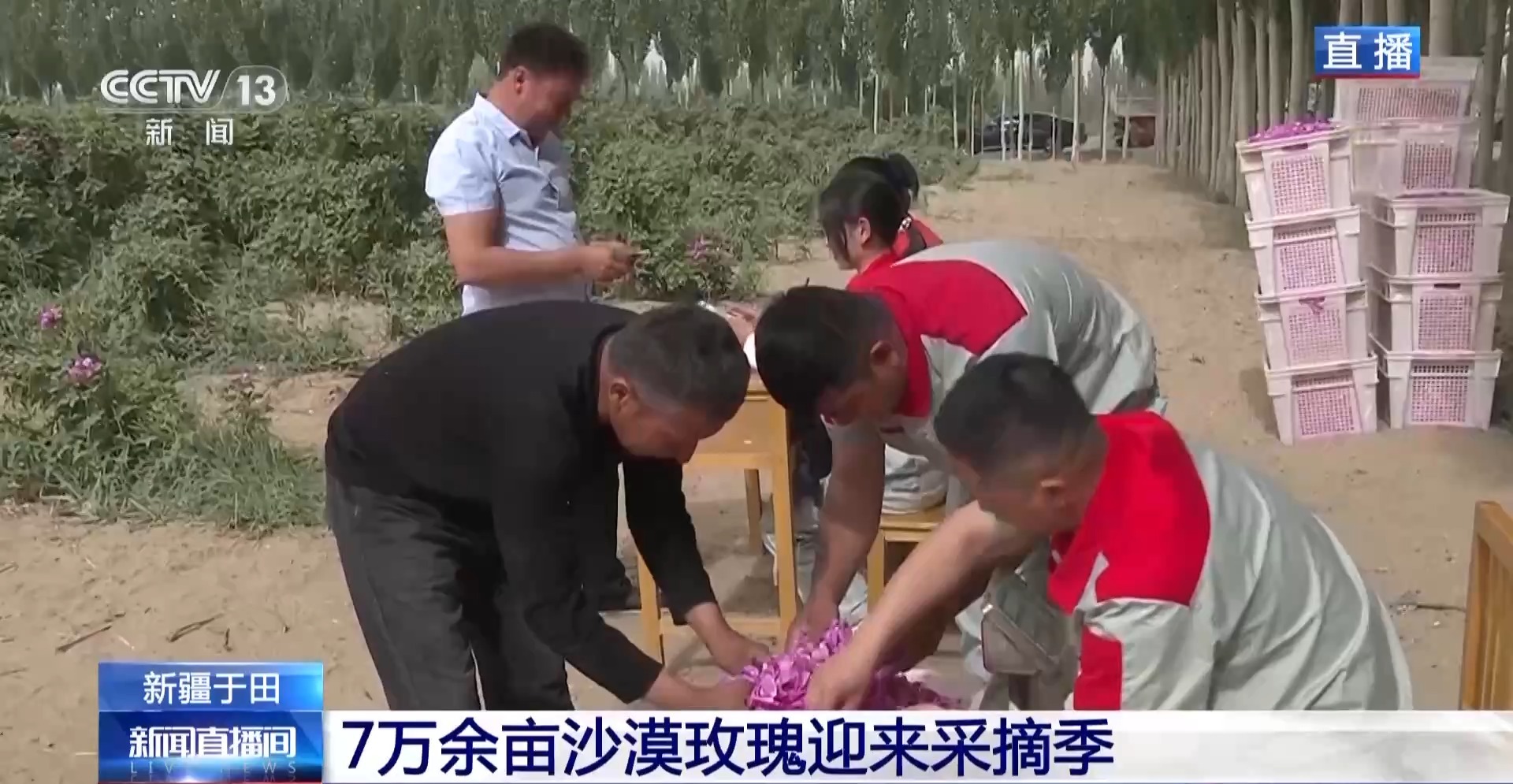
塔克拉玛干沙漠“锁边合龙”时种植的玫瑰花开了
Yang Shi Xin Wen Ke Hu Duan· 2025-05-21 10:01
Core Insights - The rose industry in Yutian County, located at the southern edge of the Taklamakan Desert, plays a significant role in both ecological protection and local economic development, with over 72,000 acres dedicated to rose cultivation [7][5][9] Group 1: Rose Cultivation and Harvesting - The optimal harvesting time for rose buds is between 5 AM and 9 AM to ensure high oil content, while petals are harvested avoiding midday heat to prevent dehydration [3] - Each villager can harvest approximately 30 to 50 kilograms of rose petals daily, contributing to the local economy [2][3] Group 2: Economic Impact - The rose industry has become a vital source of income for local residents, with daily trading volumes of rose petals reaching around 30 tons during peak seasons [9][11] - The price of roses this year is reportedly higher than in previous years, indicating strong demand from cooperatives and enterprises [11] Group 3: Employment and Community Development - The rose harvesting season creates seasonal employment for over 7,000 villagers, with daily wages ranging from 120 to 150 yuan [13] - Local cooperatives and enterprises are enhancing the value of rose products, such as rose-flavored bread and pure rose water, thereby increasing job opportunities [11][13] Group 4: Ecological Benefits - The cultivation of drought-resistant rose varieties helps combat desertification by stabilizing sand and reducing soil erosion [9][7] - The successful establishment of rose plants in the desert has achieved a survival rate of 90%, contributing to environmental sustainability [7][9] Group 5: Tourism Development - The rose fields attract numerous tourists for immersive experiences, including photography and painting, which further supports the local economy [5][15] - The local tourism department plans to expand the rose industry through a "cultural tourism+" model, promoting various activities such as picking and culinary experiences [15]

振兴“川字号”乡村产业
Jing Ji Ri Bao· 2025-04-21 22:10
Core Viewpoint - Sichuan province is making significant strides in transforming from an agricultural powerhouse to an agricultural stronghold, focusing on enhancing rural industries to reduce urban-rural disparities and promote common prosperity [1][2]. Agricultural Production - In 2022, Sichuan's total grain output reached 726.8 billion jin, with an average yield of 378.2 kg per mu, both setting historical records [1]. - The province maintained its position as the top producer of live pigs, with an output of 61.496 million heads [1]. Rural Industry Development - Sichuan is actively promoting rural industries to increase farmers' income, achieving a 6.6% growth in per capita disposable income for rural residents, surpassing the 1.9% increase for urban residents [1]. - In 2024, the total planting area for citrus in Pujiang County is expected to reach 445,000 mu, with an estimated output of 1.03 million tons and a production value of 7.282 billion yuan [2]. Innovative Agricultural Practices - The "Two Replacements" initiative in Pujiang County, which promotes organic fertilizers over chemical fertilizers and green pest control over chemical methods, has led to over 75% coverage of organic fertilizer use and over 70% for green pest control, resulting in a market price increase of over 30% for the produced goods [3]. - The county has also developed sustainable agricultural practices, such as rice-vegetable rotation and intercropping, achieving high yields and profitability [4]. Industry Clusters and Value Chains - Sichuan is focusing on building agricultural industry clusters, with a goal to create a comprehensive agricultural industry system that includes livestock, grain, and various specialty crops [6][7]. - The "1+1+8" strategy aims to enhance the agricultural value chain by integrating upstream production, midstream processing, and downstream marketing [7]. Farmer Benefit Mechanisms - The province is establishing mechanisms to ensure that farmers benefit from industrial growth, promoting models that connect small farmers with larger markets through cooperatives and direct purchasing agreements [9]. - In 2024, the East Slope District's pickled vegetable industry is projected to generate a comprehensive output value of 22.5 billion yuan, showcasing the economic impact of local agricultural enterprises [6]. Employment and Income Generation - The establishment of agricultural industry strong towns and clusters has created over 603,000 jobs, with participating farmers earning an average disposable income of 26,500 yuan, higher than the local average [12]. - Successful models of income generation include direct procurement agreements between processing companies and farmers, which have significantly increased farmers' incomes [10][11].