
Employment

Search documents
AI is already reshaping jobs, but not yet productivity
CNBC Television· 2025-08-29 21:13
Employment Trends - AI is expected to change work by shrinking the workforce and boosting productivity [1] - Stanford data indicates a 13% drop in employment for workers under 25 in jobs most exposed to AI [2] - MAG7 companies are reducing middle management, with Alphabet cutting 35% of small team managers [3] Company Strategies - Companies are seeing initial productivity gains from AI experiments, but widespread efficiency is still a challenge [1] - Companies are freeing up resources for AI development by cutting back middle management [4] - Companies are removing layers of leadership to speed up product cycles [4] Efficiency Gains - One manager is now able to do the work of three with the deployment of generative AI tools internally [5] - Microsoft is shedding 15,000 roles [3] - Amazon is pushing to flatten their org chart [3]

PCE Numbers In-Line, Pre-Market Fighting Off Lows
ZACKS· 2025-08-29 15:31
Economic Overview - Pre-market futures are improving following the release of major economic numbers, despite a drawback in EU markets due to rising unemployment and inflation in Germany [1] - U.S. indexes are experiencing volatility, with the small-cap Russell 2000 showing gains while other major indexes remain in the red [1] PCE and Inflation Metrics - July Personal Consumption Expenditures (PCE) figures were in-line with expectations, indicating no hindrance to the anticipated 25 basis point rate cut for the September Fed meeting [2] - Personal Income for July increased by 0.4%, the strongest since April, while Personal Spending rose by 0.5%, marking the highest increase since March [3] - The headline PCE Index showed a month-over-month increase of 0.2%, the lowest since May, with a year-over-year increase of 2.6%, consistent with the previous month [4] - Core PCE, excluding food and energy, increased by 0.3% month-over-month and 2.9% year-over-year, indicating stability in inflation metrics [5] Employment and Economic Indicators - Fed Chair Jerome Powell's focus has shifted from inflation to employment concerns, with July's non-farm payrolls showing an increase of 73K, which is below the previous four-month average of 54K [8] - A significant upward revision in PCE would be necessary to alter the current outlook, as weakening employment is influencing the decision for a rate cut [9] Trade and Inventory Data - Advanced Trade in Goods for July reported a deficit of $103 billion, which was more than $10 billion lower than anticipated [10] - Advanced Retail Inventories and Wholesale Inventories both reported a month-over-month increase of 0.2%, indicating stable inventory levels [11] Market Expectations - The upcoming week will feature new jobs reports, including July JOLTS numbers and private-sector payrolls from ADP, leading up to the significant BLS non-farm payrolls report [12]


X @The Wall Street Journal
The Wall Street Journal· 2025-08-28 01:16
Exclusive: Amazon plans to extend new employment offers to Whole Foods’ U.S. corporate employees https://t.co/cvBwrXkmXA ...

Mohamed El-Erian: I'm disappointed by what Fed Chair Powell did not cover in Jackson Hole
CNBC Television· 2025-08-25 13:11
Monetary Policy & Inflation - The market has priced in an 85% chance of a September rate cut, with the remaining 15% split between no cut and a 50 basis points cut [3] - The speaker suggests the Fed is de facto running an inflation target around 2.5% to 3% due to structural changes and employment considerations [8][9] - The long end of the curve's muted reaction suggests recognition of fiscal dominance, with high deficits and debt impacting monetary policy [11][12] Fed's Actions & Communications - The speaker acknowledges the Fed's recognition of higher employment risks but criticizes the lack of clarity on post-September policy and structural changes' implications [3][4] - The speaker expresses disappointment that Jackson Hole address didn't cover long-term strategy issues and lessons learned [5][7] - The speaker points out the Fed's tendency to be data-dependent rather than strategic [8] Sovereign Wealth Fund & Government Intervention - The speaker expresses concern about the government taking stakes in businesses beyond Intel, worrying about the blurring of ownership and control [16] - The speaker warns against government influence on business decisions, emphasizing the importance of a dynamic, entrepreneurial private sector [17][19] Global Economic Interdependence - US long-end rates are more influential globally than other countries' rates are on the US, with a beta near one for the US impacting the rest of the world [13]
X @Investopedia
Investopedia· 2025-08-23 18:00
Job Market Challenges - Anthropology, physics, computer engineering, commercial art and graphic design, or fine arts majors may face difficulties in finding employment [1] Career Guidance - The report provides tips for graduates to secure employment [1]
Powell says shifting risks may warrant Fed policy adjustment#shorts #powell #jacksonhole #fed
Bloomberg Television· 2025-08-22 15:25
Inflation & Employment Risks - Inflation risks are tilted to the upside, while employment risks lean towards the downside [1] - The framework necessitates balancing both sides of the dual mandate [1] Monetary Policy Stance - The policy rate is 100 basis points closer to neutral than a year ago [2] - The stability of the unemployment rate allows for careful consideration of policy changes [2] - With policy in restrictive territory, adjustments to the policy stance may be warranted [2] - Monetary policy is not on a preset course [3] - Decisions will be based solely on data assessment and its implications for the economic outlook and balance of risks [3]
Fed Chair Powell: Our policy actions depend on the economic outlook and the risks to that outlook
CNBC Television· 2025-08-22 14:50
Monetary Policy Framework - The policy decisions are guided by principles that consider deviations from goals and varying time horizons for achieving the dual mandate of maximum employment and price stability [1] - Monetary policy is forward-looking, considering the time lags in its effects on the economy, thus policy actions depend on the economic outlook and balance of risks [2] - Setting a numerical goal for employment is considered unwise because the maximum level of employment is not directly measurable and changes over time for reasons unrelated to monetary policy [3] - A longer-run inflation rate of 2% is viewed as most consistent with the dual mandate goals, and commitment to this target helps keep longer-term inflation expectations well anchored [3] Inflation Target - Experience has shown that 2% inflation is low enough to ensure that inflation is not a concern in household and business decision-making while also providing a central bank with some policy flexibility to provide accommodation during economic downturns [4] Review Cycle - The consensus statement retained a commitment to conduct a public review roughly every 5 years to reassess structural features of the economy and engage with the public, practitioners, and academics on the performance of the framework [4][5]
Powell Says Shifting Risks May Warrant Fed Policy Adjustment
Bloomberg Television· 2025-08-22 14:28
Monetary Policy Stance - The policy rate is 100 basis points closer to neutral than a year ago [2] - Policy is not on a preset course and may warrant adjusting [2] - Decisions are based solely on data assessment and its implications for the economic outlook and balance of risks [3] Economic Outlook & Risk Assessment - Near-term inflation risks are tilted to the upside, and employment risks to the downside [1] - The framework calls for balancing both sides of the dual mandate (inflation and employment) [1] - The stability of the unemployment rate allows for careful consideration of policy changes [2]
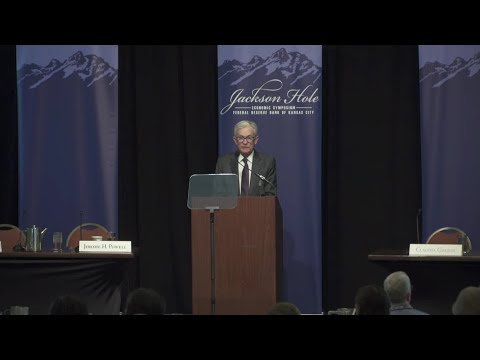
X @Ash Crypto
Ash Crypto· 2025-08-22 14:25
Economic Outlook - Downside risks to employment are rising [1] - Tariff effects on consumer prices are clearly visible [1] - Tariff impact on inflation is expected to be short lived [1] Monetary Policy - A rate cut is anticipated next month [1]
X @Wu Blockchain
Wu Blockchain· 2025-08-22 14:14
Monetary Policy - The Fed is abandoning its 2020 flexible average inflation targeting framework [1] - Stable inflation expectations cannot be taken for granted [1] - Uncertain estimates that employment may exceed its maximum sustainable level do not necessarily warrant policy tightening [1] - Preemptive action may be needed if a tight labor market risks price stability [1] Inflation & Tariffs - The impact of tariffs on consumer prices is now clearly evident [1]