Interest Rates

Search documents
Best CD rates today, March 9, 2026 (Lock in up to 4% APY)
Yahoo Finance· 2026-03-09 10:00
Core Insights - The Federal Reserve has reduced its target interest rate three times in 2025, impacting deposit account rates and presenting a potential opportunity to secure high certificate of deposit (CD) rates before they decrease further [1]. Group 1: Current CD Rates - The highest CD rate available today is 4% APY, offered by Marcus by Goldman Sachs for a 1-year CD [2]. - Today's average CD rates are among the highest seen in nearly two decades, significantly exceeding the national average of 1.55% for a 1-year term [3]. Group 2: National Average CD Rates - The national average CD rates are considerably lower than the best available rates, with online banks and credit unions typically offering more competitive options compared to traditional banks [3]. - The Federal Reserve's strategy to combat inflation has contributed to elevated interest rates, influencing the current CD rate landscape [3]. Group 3: Finding the Best CD Rates - It is advisable for consumers to shop around and compare CD rates from various financial institutions to find the best options [4]. - Online banks often provide higher interest rates on CDs due to lower overhead costs, making them a preferable choice for consumers seeking competitive rates [4]. - Consumers should be aware of minimum deposit requirements and review account terms, including early withdrawal penalties and auto-renewal policies, to ensure alignment with their financial goals [4].
US Equities Dragged Into Global Selloff as Iran Crisis Escalates
Bloomberg Television· 2026-03-09 07:00
So, Mark, a warning from Yardeni Futures pointing to a very rough day for U.S. stocks. What are the odds of a major sell off at this point. And I'm not just talking about a couple of more percentage points.Yeah. Much higher than they were a week ago, that's for sure. As you've been hearing from everybody today, I mean, the significant change over the weekend is the fact that oil prices are now above $100 rather than below, and they're quite likely going to stay there for some time as well.That's a game chan ...


X @Bloomberg
Bloomberg· 2026-03-09 02:48
In today’s Markets Daily India, we look at how rising oil prices are clouding the outlook for bank earnings and interest rates. https://t.co/hHpfxsQw5g ...
$150 Oil Won't Hurt Broadcom's Business, But It Could Still Hurt the Stock
247Wallst· 2026-03-09 02:32
Group 1 - Broadcom's business model is asset-light, with capital expenditures of only $250 million in Q1 FY2026 against $19.31 billion in quarterly revenue, indicating resilience to oil price fluctuations [1] - The company has a significant backlog of $73 billion in AI infrastructure spending, which is expected to remain unaffected by oil price spikes, as these are strategic commitments from major clients like Google, Amazon, and Meta [1] - AI revenue for Broadcom reached $8.4 billion in Q1 FY2026, reflecting a 106% year-over-year increase, with expectations of $10.7 billion in Q2, showcasing a structural growth trajectory [1] Group 2 - A hypothetical $150 oil price could lead to broader market concerns, impacting high-multiple tech stocks like Broadcom, which trades at approximately 69x trailing earnings and 31x forward earnings [1] - Sustained high energy costs could potentially slow down data center expansions by hyperscalers, which may soften demand for Broadcom's products at the margins [1] - Despite strong fundamentals, the stock could face short-term compression due to macroeconomic fears and a shift in investor sentiment towards safer assets [1]


Oil’s Push Toward $100 Increases Risks for Stocks and Credit Markets
Mott Capital Management· 2026-03-08 12:45
Market Overview - The S&P 500 experienced a decline of over 1% as oil prices surged past $91, with indications of an opening around $95 for the weekend [1][2] - The Nasdaq 100 proxy is trading lower by approximately 70 basis points, reflecting a broader market trend [1] Oil Market Dynamics - An opening price of $95 for oil would represent its highest level since September 2023, with potential for further increases into the $100 to $110 range as resistance levels thin out [2] - Rising gasoline prices are significant, with current resistance levels at $2.60, $2.81, and $3.00, which could impact inflation metrics [4] Inflation and Economic Indicators - The rise in oil and gasoline prices is expected to exert upward pressure on inflation, particularly with upcoming CPI and PCE reports [4] - Gasoline has a nearly 3% weighting in the headline CPI report, suggesting that March data will likely reflect the recent increases in energy prices [4] Credit Market Implications - Rising commodity prices, including oil and gasoline, are likely to widen credit spreads and pressure high-yield credit, which may affect stock market performance [9][23] - The relationship between the HYG ETF and RBOB gasoline indicates that increasing oil prices could lead to lower high-yield credit performance [9] Market Sentiment and Future Outlook - The current market regime is characterized by liquidity pressures and volatility, with rising oil prices potentially signaling a recession warning if they continue to escalate [5][7] - The market remains uncertain regarding the ultimate direction of oil and gasoline prices, indicating a need for close monitoring [25]
HELOC and home equity loan rates Sunday, March 8, 2026: Seasonal demand grows
Yahoo Finance· 2026-03-08 10:00
Core Insights - The onset of daylight saving time increases interest in home equity lines of credit (HELOCs) and home equity loans as homeowners look to enhance their properties [1] Interest Rates - The average HELOC rate is currently 7.20%, a decrease of three basis points from the previous month, while the average home equity loan rate is 7.47%, an increase of three basis points [2] - The 52-week low for HELOCs was 7.19% in mid-January, and the low for home equity loans was 7.38% in early December 2025 [2] Homeowner Considerations - Homeowners with low primary mortgage rates may find it challenging to access their home's increasing value, making HELOCs or home equity loans a viable option [3] - Home equity interest rates differ from primary mortgage rates, typically based on an index rate plus a margin, with the current prime rate at 6.75% [4] Lender Flexibility - Lenders have flexibility in pricing second mortgage products, and rates can vary based on credit score, debt levels, and the loan-to-value ratio [5] - HELOCs may include introductory rates that last for a limited time, after which rates can become adjustable [5] Loan Characteristics - Home equity loans generally do not have introductory rates, providing a fixed rate throughout the loan term [6] - The best HELOC lenders offer low fees, fixed-rate options, and generous credit lines, allowing homeowners to utilize their equity as needed [7] Current Offers - LendingTree currently offers a HELOC APR as low as 6.13% for a credit line of $150,000, but borrowers should be aware of the variable nature of HELOC interest rates [8] - Home equity loans provide a fixed rate for the duration of the repayment period, simplifying the borrowing process [9] Market Trends - The national average for HELOCs is 7.20% and 7.47% for home equity loans, with rates varying significantly based on individual creditworthiness [11] - For homeowners with substantial equity and low primary mortgage rates, now is considered an advantageous time to secure a HELOC or home equity loan for home improvements [12]
‘Not a very strong economy by any stretch of the imagination’: Financial journalist
MSNBC· 2026-03-07 21:49
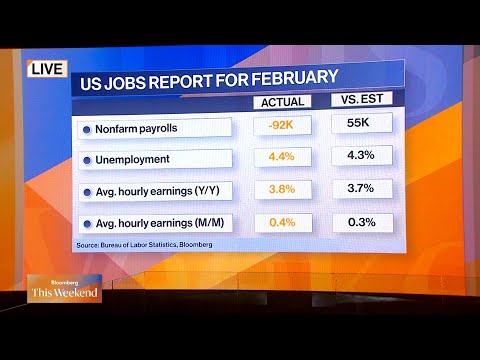
Some new reaction today to the domestic impact of the war in Ira compounded by a weak jobs report. Joining me now is our friend Ron Insana, senior analyst and commentator at CNBC. Ron, big welcome to you.Looking at the U .S. labor market, it lost LOST 92 ,000 JOBS IN FEBRUARY FALLING EXTREMELY SHORT OF JANUARY'S GAIN OF 126 ,000 JOBS. MEANWHILE THE UNEMPLOYMENT RATE CLIMBED SLIGHTLY HIGHER TO 4 .4%.SO WHAT KIND OF OUTLOOK DOES THIS paint for the U .S. economy, does this add another layer of uncertainty in w ...

Fed Policymakers Cautious Over Rising Gas Price Concerns
Bloomberg Television· 2026-03-07 15:57
Bloomberg News Economics Editor, Michael McKee, joins Bloomberg’s David Gura and Christina Ruffini to discuss recent comments from Tom Barker of the Richmond Fed regarding the impact of rising gasoline prices on the US economy. The Federal Reserve is aware that lowering interest rates will not reduce gasoline prices and could instead fuel inflation, so they are monitoring for secondary effects on the broader economy rather than reacting directly to fuel cost changes. Watch on "Bloomberg This Weekend." ----- ...
X @Bloomberg
Bloomberg· 2026-03-07 08:10
European Central Bank efforts to project calm over war and inflation are being tested as markets price in a hike in interest rates this year https://t.co/LjkrlwJBzd ...
The Fed Is Behind! CUT RATES NOW Before The Economy Worsens
From The Desk Of Anthony Pompliano· 2026-03-06 22:01
Hello everyone. The jobs report this morning shows that the Fed is behind the curve. We know the Donro doctrine is changing financial markets quickly.Geopolitics has rattled markets. And Anthropic just dropped a brand new chart that's going to make you question whether AI can take your job. We're live today from the desk of Anthony Pompiano.Before we get into today's episode, I need your help. We currently have 44,763 subscribers on YouTube. My goal is to get to 1 million.Hit the subscribe button and let's ...