
National Security

Search documents
X @外汇交易员
外汇交易员· 2025-09-29 23:42
Government Policy & National Security - The U.S government is considering equity investments in critical mineral producers to strengthen supply chains deemed vital to national security [1] - The U.S government is exploring quasi-equity investments, potentially including warrants to purchase company shares [1] - A forum hosted by the Australian Ambassador to the U.S attracted key officials involved in the Trump administration's critical minerals policy [1] International Cooperation - Over ten Australian mining companies met with U.S officials in Washington to discuss potential investments [1] - The discussions did not focus on specific transactions but explored financial techniques the government could utilize [1]
China Has Mass. Can America Catch Up?
a16z· 2025-09-29 13:00
Manufacturing & Industrial Base - US technological superiority is not sufficient for winning conflicts; industrial production has a deterrence factor and mass matters [1] - The US systematically outsourced key-scaled manufacturing, eroding skill sets, and now lags in mass manufacturing at scale [1] - The US needs to address the skilled labor replacement problem in manufacturing, as many skilled workers are nearing retirement [2] - China has strategically controlled rare earths and magnet-making technology, creating supply chain bottlenecks [3] - China's manufacturing autonomy is estimated to be 20 years ahead of the US due to a lack of pressure to put software engineering automation in manufacturing [3] Defense & National Security - US war games show that the US would run out of key high-end munitions in about 8 days, which is not a deterrence factor [1] - Russia is currently outproducing NATO on 155 munitions, highlighting the need for increased production capacity [4] - The US lacks a strategic plan for preserving supply in a catastrophic situation [4] - China has invested in technologies that push back the US and cripple the US war apparatus, such as space-based sensing and carrier killer missiles [20][21] - The US military is better at infusing technology into war fighting, but faces challenges in producing enough at scale and affording it [4] Policy & Economic Strategies - The US government should create large offtake agreements to support domestic manufacturing and create a commercial market [5] - The US needs to identify key supply chain constraints and implement strategies such as stockpiling and regulatory relaxation [5] - The US should leverage its capital market system to create incentives for industries to grow, such as low-cost loans and risk-sharing with banks [5][9] - China's success is due to subsidizing capex, energy, and export subsidies, creating an uneven playing field [7] - The US should counteract unfair practices from other countries and incentivize growth through targeted policies and protectionism [13]


Pres. Trump urges Microsoft to fire Lisa Monaco, who served as deputy AG in the Biden administration
CNBC Television· 2025-09-29 12:52
Business and Politics Intersection - President Trump urged Microsoft to fire Lisa Monaco, citing national security concerns due to her past role in the Biden administration and Microsoft's government contracts [1][2] - The situation highlights the increasing partisan nature of Washington and its potential impact on corporate hiring decisions [3][4][6] - The discussion raises concerns about government intervention in business and the potential chilling effect on the "revolving door" between government and corporate America [7] Talent Acquisition and Corporate Strategy - Companies may face challenges in hiring individuals with previous government affiliations due to potential political backlash [6] - The potential shutdown of the revolving door could impact the ability to attract talent to government positions [7] - The lack of public outcry from business leaders and political figures suggests a climate of fear and reluctance to challenge government intervention [7]


Trump Explodes On Truth Social, Demands Microsoft Fire Ex–Biden DOJ Official Lisa Monaco: '...A Menace To US National Security' - Microsoft (NASDAQ:MSFT)
Benzinga· 2025-09-27 02:12
Core Viewpoint - President Trump has called for Microsoft to terminate Lisa Monaco, citing concerns over national security due to her previous role in the Biden administration and her current position at Microsoft [2][3]. Group 1: Trump's Allegations - Trump labeled Monaco as a "menace to U.S. National Security," referencing her past actions that led to the revocation of her security clearances and access to national security intelligence [2]. - He emphasized that Monaco's wrongful acts have serious implications for Microsoft's contracts with the U.S. Government [2]. Group 2: Monaco's Role and Background - Monaco was instrumental in coordinating the Justice Department's response to the January 6 Capitol assault [3]. - She joined Microsoft in July as the President of Global Affairs, indicating her significant role within the company [4]. Group 3: Microsoft's Government Contracts - Microsoft has a substantial portfolio of contracts with various U.S. government agencies, recently agreeing to provide $3.1 billion in savings on cloud services over one year [4]. Group 4: Recent Policy Changes - Microsoft has made recent policy changes, including cutting off cloud-based storage and AI subscriptions to a unit of the Israeli military following investigations into their activities [5].
Trump calls for firing of Microsoft's global affairs president who served in Biden administration
CNBC Television· 2025-09-26 22:59
Melissa, President Trump here creating a potential political problem for Microsoft. Uh posting on social media just a short time ago, a lengthy attack on Lisa Monaco, who is the deputy attorney general under President Biden. Uh President Trump blames Monaco for her involvement in the Russia investigation, the January 6 investigation, and a whole host of other things. And in a lengthy post about her, uh which he just put up, he says this. He says, "Monaco has been shockingly hired as the president of global ...
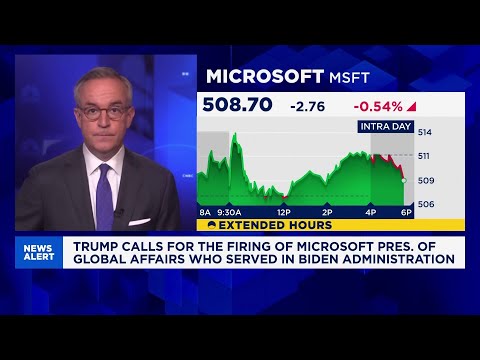
Trump calls for the firing of Lisa Monaco, Microsoft president of global affairs
CNBC· 2025-09-26 21:40
Group 1 - The U.S. Deputy Attorney General Lisa O. Monaco is facing calls for her dismissal from Microsoft by former President Donald Trump, citing concerns over national security due to her previous role in the Biden administration [1][3] - Trump's demand follows the indictment of former FBI Director James Comey and is made through his Truth Social account, which has a significant following of 10 million [2] - Monaco has been accused by Trump of having her security clearances revoked and being banned from federal properties, which he claims is due to her "wrongful acts" [3] Group 2 - Microsoft has significant contracts with the U.S. government, utilizing its cloud infrastructure and productivity software, and recently agreed to provide $3.1 billion in savings on cloud services for government agencies [4] - Following an investigation, Microsoft decided to cut off cloud-based storage and AI subscriptions to a unit of the Israeli military over allegations of tracking Palestinians' phone calls [5]
X @The Wall Street Journal
The Wall Street Journal· 2025-09-26 16:09
Industry Perspective - Robotics is seen as essential to U S economic growth and national security [1] - The U S needs to beat China in robotics [1] Leadership Insight - Jeff Cardenas, CEO and co-founder of Apptronik, shares his views [1]