世界级城市群

Search documents
专家建议:在新一轮疏解中加强科技创新和产业创新融合发展
Bei Jing Ri Bao Ke Hu Duan· 2025-05-21 14:00
Core Viewpoint - The Beijing-Tianjin-Hebei region has entered a deep collaborative development phase, with a focus on enhancing technological and industrial innovation integration during the new round of non-capital function relocation [1][4]. Group 1: Non-Capital Function Relocation - The new round of non-capital function relocation aims to strengthen industrial cluster cultivation, with a focus on relocating central enterprise headquarters and their subsidiaries to Tianjin and Hebei [4]. - The construction of urban agglomerations in Beijing, Tianjin, and Shijiazhuang is emphasized to optimize spatial structure and promote the integration of technological and industrial innovation [4][5]. Group 2: Technological and Industrial Innovation Integration - There is a need to enhance the integration of technological innovation and industrial innovation, as current advantages in technological innovation have not been effectively transformed into industrial innovation advantages [7]. - Recommendations include accelerating the construction of the Beijing International Science and Technology Innovation Center and optimizing the collaborative innovation spatial layout in the region [7][12]. Group 3: World-Class City Cluster Development - The overall positioning of the Beijing-Tianjin-Hebei collaborative development is to build a world-class city cluster centered around the capital [12]. - Suggestions include focusing on advanced manufacturing clusters and addressing the innovation capability shortfalls in Hebei [12][13]. Group 4: Higher Education and Talent Development - Xiong'an New Area is becoming a significant hub for high-level open international higher education through the relocation of Beijing's universities [18]. - The development of a modern industrial system necessitates a large number of high-quality new talents, which can be supported by enhancing higher education collaboration and industry-education integration [20]. Group 5: Policy Recommendations - Recommendations for Xiong'an New Area include applying for the establishment of a national comprehensive innovation reform pilot zone and exploring new financing methods suitable for technological innovation [22].

新华全媒+|专家建议:在新一轮疏解中加强京津冀产业协作创新
Xin Hua She· 2025-05-19 02:40
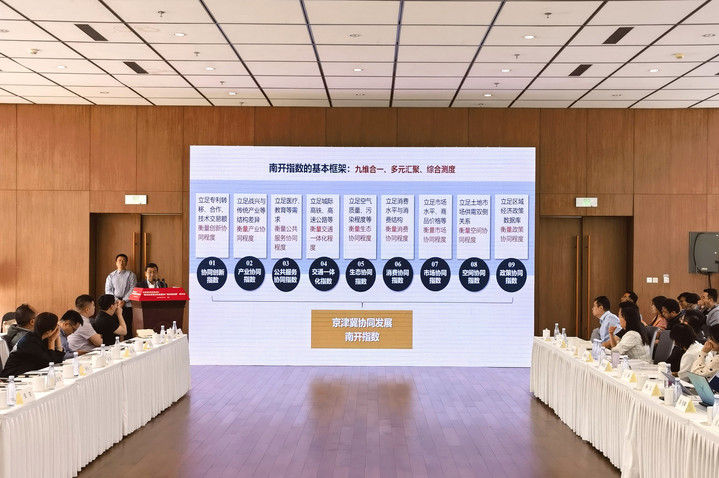
Group 1 - The core viewpoint of the articles emphasizes the collaborative development of the Beijing-Tianjin-Hebei region, focusing on deepening industrial cooperation and enhancing regional innovation capabilities to build a world-class city cluster [1][2][4] - The Beijing-Tianjin-Hebei collaborative development index increased from 0.38 in 2018 to 0.58 in 2023, indicating a transition from extensive growth to high-quality development [1] - The region aims to address urban challenges through the relocation of non-capital functions, with a focus on central enterprise headquarters and service institutions [2] Group 2 - Experts suggest that industrial collaboration is shifting from single project undertakings to full-chain cooperation, requiring broader and deeper engagement [4] - The region's GDP growth rate is projected to exceed the national average in 2024, reaching a total of 11.5 trillion yuan, which is 2.1 times that of 2013 [2] - The development of an international technology innovation center in Beijing is crucial for enhancing innovation resources and driving collaboration with Tianjin and Hebei [4]