
空气质量

Search documents
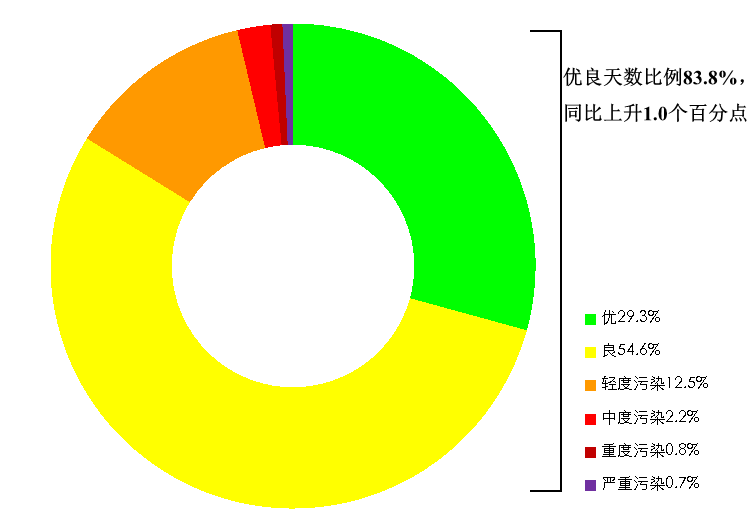
1—6月全国339个地级及以上城市平均空气质量优良天数比例为83.8%
Yang Shi Wang· 2025-07-28 03:20
Air Quality Overview - In June, the average PM2.5 concentration across 339 cities was 16.3 µg/m³, a year-on-year decrease of 4.7% [2] - The average PM10 concentration was 33 µg/m³, down 5.7% year-on-year [2] - The average O3 concentration was 153 µg/m³, an increase of 0.7% year-on-year [2] - The proportion of days with good air quality was 84.0%, up 5.7 percentage points year-on-year [2] - The proportion of days with heavy pollution was 0.2%, unchanged year-on-year [2] Year-to-Date Air Quality - From January to June, the average PM2.5 concentration was 32.1 µg/m³, a decrease of 2.4% year-on-year [2] - The average PM10 concentration remained stable at 55 µg/m³ [2] - The average NO2 concentration was 20 µg/m³, down 4.8% year-on-year [2] - The average CO concentration was 1.0 mg/m³, a decrease of 9.1% year-on-year [2][3] Key Regions Analysis Beijing-Tianjin-Hebei Region - In June, the average PM2.5 concentration was 24.2 µg/m³, down 11.7% year-on-year [7] - The average O3 concentration was 213 µg/m³, a decrease of 3.6% year-on-year [7] - The proportion of good air quality days was 46.5%, an increase of 26.9 percentage points year-on-year [7] Yangtze River Delta Region - In June, the average PM2.5 concentration was 18.1 µg/m³, down 10.8% year-on-year [9] - The average O3 concentration was 176 µg/m³, a decrease of 11.6% year-on-year [9] - The proportion of good air quality days was 76.0%, an increase of 15.7 percentage points year-on-year [9] Fenwei Plain - In June, the average PM2.5 concentration was 20.4 µg/m³, down 17.4% year-on-year [11] - The average O3 concentration was 197 µg/m³, a decrease of 3.9% year-on-year [11] - The proportion of good air quality days was 49.2%, an increase of 15.3 percentage points year-on-year [11] Key Cities Performance - Among 168 key cities, the top 20 cities with the best air quality included Lhasa, Haikou, and Zhangjiakou [12] - The bottom 20 cities with the poorest air quality included Xianyang, Xi'an, and Kaifeng [12] - The cities with the most significant improvement in air quality included Xinzhou, Hohhot, and Baotou [12][13]

6月下半月,全国大部分地区空气质量以优良为主
Xin Jing Bao· 2025-06-17 06:25
Core Viewpoint - The overall air quality in China for the second half of June is expected to be predominantly good, with some regions experiencing moderate pollution due to high temperatures and dust storms [1][2]. Group 1: National Air Quality Forecast - The air diffusion and wet removal conditions across the country are generally favorable, leading to good air quality in most areas [1]. - The Beijing-Tianjin-Hebei region and surrounding areas may experience light to moderate pollution due to high temperatures, particularly from June 17 to 30 [1]. - Dust storms may cause moderate or higher pollution levels in eastern and southern Xinjiang during certain periods [1]. Group 2: Beijing Air Quality Forecast - In Beijing, the air quality is expected to be good for most of the second half of June, with some periods of light ozone pollution [2]. - From June 18 to 25, average diffusion conditions are expected, leading to light pollution from ozone [2]. - The primary pollutant in Beijing during this period is expected to be ozone (O3) [2].
4月全国地级及以上城市平均空气质量优良天数比例为83.1%
Zhong Guo Xin Wen Wang· 2025-05-28 01:58
Group 1 - The average proportion of days with good air quality in 339 cities in China was 83.1% in April, a year-on-year decrease of 6.7 percentage points [1] - From January to April, there were 2060 days of sandstorm exceedance, an increase of 497 days compared to the previous year [1] - The main reasons for the increased sandstorm frequency include reduced precipitation, higher temperatures, and strong winds [1] Group 2 - The average concentration of PM10 in April was 56 micrograms per cubic meter, a year-on-year increase of 5.7% [1] - The proportion of days with severe pollution was 2.1% in April, an increase of 0.9 percentage points year-on-year [1] - It is expected that after June, the risk of sandstorms will significantly decrease due to increased rainfall and vegetation growth [2]
环境空气污染简介:空气污染与卫生工作者培训工具包(APHT)
WHO· 2025-03-20 06:34
Investment Rating - The report does not provide a specific investment rating for the industry Core Insights - The report emphasizes the increasing global concern regarding air pollution and its significant health impacts, particularly on non-communicable diseases and the overall disease burden [5][6][50] - It highlights the role of the World Health Organization (WHO) in developing air quality guidelines and the importance of addressing air pollution as a public health issue [50][54] Summary by Sections Historical Context of Air Pollution - The report discusses the historical events of air pollution, including the London smog of 1952, which resulted in thousands of deaths and led to significant legislative changes [24][25] - It notes that air pollution has been a concern since ancient times, with increasing intensity during the Industrial Revolution [16][24] Classic Air Pollutants and Their Sources - The report identifies key air pollutants, including particulate matter (PM), nitrogen oxides (NOx), sulfur dioxide (SO2), and ozone (O3), and discusses their sources such as transportation, industrial activities, and residential fuel use [62][73] - It categorizes pollutants into primary and secondary pollutants based on their origins and formation processes [82][83] Health Impacts of Air Pollution - The report outlines the health effects of air pollution, linking it to increased risks of cardiovascular diseases, respiratory issues, and overall mortality [5][6][94] - It emphasizes the need for improved public awareness and political will to combat air pollution [44] WHO's Role and Guidelines - The report details the WHO's efforts in establishing air quality guidelines, which are based on extensive scientific evidence regarding the health impacts of air pollution [50][54] - It mentions the updates to the WHO air quality guidelines in 2021, which set lower recommended levels for pollutants compared to previous guidelines [55][56] Data Sources for Air Quality - The report introduces two key databases for air quality data: the WHO Air Quality Database and OpenAQ, highlighting their roles in providing verified and real-time air quality information [57][58]