Neurodiversity

Search documents
The Neurodivergent Experience | Sofia Amorim Fuchs | TEDxGerman European School Singapore Youth
TEDx Talks· 2025-10-02 15:23
Hi, my name is Sophia Fuks. I am neurody divergent and I would like to tell you how to understand neurodiversity and why we should support it. First of all, a lot of you guys may be asking, "Oh, Sophia, what on earth is neurodeiversity?" Well, let me explain.Neurode diversity is defined as the concept that not all brains are the same and that we all have different ways of thinking. Adding on to that, a person who is neurode divergent has different brain wiring. So think someone with ADHD, autism, Tourette's ...

Writing: As a Way of Life | Ms. Mariyam | TEDxKnowledgeum Academy Youth
TEDx Talks· 2025-09-30 15:14
[Music] The question should not be that if I'm audible. The question should be if I'm visible. [Music] >> It's okay. It's just me singing a prayer song.[Music] >> Dear friend, I will move on around you like the earth and I will get anything and everything I want done. Time stop and rock and roll. I will make well and beauty.Time stop and rock and roll. I believe well and beauty. [Music] So why were there so many people holding a piece of paper as if they escaped prison and they were wanted.Well, they are wa ...

Designing truly inclusive education for every child | Gayatri Narasimhan | TEDxVITPune
TEDx Talks· 2025-09-22 16:26
Core Concept - Unifying pathways aims to create one school for many abilities, merging the mainstream and special education systems to ensure all learners are included and valued [5][7][13] - The unifying pathways model focuses on assessment of individual interests, needs, and learning styles, implemented through teacher training, peer awareness programs, adaptable classrooms, and a supportive environment [21][22][23] - The unifying pathways model draws inspiration from the ancient Indian Gurukul system, where all types of learners learn together with dignity, regardless of their abilities [24][25] Challenges and Solutions - Parents' concerns about inclusion, such as children being left behind or learning unwanted behaviors, can be addressed through awareness programs, parent-teacher dialogues, and transparent school policies [26][27] Statistics and Impact - Only 10% of neurodivergent students progress from 10th to 12th grade, and only 5% continue to college, highlighting a systemic issue [32] - 30% of learners in any school have learning disabilities, indicating a significant portion of students are struggling in systems not designed for them [33] Call to Action - Teachers should learn new ways to include all children, parents should teach their children to see beyond differences, and policymakers should design inclusive systems [34]
How being neurodivergent affects my life | Alessia Block | TEDxUniversityCollegeRoosevelt
TEDx Talks· 2025-09-19 15:52
Neurodiversity & Self-Awareness - The discussion revolves around the complexities of self-awareness, particularly in the context of neurodivergence (autism and ADHD) [1][3][19] - The speaker shares their personal journey of being diagnosed with autism and ADHD, highlighting the initial lack of understanding and the later challenges faced in college [2][3][7] - The presentation explores the dual nature of self-awareness, acknowledging its potential for growth and adaptation while cautioning against the pitfalls of excessive self-criticism [17][18] Challenges & Coping Mechanisms - The speaker describes the difficulties encountered in college due to ADHD, including disorganization, attention dysregulation, insomnia, and executive dysfunction [8][9][11] - The narrative addresses the internal conflict between past achievements and current struggles, leading to feelings of incompetence and laziness [9][10] - The speaker emphasizes the importance of seeking help from peers, professors, parents, and psychiatrists to manage the challenges associated with neurodivergence [13] Impact of Diagnosis - The diagnosis of autism and ADHD is not portrayed as a simple solution but rather as a starting point for self-understanding and adaptation [19][20] - The speaker notes that increased self-awareness can sometimes lead to heightened self-consciousness and overthinking of social interactions [14][15] - The presentation advocates for a balanced approach to self-awareness, encouraging self-understanding without succumbing to self-doubt and negative self-criticism [18]
The myth of the gifted girl | Kaia Vernon-Oliveria | TEDxLasVegas
TEDx Talks· 2025-09-11 15:57
Giftedness & Neurodiversity - Up to 5% of the population is gifted, and 0.1% is profoundly gifted, defined as having an IQ of 145 and up [4] - Giftedness is a type of neurodiversity where brains process information differently [4] - Giftedness in girls is often overlooked or diagnosed later than in boys due to differing manifestations [5] Gender Differences in Giftedness - Educators recognize perfectionism in over 50% of gifted girls [12] - 58% of educators believe gifted girls are likely to downplay their abilities to fit in [12] - Gifted girls may be seen as smart but not as gifted, leading to fewer spots in gifted programs [9] - Teachers are more likely to nominate boys for gifted programs or suggest they get tested [9] Recommendations - More research is needed on gifted girls [16] - Parents and teachers need to better recognize giftedness in girls and ensure they take up space in gifted programs [16] - Address how perfectionism, self-criticism, and emotional intensity can derail gifted girls from unleashing their full potential [18]

ADHD and Autism: Breaking Misconceptions | Millie Sawyer | TEDxCronulla High School Youth
TEDx Talks· 2025-08-12 15:25
Neurodiversity Awareness and Understanding - The presentation emphasizes the need for increased awareness and understanding of neurodiversity, specifically ADHD and autism [1][25] - It highlights that ADHD and autism are spectrums with diverse presentations, challenging common misconceptions [2][3][13][14] - The speaker advocates for recognizing neurological differences as variations rather than deficits or mental illnesses [25] - The presentation addresses the limitations of a one-size-fits-all education system for neurodivergent individuals [5][9] - It encourages educators and others to consider alternative approaches to learning and problem-solving that accommodate different cognitive styles [10][12] Types and Levels of ADHD and Autism - The presentation clarifies that there are three types of ADHD: inattentive, hyperactive, and combined [15][16][17] - It explains that autism is categorized into three levels based on the amount of support an individual requires [19][20][22][23] - Level one autism (formerly Asperger's) may involve difficulty with social cues and transitions [20] - Level two autism requires substantial support, potentially involving antisocial behavior or distress when change occurs [22] - Level three autism requires high levels of support, potentially involving difficulty or inability to speak [23]
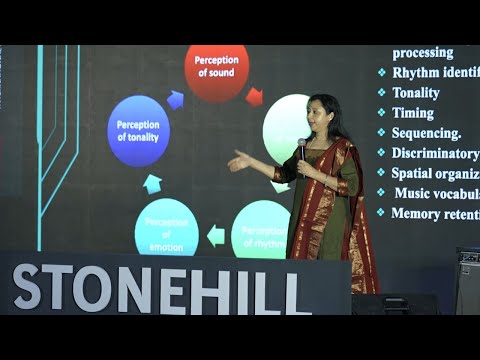
Music’s Transformative Resonance | Dr Geetha Ramanatha Bath | TEDxStonehill Intl School
TEDx Talks· 2025-07-25 15:24
Music Therapy & Neurodiversity - Music serves as a powerful medium to connect with disadvantaged communities, especially neurodiverse individuals including those with autism spectrum disorder, ADHD, and chromosomal abnormalities [2] - Indian classical music is utilized as a foundation for music-based interventions, drawing from ancient wisdom and cultural roots [4][5] - Music engages the entire brain, stimulating various regions regardless of active or passive participation, impacting memory, emotion, and reward perception [8][9][10] - Music is a multi-sensory experience involving kinesthetic, auditory, and visual systems, crucial for children playing instruments [12][13] - Individuals with autism may not perceive music as a whole due to sensory sensitivities, requiring a breakdown into elements [15][16] - Music perception involves multiple processes including sound, tone, emotion, and language [17][18] - Music can be collaborated with disciplines like psychology and neuroscience to provide scientific backing [26][27] - Music offers emotional resilience and can be used as a healing agent in a stressful world [28][30] - Music therapy emphasizes empathy over entertainment, aiming to understand and alleviate others' pain [32][33] Case Study - A case study highlighted a child with autism who initially struggled to differentiate between sound, music, and noise, but after intervention, could recite texts [20][21][22][23]
How Does It Feel to Be Neurodivergent? | Luke Whiteoak | TEDxYouth@YCYWShanghai
TEDx Talks· 2025-07-08 15:26
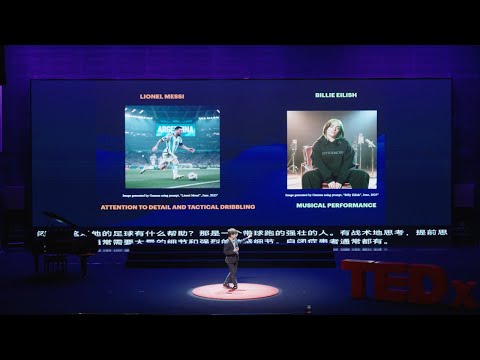
[Music] I often feel that this question is blindly ignored among my fellow peers which is why I'm stepping forward today to ask how does it feel to be neurodyiverged. ent. Well, it's a question without a short answer.My name is Luke White Oak and I have a mental disorder called autism. And I want to show you how that feels for me. But first, we need to find the ethmology of this word.Neuro meaning mind and divergent is just a synonym for different. So, neurode divergence is just to have a different mind. I ...
What happens when you stop masking your differences | Jesse Sanchez | TEDxWIS Youth
TEDx Talks· 2025-06-30 16:40
Personal Background & Challenges - The speaker's early life was marked by instability, violence, and exposure to drug cartels, leading to a search for belonging in harmful environments [1] - The speaker was diagnosed with ADHD and learning disabilities, which initially made school difficult until academic accommodations were received [1] - The speaker experienced a significant decline in academic performance and self-worth at Berkeley after discontinuing academic accommodations, leading to feelings of being a fraud [1] Turning Points & Community - Community college provided a transformative experience through mentorship and student leadership opportunities [1] - A youth mentoring program invitation from UC Berkeley Disability Service Office became a pivotal moment, leading to self-acceptance and community involvement [1] - Attending a national student conference revealed the potential of neurodiversity and the importance of embracing differences [3][4] Neurodiversity Advocacy & Impact - The speaker emphasizes the importance of building communities where individuals can be authentic and accepted for who they are [8] - The Neurodiversity Alliance aims to rewrite the narrative around neurodiversity, promoting dignity and potential fulfillment [9] - The speaker advocates for owning one's true self rather than masking differences to defy the odds [11]
The Unsung Self | Jyotsna Radhakrishnan | TEDxMITS
TEDx Talks· 2025-06-12 14:51
Personal Growth & Self-Discovery - The talk emphasizes the importance of inner renaissance, defined as personal growth through self-discovery by peeling off societal conditioning [21] - It encourages individuals to slow down and ask themselves "Who am I?" to live a life aligned with their physical, emotional, and mental needs [22] - The speaker's personal journey highlights the experience of burnout from societal pressures and the competitive environment of the entertainment industry [1][2] Neurodiversity & Awareness - The speaker shares a personal diagnosis of late-diagnosed high-masking autism to promote awareness and understanding of neurodiversity [13][14] - The talk advocates for increased awareness and tools for identifying neurodivergence (ADHD, autism, giftedness) in children within families and the school system [17][18] - It highlights that the struggles of neurodivergent individuals are often invisible and internal [19] Career & Life Transition - The speaker transitioned from a successful music career to becoming a certified life coach specializing in artist coaching [12][20] - A two-year job offer in the UK provided an opportunity for the speaker to take a break, slow down, and rediscover personal interests [5] - The speaker's experience in the UK involved initial loneliness and second-guessing, but ultimately led to personal growth and a renewed sense of self [8][9]