Nuclear Renaissance

Search documents
铀行业专家电话会纪要与 2026 年展望-Uranium Expert Call Takeaways and 2026 Outlook
2026-01-13 11:56
Summary of Uranium Industry Insights Industry Overview - The discussion centers on the uranium industry, particularly the outlook for uranium and key investor debates, featuring insights from John Ciampaglia, CEO of Sprott Asset Management, which holds over 75 million pounds of physical uranium in storage after purchasing 8.7 million pounds last year [1] Key Points and Arguments Market Sentiment and Pricing - 2025 was a favorable year for uranium equities and market sentiment, although prices remained stable due to low contracting volumes. The market was initially hindered by uncertainties related to tariffs and energy policy, but a shift in the policy environment led to increased contracting towards the end of the year, with September to November seeing approximately 40 million pounds contracted, bringing the total for 2025 to around 100 million pounds [2] - The U.S. government committed $80 billion to build reactors, aiming to streamline approval processes and expedite construction of 10 new large reactors by 2030, which is expected to mitigate execution risks [3] Demand Dynamics - Uranium demand is projected to grow over 50% by 2035, with a compound annual growth rate (CAGR) of 4% per year, driven primarily by new nuclear capacity in China and India. The demand growth is expected to be back-end loaded, with significant contributions from reactor extensions and refurbishments [9][18] - The U.S. currently consumes over 40 million pounds of uranium annually, indicating substantial potential for policy support to stimulate domestic production [4] Contracting and Supply Challenges - Utilities are expected to increase contracting as they recognize supply challenges, with 2025 contracting likely around 100 million pounds, still below the theoretical replacement rate of 150 million pounds per year. The next wave of contracting is anticipated to see higher prices due to supply constraints [5] - The supply of uranium is characterized by high geographical concentration, with 75% of global production coming from Kazakhstan, Canada, and Namibia. The industry is facing challenges such as permitting delays and supply chain frictions, which could prolong project lead times [12][56] Strategic Initiatives and Policy Support - The U.S. government is building a strategic uranium reserve, with $75 million allocated for purchasing legacy U.S. production at prices above spot rates. This initiative is part of a broader strategy to secure domestic uranium supply amid geopolitical tensions [4] - The Biden Administration's ongoing Section 232 review could incentivize domestic production and establish price floors for uranium offtake [4] Financial Demand and Trust Buying - Financial demand from physical trusts, such as Sprott Physical Uranium Trust, has significantly influenced uranium prices, with holdings increasing from 35 million pounds in 2020 to 80 million pounds in 2023. However, a collapse in trust buying in 2023/24 has contributed to weaker uranium prices [52][53] - The role of financial demand is crucial as it removes volumes from tradeable inventories, tightening the spot market and potentially altering contracting behavior [54] Future Outlook - The uranium market is expected to face a growing deficit driven by supply discipline from major producers like Cameco and Kazatomprom. Legislative changes in Kazakhstan are tightening access to uranium contracts, which could further impact supply dynamics [11] - The anticipated growth in nuclear power generation is likely to lead operators to add to uranium inventories, with two-thirds of utilities' demand over the next two decades currently uncovered [31] Additional Important Insights - The construction of new nuclear reactors has slowed significantly compared to historical rates, with political will diminishing in the West. However, there is a push for faster and cheaper nuclear rollout through consolidation of reactor models and improved regulatory frameworks [32][35] - Small modular reactors (SMRs) are emerging as a potential solution for reliable electricity, with significant investments from both government and private sectors, although their deployment is not expected until the 2030s [42][43] This comprehensive overview highlights the key dynamics and future outlook of the uranium industry, emphasizing the interplay between demand, supply, policy, and financial factors that will shape the market in the coming years.

Nuclear Stocks Rally As Trump Opens the Federal Vault
Benzinga· 2026-01-06 16:22
Core Insights - The nuclear energy sector is experiencing significant growth due to a $2.7 billion funding boost from the U.S. Department of Energy aimed at revitalizing the domestic uranium enrichment pipeline [1][2] Group 1: Funding and Government Support - The funding is part of a broader federal initiative to support the domestic nuclear energy industry, continuing the "nuclear renaissance" policy from the Trump administration [1][3] - The capital is specifically allocated to address a critical shortage of low-enriched uranium (LEU) and high-assay low-enriched uranium (HALEU) [2] Group 2: Contractors and Production Expansion - The Department of Energy has distributed funds through task orders to reduce reliance on Russian nuclear fuel, with three primary contractors each receiving $900 million to expand production [3] - Global Laser Enrichment, a joint venture involving Cameco Corp., received $28 million to advance next-generation laser enrichment technologies [3] Group 3: Market Reaction and Stock Performance - Investors have reacted positively, leading to aggressive buying in the nuclear sector, particularly among small modular reactor (SMR) developers and uranium miners [4] - Key players in the market, including Oklo Inc., NuScale Power Corp., and Nano Nuclear Energy, have seen significant stock price increases due to expectations of a reliable HALEU supply chain [7] Group 4: Strategic Focus on Domestic Energy - The administration's focus on "American-made" energy is increasing the value of domestic mining and processing assets, benefiting companies like Uranium Energy Corp. and the Sprott Uranium Miners ETF [7] - Centrus Energy is positioned as the primary domestic enricher, focusing on enhancing HALEU capacity [6][7]


Anfield Energy Achieves Transformative Milestones in 2025, Positioning Itself as a Key Player in America’s Nuclear Renaissance
Globenewswire· 2026-01-06 12:00
Core Insights - Anfield Energy Inc. has made significant progress in 2025, positioning itself as a leading near-term U.S. uranium producer, supported by favorable federal policies for nuclear energy [1][2]. Group 1: Achievements in 2025 - The company received accelerated regulatory approvals and made infrastructure investments, bringing it closer to restarting U.S. uranium production [2]. - Anfield successfully uplisted to the NASDAQ under the symbol "AEC" in September 2025, enhancing visibility among U.S. investors [3]. - Key management additions included former U.S. House Representative Jeff Duncan and former Fission Uranium CEO Ross McElroy, bringing valuable experience to the board [3]. - The Velvet-Wood Mine received expedited federal environmental approval in May 2025, with groundbreaking for mine reopening occurring on November 6, 2025 [3]. - Anfield completed a confirmation drill program at the JD-7 Mine and submitted applications to restart the JD-8 Mine, targeting operations in the second half of 2026 [3]. - The company procured specialized underground mining equipment, demonstrating operational readiness [3]. - Anfield signed an agreement to acquire BRS, Inc., enhancing its engineering capabilities and operational efficiency [3]. Group 2: Goals for 2026 - The company aims to commence initial uranium and vanadium production at the Velvet-Wood Mine and achieve operational restart at the JD-8 Mine [4]. - Anfield plans to secure final radioactive materials license amendment approval and refurbish the Shootaring Canyon mill to enable a full production restart with expanded capacity of up to 3 million pounds of uranium per year [4]. - The company intends to advance permitting and development at additional mines, including Slick Rock, to expand its resource pipeline [4]. - Anfield aims to ramp up overall mine production significantly to contribute to U.S. domestic supply, supported by long-term offtake discussions [4]. Group 3: Industry Context - The demand for uranium is surging due to nuclear power expansion, AI data center requirements, and energy security priorities [5]. - Anfield's progress aligns with broader U.S. nuclear industry milestones, including executive actions aimed at reinvigorating the nuclear industrial base and increasing capacity by 2050 [5]. - National initiatives emphasize energy independence and critical mineral security, creating a favorable environment for companies like Anfield [5]. - Significant investments are being made in advanced reactors and initiatives to expand uranium production, bolstering the nuclear workforce and supply chains [9].
How Trump Moved Stocks in 2025: Nuclear, Space, Quantum Sectors
Benzinga· 2026-01-04 20:46
Nuclear Power - President Trump signed four executive orders on May 23, 2025, aimed at initiating a nuclear renaissance to meet the energy demands of AI data centers and domestic manufacturing [2] - The orders required the Nuclear Regulatory Commission (NRC) to expedite reactor licensing timelines and mandated the Department of Energy to have at least three advanced pilot reactors operational by July 4, 2026 [3] - Following these announcements, uranium miners like Uranium Energy Corp. and Centrus Energy Corp. experienced over 20% stock price increases, while small modular reactor companies like Oklo, Inc. and NuScale Power Corp. saw triple-digit gains throughout the year [4] Space - A series of executive orders in 2025 led to a significant rally in the space sector, increasing the total market capitalization of leading U.S. space companies from approximately $450 billion to over $1.3 trillion by year-end [6] - The momentum began with an April 15 executive order promoting commercial solutions in federal contracts and peaked with the December 18 order focused on American space superiority [6] - Following the December announcement, stocks like Intuitive Machines, Inc. and Rocket Lab Corp. experienced double-digit single-day gains, while defense contractors like L3Harris Technologies, Inc. also saw upward trends [8] Quantum Computing - On January 23, 2025, an executive order was signed to prioritize quantum research alongside AI to maintain U.S. leadership over global competitors [9] - A subsequent order on May 23 directed the Department of Energy to address 20 specific technology challenges in the quantum sector [9] - The most significant market movement occurred in October 2025 when reports emerged about the administration considering direct equity stakes in domestic quantum firms, leading to a surge in shares of companies like IonQ, Inc. and Rigetti Computing, Inc. [10][11]

NuScale Power (SMR) Soars 15% on 2026 Nuclear Renaissance
Yahoo Finance· 2026-01-03 07:03
Group 1 - NuScale Power Corp. (NYSE:SMR) experienced a significant stock increase of 15.10%, closing at $16.31, as investors showed renewed interest in nuclear stocks following government policy support [1][2]. - The U.S. government has committed to a major policy initiative aimed at reviving and expanding the nuclear energy sector, which has positively impacted companies like NuScale Power [2][3]. - An executive order signed in May 2023 mandates the rapid deployment of advanced nuclear reactor technologies, including at military sites by September 30, 2028, which is expected to benefit NuScale Power in the long term [3][4]. Group 2 - NuScale Power is seeking approval to increase its authorized capital stock from 332 million shares to 662 million shares, with a par value of $0.0001 per share, a plan already approved by its Board of Directors [5].

Red Screens, Green Future: 2 Ways to Buy the Nuclear Sector Dip
Yahoo Finance· 2025-12-30 21:10
Core Insights - The article discusses the volatility in the stock market during 2025, highlighting Oklo Inc. and NuScale Power Corporation as examples of companies experiencing significant price fluctuations, with Oklo's stock dropping from nearly $193 to the $70-$80 range [1][5] - It emphasizes the seasonal market phenomenon where year-end tax-driven selling impacts stock prices, creating opportunities for opportunistic investors to acquire high-growth assets at discounted prices [2][3][8] Company Analysis: Oklo Inc. - Oklo Inc. has seen a 36% decline in stock price over the past three months, attributed to market anxiety and tax-loss selling rather than fundamental issues [5][8] - The company is advancing in physical construction at its Aurora powerhouse site in Idaho, indicating a transition from concept to execution, which is a positive sign for investors [15] - Oklo maintains a strong financial position with approximately $1.2 billion in cash and marketable securities, allowing it to weather regulatory delays without needing to dilute shares [16][17] Company Analysis: NuScale Power Corporation - NuScale Power has experienced a 62% decline in stock price over the same period, despite making significant commercial strides and solidifying its leadership position through strategic partnerships [5][9] - The company is the only Small Modular Reactor (SMR) manufacturer with a design fully approved by the Nuclear Regulatory Commission, providing a distinct value proposition for risk-averse investors [9] - NuScale's revenue has increased throughout 2025, driven by engineering services for the RoPower project in Romania, indicating a transition to a revenue-generating entity [11] Industry Trends - The demand for reliable, clean baseload energy is driven by the needs of artificial intelligence data centers, which require substantial power availability [7][18] - The article suggests that the nuclear sector is entering an accumulation phase where long-term investors seek companies with real contracts and regulatory progress, contrasting with the previous speculative phase [19][21] - The anticipated energy demand for 2026 is expected to create significant opportunities for nuclear power, as it is the only scalable solution to meet the needs of tech giants and support industrial decarbonization [18][20]
Overlooked Stock: UUUU Powers Rally Through Guidance
Youtube· 2025-12-29 21:50
Core Viewpoint - Energy Fuels has exceeded its guidance for the full year, contributing to a stock rally of approximately 3% [2][6]. Company Performance - Energy Fuels reported an increase in production rate, exceeding previous estimates by 11%, with a total of 1.6 million pounds of uranium ore and aggregates [6]. - The company's Q4 sales were up 50% year-over-year compared to Q3, indicating strong operational performance [6]. - Despite a pullback from earlier highs, the stock has increased over 200% in the last 52 weeks [6][7]. Financial Metrics - The market capitalization of Energy Fuels is currently $3.6 billion, with $235 million in cash and no debt [7]. - The total diluted weighted average share count has increased by 48% over the past year, from approximately 160 million to around 214 million shares [6][7]. Industry Context - Energy Fuels is positioned within a broader energy renaissance, particularly in the nuclear sector, which is gaining attention for national security and energy independence [3][4]. - The company is one of the few players in the exploration, recovery, and sale of uranium and rare earth metals, with the only uranium processing mill in the U.S. located in Utah [3][4]. - The sector is experiencing a reshaping, with Energy Fuels at the core of uranium exploration and processing, while other companies face challenges in generating revenue [10][11]. Market Dynamics - The prices of uranium have increased, and Energy Fuels has reestablished supply agreements with two major nuclear power customers, enhancing its market position [13][14]. - The company is not involved in the enrichment stage of nuclear fuels but plays a critical role in the initial processing of uranium [11][12].


Defense Policy Becomes a Tailwind for the Nuclear Renaissance
Etftrends· 2025-12-19 22:03
Core Insights - The National Defense Authorization Act (NDAA) for fiscal year 2026 is acting as a catalyst for the nuclear energy sector, emphasizing its importance in national security and reindustrialization [1] - The bill authorizes approximately $901 billion in national defense discretionary funding, with $34.3 billion allocated to the Department of Energy (DOE) for national security programs, indicating a long-term demand for nuclear power [2] - The National Nuclear Security Administration (NNSA) received $26 billion in authorizations, marking a significant increase compared to previous years [2] Military Adoption of Nuclear Technology - The NDAA expands the Department of Defense's (DOD) authority to pilot and deploy Small Modular Reactors (SMRs), prioritizing advanced nuclear technology at naval-support installations [3] - A pilot program is established to integrate SMRs into the DOD footprint, following a recent $800 million federal cost-share award to support early SMR deployments [3] - The U.S. Army is pursuing black-start capabilities through Project Janus, aiming to deploy commercial microreactors at nine domestic installations by the end of the decade [4] Investment Opportunities - Federal commitments to nuclear technology provide advantages to companies capable of delivering modular designs, with initial deployments at military bases paving the way for future civilian applications [5] - Advisors looking to invest in the intersection of defense policy and energy technology may consider the Range Nuclear Renaissance ETF (NUKZ), which tracks companies across the nuclear fuel and energy industry [6] - NUKZ's holdings are positioned to benefit from the increased focus on U.S. energy security and modernization efforts outlined in the NDAA [6]

Lot of opportunity across energy space, says Cohen & Steers' Rosenlicht
CNBC Television· 2025-12-18 20:29
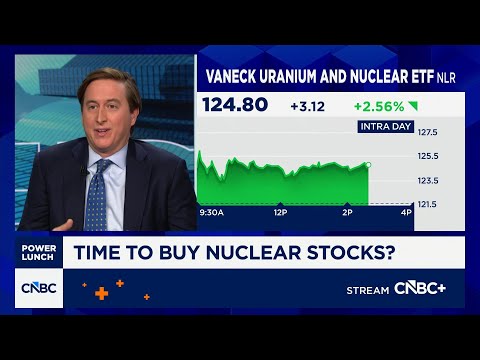
Mergers and Acquisitions - Trump Media is merging with TAE Technologies, a nuclear fusion power company [1] - The combined company will be co-run by the nuclear team and the media team [1] - Investors reacted positively, with Trump Media shares soaring [1] Nuclear Energy Outlook - Nuclear energy is viewed as a resource that will be needed in the future [4] - The industry anticipates a nuclear renaissance with a four-phase approach [4] - The phases include maintaining existing capacity, restarting shut-down plants, increasing capacity at existing facilities, and increasing electricity capacity by 2030-2035 [5][6] - Long-tail technology investments need to be cost-effective and cost-competitive to be viable in the electricity markets [7] BP Leadership and Strategy - BP appointed Mega O'Neal as CEO, the fourth CEO in six years and the first female CEO [7] - BP had previously made poorly timed pivots towards renewables but is now shifting back [8] - A new CEO may be the right strategy to correct corporate missteps [9] - Energy demand is expected to continue rising, creating opportunities across the energy sector if the strategy is right [10]

Lot of opportunity across energy space, says Cohen & Steers' Rosenlicht
Youtube· 2025-12-18 20:29
Group 1: Trump Media and TAE Technologies Merger - Trump Media is merging with TAE Technologies, a nuclear fusion power company based in California, which will be co-managed by both the nuclear and media teams [1] - The merger has positively impacted Trump Media's stock, leading to a significant increase, marking its best performance in nearly two years [1] Group 2: Nuclear Industry Insights - The capital from the merger will be directed towards developing a fusion power future, distinguishing it from fission companies [2] - There is a growing belief in a nuclear renaissance, with a long-term approach involving four phases: maintaining existing nuclear capacity, restarting previously shut down plants, increasing capacity at current facilities, and expanding electricity capacity by 2030-2035 [4][5][6] - The nuclear sector is expected to be a critical resource for electricity markets in the next decade, with investments in viable and cost-effective technologies being essential [7] Group 3: BP's Leadership Change - BP has appointed Mega O'Neal as its new CEO, marking the first female CEO in the company's history and the fourth CEO in six years [7] - BP is undergoing a strategic shift after previous missteps in its corporate strategy, particularly regarding its focus on renewables [8][9] - The energy demand is projected to continue rising, presenting opportunities across various energy sectors if the company can realign its strategy effectively [10]