
AI bubble

Search documents
Stock Market Today: S&P 500 Closest At Lowest Point Since September Despite Nvidia's Strong Earnings
Yahoo Finance· 2025-11-20 16:08
Did Federal Reserve Governor Lisa Cook and Chicago Fed President Austan Goolsbee compare notes ahead of their remarks today? Earlier today, Cook singled out "stocks" when talking about valuations. Now, her colleague at the central bank is warning that AI investment 'raises concerns' about a bubble. Of course, this is likely obvious to most traders -- who seem to have been shaken from complacency in the last few weeks, evidenced in part by the moves in the market.Coming up after the market close, we'll have ...

Are we in a K-shaped economy? Delayed employment numbers could reveal recession odds
Fastcompany· 2025-11-20 15:27
LOGIN SUBSCRIBE | FastCo Works advertisement BYÂ Jennifer Mattson Listen to this ArticleMore info 0:00 / 0:00 The gap between the richest and poorest Americans is widening in what Federal Reserve Chairman Jerome Powell has called a "bifurcated economy,†as the cost of living skyrockets from housing to food prices, but wages for most workers remain stagnant. Basically, high-income individuals are doing well, while lower- income consumers are struggling more and more. That situation has sparked discussions abo ...


'Big Short' investor Michael Burry takes aim at Nvidia after its earnings blowout
Business Insider· 2025-11-20 15:19
Core Viewpoint - Michael Burry continues to express concerns about Nvidia and the AI sector, arguing that the current market may be experiencing a bubble despite Nvidia's strong earnings report and optimistic growth forecasts [1][2][8]. Company Performance - Nvidia reported record revenue and profit for the last quarter, leading to a 5% increase in stock price during premarket trading [2]. - The company's finance chief, Colette Kress, indicated visibility to $0.5 trillion in revenue from Blackwell and Rubin over 2025 and 2026, and projected $3 trillion to $4 trillion in annual AI infrastructure spending by 2030 [3]. Management's Perspective - CEO Jensen Huang dismissed concerns about an AI bubble, stating that the company sees a different reality [3]. - Kress emphasized the longevity of Nvidia's older chips due to the CUDA software, which allows older systems to run current applications effectively [3]. Investor Concerns - Burry criticized Nvidia's accounting practices, suggesting that the extended use of older chips does not equate to profitability, drawing parallels to airlines retaining old planes for capacity [4][5]. - He highlighted the inefficiency of older chips compared to newer models, implying that customers using them incur higher operational costs [4]. Market Dynamics - Burry pointed out the complex financial relationships between Nvidia and other AI companies, suggesting that true demand for AI products is limited and often reliant on dealer funding [6][9]. - He expressed skepticism about the sustainability of investments in the AI sector, comparing it to the dot-com bubble and warning of potential overinvestment [9]. Stock Buybacks and Compensation - Burry noted that Nvidia has repurchased nearly $113 billion in stock since 2018, yet the number of shares outstanding has increased by 47 million, raising concerns about stock-based compensation diluting owner earnings [7].

Nvidia earnings takeaways: Bubble talk, 'half a trillion' forecast and China orders
CNBC· 2025-11-20 14:06
Core Insights - Nvidia reported fiscal third-quarter earnings that exceeded expectations and provided a strong forecast for the current quarter, leading to a rise in its stock and boosting other AI-related stocks [3][4] - The company expects approximately $65 billion in sales for the current quarter, representing a 65% year-over-year growth [4] Group 1: Market Position and Outlook - Nvidia continues to dominate the AI chip market, particularly in GPUs, with CEO Jensen Huang expressing confidence in the company's products and future outlook during the earnings call [4][5] - Huang rejected the notion of an "AI bubble," stating that there are three growing uses for AI that are driving infrastructure investments [5][6] - The company maintains a forecast of $500 billion in AI chip orders for 2025 and 2026, with the order backlog expected to grow due to recent deals [8][9] Group 2: China Market Dynamics - Nvidia's sales of the H20 chip to China were reported as "insignificant," with only $50 million recorded during the quarter, attributed to geopolitical issues and competition in the Chinese market [11][12] - The company is advocating for the ability to export more advanced chips to China, arguing it is better for national security [13][14] - Analysts noted that the lack of sales in China made Nvidia's overall performance even more remarkable, projecting nearly $400 billion in free cash flow over the next nine quarters [15]
Markets soothed by AI chip maker's results but bubble concerns haven't gone away
Sky News· 2025-11-20 14:04
Group 1 - The core message of the articles emphasizes that Nvidia's record-breaking sales and strong guidance have reassured investors about the demand for AI, suggesting that the AI and tech sectors are not in a bubble [1][2][3] - Nvidia reported $57 billion in revenue for the three months ending in October and anticipates $65 billion in sales for the next quarter, which has positively influenced market sentiment and increased investor risk appetite [7] - The financial services firm Wedbush views Nvidia's performance as a pivotal moment in the ongoing AI Revolution, indicating that this is the third year of a projected ten-year build-out of the fourth industrial revolution [3][1] Group 2 - The positive outlook for Nvidia has led to a rise in share prices for tech companies and competitors across Asia and Europe, reflecting a broader enthusiasm for AI-related investments [4][2] - Despite the current optimism, there are lingering concerns about the sustainability of AI demand, with some investors, like Michael Burry, expressing skepticism about the true end demand for AI products [9][11] - The articles highlight that while Nvidia's results have calmed valuation concerns for now, the potential for future market volatility remains due to external factors such as geopolitical tensions and competition from other AI models [8][7]

Bridgewater founder Ray Dalio: We are definitely in a bubble, but that doesn't mean you should sell
CNBC Television· 2025-11-20 13:43
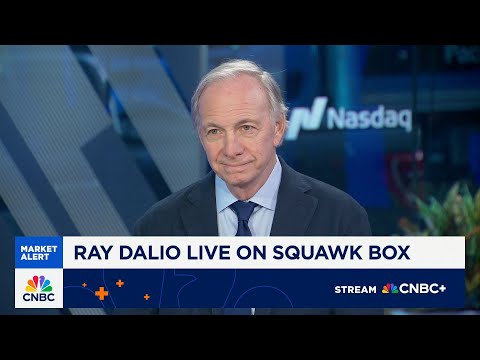
And now to our newsmaker of the morning. He is here joining us to discuss the markets, the history of economic bubbles, artificial intelligence, so much more. Bridgewater founder Ray Dallio is with us. Good morning to you, sir. >> Good morning. >> So, you've been uh providing lessons for us for a very long time about economic cycles and where we are and what's going on. The big question in the market right now because we're looking at Nvidia this morning and I think a lot of people are waking up thinking wh ...
13 Stocks That Crossed Jim Cramer’s Radar
Insider Monkey· 2025-11-20 13:36
In this piece, we will look at the stocks Jim Cramer discussed.In a recent appearance on CNBC’s Squawk on the Street, Jim Cramer discussed the weakness in the stock market as technology stocks headed towards ending a seven-month winning streak. Cramer’s remarks came before AI chip giant NVIDIA’s earnings report and after co-host Carl Quintanilla mentioned a Bank of America survey that didn’t do much to quell market uneasiness. BofA’s Global Fund Manager Survey outlined that a net 20% of managers part of the ...


NVIDIA-Led Relief Rally in Tech Sector? Undervalued ETFs in Focus
ZACKS· 2025-11-20 13:36
Core Viewpoint - Global technology shares experienced a rally as investors shifted back to AI-linked stocks following NVIDIA's strong earnings report, despite ongoing concerns about overvaluation in the AI sector [1][2]. Company Performance - NVIDIA reported $57 billion in revenue for the quarter ending in October, a 62% increase year-over-year, driven by a 66% surge in sales from its AI data center division, which exceeded $51 billion [3][4]. - The company's earnings per share (EPS) for Q3 was $1.30, surpassing the Zacks Consensus Estimate of $1.24, while revenues exceeded estimates by 4.14% [4]. - NVIDIA's data center business generated $51.2 billion, outperforming the Bloomberg consensus estimate of $49.3 billion [4]. - The company provided an optimistic fourth-quarter revenue guidance of $65 billion, beating the Zacks Consensus Estimate of $60.30 billion, leading to a 5% increase in shares during premarket trading [5]. Market Reaction - The positive sentiment from NVIDIA's results extended to global chipmakers, with Dutch semiconductor companies BESI and ASMI rising over 3% and 2%, respectively, and Asian companies like Samsung Electronics and Hon Hai Precision Industry also seeing gains [6]. - U.S. tech stocks rebounded in pre-market trading, with AMD shares up about 5%, Arm nearly 4%, Marvell Technology adding 3.7%, and Broadcom climbing 3% [7]. Industry Concerns - There are concerns regarding the concentration of major AI players, as highlighted by Karen McCormick, who noted the potential vulnerability of the market if an AI bubble bursts, despite the strong balance sheets of these firms [8][9]. - The interconnected nature of AI companies, particularly with NVIDIA and Microsoft planning significant investments in Anthropic, raises caution about market stability [8][9]. Investment Opportunities - Amidst the mixed scenario of growth and risks, investing in undervalued tech-based exchange-traded funds (ETFs) is suggested as a viable option, with several ETFs showing lower valuations compared to the broader tech ETF iShares U.S. Technology ETF (IYW) [10]. - Specific undervalued ETFs include Invesco Next Gen Connectivity ETF (P/E: 20.98X), Invesco S&P 500 Equal Weight Technology ETF (P/E: 22.74X), and others with P/E ratios ranging from 22.99X to 23.45X [11][12].

Morning Bid: Nvidia calms the horses, Fed bets evaporate
Yahoo Finance· 2025-11-20 11:47
By Mike Dolan - What matters in U.S. and global markets today By Mike Dolan, Editor-At-Large, Finance and Markets As has often been the case over the past two years, Nvidia's forecast-beating results have helped calm a tech sector nervous about bubble-like AI valuations. Meanwhile, hopes of another U.S. interest rate cut this year have all but disappeared. Demand for Nvidia's chips was never the root of the AI bubble worries, which are mostly focussed on whether the gigantic AI infrastructure spend wi ...
Is there an AI bubble and has it started to burst?
Yahoo Finance· 2025-11-20 11:00
A sign to an Nvidia office building is shown in Santa Clara, Calif., on Aug. 7, 2024. (Jeff Chiu / Associated Press) The artificial intelligence boom seems unstoppable, but a growing number of investors and other observers worry it could be a bubble about to burst. After skyrocketing more than 50% from April lows, the tech-heavy Nasdaq composite experienced a decline of close to 5% this month. Investors are concerned it could take longer than expected to see big profits from the trillions of dollars they ...