Unemployment

Search documents
The job market is 'kind of like a black hole' for recent grads
NBC News· 2025-08-06 19:58
Getting a job is a full-time job. Recent grads are facing one of the toughest job markets in a decade. My perception is it's kind of like a black hole out there.Out of 70 plus jobs, had three job interviews, and out of those three, I got ghosted from two of them. New data from the US Bureau of Labor Statistics shows on average recent grad unemployment has been around 5.3% in 2025 compared to roughly 4% of the entire workforce according to economists from the Federal Reserve Bank of New York. And some degree ...


X @Bloomberg
Bloomberg· 2025-08-05 12:18
Housing Market Trends - New Zealand house prices declined for the fourth consecutive month [1] - Sluggish economic growth and rising unemployment are keeping buyers away [1]
全球经济简报 -各国央行都将维持现状吗?Global Economic Briefing-The Weekly Worldview Holding pattern for all central banks
2025-08-05 03:16
Summary of Key Points from the Conference Call Industry Overview - The discussion primarily revolves around the global economic landscape, focusing on the implications of tariffs and central bank policies in the US, Europe, and Japan [3][10][14]. Core Insights and Arguments 1. **Impact of Tariffs on Inflation and Growth**: - US tariffs are increasing inflation while negatively affecting growth. This creates a complex scenario for the Federal Reserve (Fed) as it navigates these challenges [3][4]. - For exporters to the US, tariffs are expected to push inflation and growth in the same direction, complicating the Fed's task compared to other central banks [3][4]. 2. **Federal Reserve's Position**: - The Fed's July FOMC statement was neutral, but Chair Powell emphasized the lack of urgency for rate cuts, despite two dissents within the committee [4][9]. - The unemployment rate remains low, but labor demand is slowing, which poses challenges for the Fed in meeting its "full employment" mandate [4][7]. 3. **Inflation Forecasts**: - Inflation is anticipated to rise in Q3 2025, driven by tariff impacts, although the extent and duration of this inflation increase remain uncertain [5][9]. - The Fed is expected to prioritize inflation control over employment metrics, as inflation is viewed as the more pressing issue [9][10]. 4. **European Central Bank (ECB) and Bank of England (BoE) Outlook**: - The ECB and BoE are expected to ease monetary policy further this year, although recent data may alter this outlook [10][11]. - The ECB's decision in September will depend heavily on upcoming inflation and activity data [10][11]. 5. **Bank of Japan (BoJ) Stance**: - The BoJ is projected to maintain its current policy stance through 2026, with Governor Ueda expressing caution due to inflation indicators remaining below 2% [14][15]. Additional Important Insights 1. **Labor Market Dynamics**: - Immigration restrictions are contributing to a slowdown in labor supply, which is affecting job creation and overall economic growth [4][7]. - The nonfarm payrolls data for July indicated a softer labor market than expected, with prior months' figures revised lower [7][9]. 2. **Global Trade Risks**: - Tariff uncertainties continue to pose risks to global trade, impacting growth forecasts in the euro area and beyond [10][11]. - The potential for further tariff increases remains a concern, particularly with ongoing trade negotiations and geopolitical tensions [12][13]. 3. **Macroeconomic Data and Forecasts**: - The report includes various macroeconomic forecasts, indicating a cooling economy in the US and potential growth in Europe, albeit with significant downside risks [10][16]. This summary encapsulates the key points discussed in the conference call, highlighting the intricate relationship between tariffs, inflation, and central bank policies across major economies.
Citizens Wealth's Hans: Jobs data surprised markets amid low volatility
CNBC Television· 2025-08-05 00:00
Market Reaction & Data Trust - Market is likely to react to recent data revisions, but a significant fallout is not immediately apparent [1][2] - The market was surprised due to lower volatility and liquidity during the summer months [2] - The industry continues to trust the data, acknowledging that some data points are estimates that are backfilled later [5] - Every report needs to be scrutinized in the context of the Federal Reserve's policy shift [6] Labor Market & Economic Narrative - The focus remains on the labor market, specifically the absence of increased layoffs [3] - The prevailing narrative is that employers are hoarding labor [4] - The market perceives the labor market as more critical than inflation, a sentiment telegraphed by the Federal Reserve [8] - Fears of the Federal Reserve being behind the curve are expected to escalate [9] Inflation & Federal Reserve Policy - Incremental inflationary pressures are considered less of a concern, with a return to the "transitory" narrative [10] - Political challenges of elevated unemployment are expected to be more concerning to the Federal Reserve [11] - It's possible the Federal Reserve would have acted differently on rate policy with correct data [8] Investment Strategy - Current guidance advises clients to remain overly diversified across risk spectrums [12] - Fixed income acted as a ballast during the equity drawdown, and foreign markets have been supportive [12] - The industry is constantly seeking opportunities to add or reduce risk based on the evolving environment [13]
Sarat Sethi: Inflation not coming down has put Fed in quandary
CNBC Television· 2025-08-04 18:39
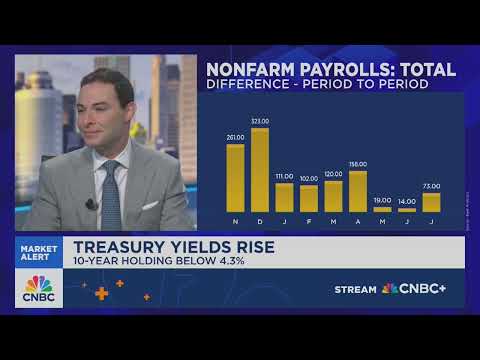
Okay, Mike. Thanks. Sat, how how much did the revisions in particular and the jobs data on Friday change your view of the market if at all.>> I think the lagging indicator, the the data coming in that we all expected finally hit home after Doge and all the unemployment. So, I don't think it was that much of a surprise. I think the other surprise was, hey, inflation's not coming down.So, that really puts the Fed in this quandry as to, you know, three days ago they were saying, hey, we're not going to do anyt ...
Citizen's Wealth: Markets were surprised by the jobs data in an environment with low volatility
CNBC Television· 2025-08-04 11:49
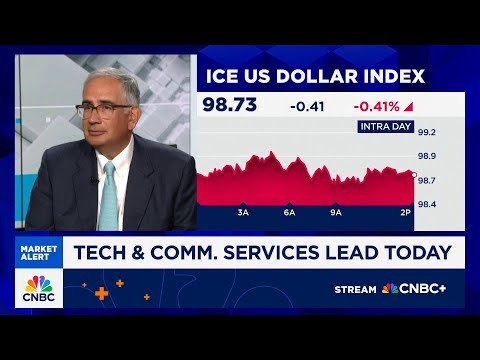
Market Reaction and Data Trust - The market is likely to react to the surprise in data, potentially leading to back and forth trading sessions [2][3] - The industry continues to trust the data, despite recent revisions and estimations in inflationary reports [5] - Every report needs scrutiny due to the coinciding turn in Fed policy, requiring an overall mosaic approach [6] Fed Policy and Labor Market - The Fed might have acted differently on rate policy with correct data, but full consensus for a cut last week was uncertain [8] - The market perceives the labor market as more important than inflation, a view telegraphed by the Fed [8][9] - Fears of the Fed being behind the curve are expected to escalate into September [9] - Political challenges of elevated unemployment are considered more acute to the Fed historically [11] Investment Strategy - Current guidance advises clients to stay overly diversified, which has driven performance across risk spectrums this year [12] - Fixed income acted as a ballast during the equity drawdown, and some foreign markets have been supportive [12][13] - The industry is constantly looking for opportunities to add or incrementally take down risk depending on the environment [13]
X @The Economist
The Economist· 2025-08-03 23:00
The jobs market in America is looking increasingly fragile. So far unemployment remains low by historic standards. But the pace of hiring has slowed sharply, potentially an early warning of trouble ahead https://t.co/5AWsvEmKEe ...
X @Bloomberg
Bloomberg· 2025-08-01 22:53
As markets dived amid trade war turmoil and negative jobs data, Trump reacted to rising US unemployment by firing the messenger: Here’s your Evening Briefing https://t.co/9uOUzHGUid ...
US notches worst three months for jobs growth since pandemic#shorts #jobsreport #unemployment
Bloomberg Television· 2025-08-01 17:15
for the first few months when we saw those big numbers um that was the Biden economy. Now that the Trump policy is taking effect, you're seeing downward revisions of 258,000 over the last uh couple of months, only 73,000 jobs added. And it looks like not just to me, but to uh uh participants in this market that today's weak payroll numbers are a direct result of the conscious policy to limit immigration.And I'm just wondering if that trade-off is delivering the kind of benefits you want to see to us workers ...
Roger Ferguson: July jobs report creates 'increased complexity' for the Fed
CNBC Television· 2025-08-01 16:15
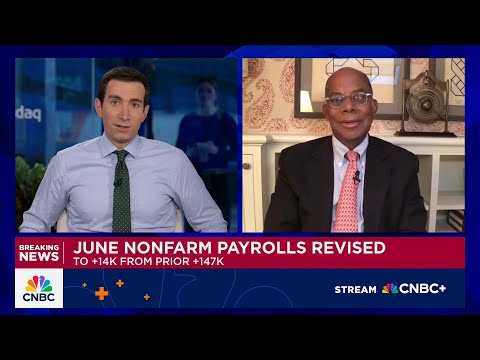
The July jobs report coming in weaker than expected. President Trump just posting on Truth Social. Too little, too late. Jerome, too late.Powell is a disaster. Drop the rate. The good news is the tariffs are bringing billions of dollars into the USA.Clearly, the president thought that his tariffs were actually going to have this impact and therefore needed the Fed to make these moves. We're going to bring in Roger Ferguson right now. Uh former Fed vice chairman, now a CNBC contributor.What do you make of al ...