
单位行贿罪

Search documents
豪尔赛与前任董事长被公诉,系涉嫌单位行贿罪
Zhong Guo Ji Jin Bao· 2025-08-09 03:50
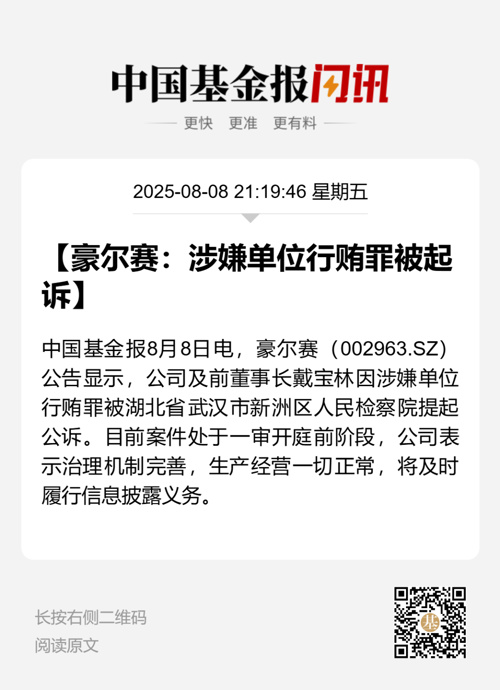
Core Viewpoint - Haosai and its former chairman Dai Baolin have been prosecuted for alleged unit bribery, which has raised concerns about the company's governance and future performance [1][6][21]. Group 1: Legal Issues - On August 8, Haosai announced that it and former chairman Dai Baolin were prosecuted for alleged unit bribery by the Wuhan New District People's Procuratorate [1][6]. - The case is currently in the stage of awaiting the first-instance trial, with the investigation initiated on December 12, 2024, leading to Dai Baolin's detention [9][11]. - Dai Baolin was arrested on June 19, 2025, and prior to this, he had not disclosed his detention or arrest to the company [12][11]. Group 2: Management Changes - Dai Baolin resigned from his positions as chairman and general manager in early June 2025, citing reaching the legal retirement age, and subsequently became an honorary chairman [13][15]. - Following his resignation, Dai Congqi was appointed as the new general manager, and he became the legal representative of Haosai [16]. - Dai Baolin transferred his voting rights for 23.36% of Haosai's shares to his son, Dai Congqi, establishing a unified action relationship among the family members [17][20]. Group 3: Financial Performance - Haosai is expected to report a significant loss for the first half of 2025, with projected net losses ranging from 30.39 million to 38.51 million yuan, a decline of 495.35% to 600.95% year-on-year [21][22]. - The anticipated losses are attributed to adjustments in investment rhythms in the infrastructure and real estate sectors, leading to a decrease in demand in the lighting engineering industry and increased competition [21][22].

突发!002963,被公诉!
Zhong Guo Ji Jin Bao· 2025-08-09 03:49
Core Viewpoint - Haosai and its former chairman Dai Baolin have been prosecuted for alleged unit bribery, which has raised concerns regarding the company's governance and operational integrity [1][4][16]. Group 1: Legal Proceedings - On August 7, 2025, Haosai received a prosecution notice from the Wuhan New District People's Procuratorate regarding allegations of unit bribery against both the company and Dai Baolin [4]. - The case is currently in the stage of awaiting the first-instance trial [5]. - The investigation into Dai Baolin began on December 12, 2024, when the Wuhan New District Supervisory Committee initiated a case against him for suspected illegal activities [5]. Group 2: Company Governance Changes - Following the legal issues, Dai Baolin resigned from his positions as chairman and general manager in early June 2025, citing reaching the legal retirement age [10]. - Dai Congqi was appointed as the new general manager, and he became the legal representative of Haosai on June 24, 2025 [11]. - Dai Baolin transferred his voting rights associated with 23.36% of Haosai's shares to his son, Dai Congqi, establishing a unified action relationship among the family members [14]. Group 3: Financial Performance - Haosai is expected to report a significant loss for the first half of 2025, with projected net losses ranging from 30.39 million to 38.51 million yuan, a year-on-year decline of 495.35% to 600.95% [15]. - The anticipated losses are attributed to adjustments in investment rhythms in the infrastructure and real estate sectors, leading to a temporary decline in demand in the lighting engineering industry [16].
豪尔赛: 关于公司重大事项的公告
Zheng Quan Zhi Xing· 2025-08-08 13:08
Group 1 - The company and its former chairman, Dai Baolin, are facing prosecution for alleged unit bribery, with the case currently awaiting trial [1] - The investigation into Dai Baolin began on December 12, 2024, leading to his detention and subsequent arrest on June 19, 2025 [1] - As of the announcement date, Dai Baolin is no longer part of the company's board or management and is not the controlling shareholder [1] Group 2 - The company maintains a robust governance and internal control mechanism, with all business operations proceeding normally [2] - The company's control has not changed, and the board is functioning legally while management continues to perform daily responsibilities [2] - The management is prepared to address any potential impacts and risks to uphold the company's brand reputation and ensure business stability [2]
要求管理服务对象向所在单位“捐赠”财物相关问题辨析
Zhong Yang Ji Wei Guo Jia Jian Wei Wang Zhan· 2025-07-23 01:21
Core Points - The case involves a public institution (A unit) and a private company (B company), where the head of A unit, Shen, solicited a donation of 1 million yuan from Zhang, the actual controller of B company, to fund a research project [1][2] - The donation was used to gain favorable treatment in project bidding, with B company winning contracts worth over 20 million yuan as a result [1][2] - Different legal interpretations exist regarding the nature of the donation, with one view categorizing it as bribery and the other as a legitimate donation benefiting the unit [2][3] Summary by Sections - **Nature of the Donation**: The 1 million yuan donation from Zhang to A unit is characterized as a bribe rather than a legitimate donation, as it was not voluntary and aimed at securing improper benefits [3][4] - **Legal Implications**: Shen's actions are analyzed under the lens of bribery laws, with the consensus leaning towards classifying the donation as unit bribery, and Shen's subsequent actions as both unit bribery and personal embezzlement [2][5] - **Financial Misappropriation**: Shen misappropriated 150,000 yuan for personal use from the donation, which constitutes embezzlement under criminal law, highlighting the misuse of public funds [5][6]
以案明纪释法丨指使单位虚增交易环节让第三人获利行为性质辨析
Zhong Yang Ji Wei Guo Jia Jian Wei Wang Zhan· 2025-06-04 01:19
Core Viewpoint - The article discusses cases of state employees using their positions to inflate transaction processes, resulting in profits for third parties, and analyzes the legal implications of such actions [1][6]. Case Summaries Case One - A state-owned company manager, knowing that a procurement was already established, directed the company to sign a procurement agreement with a specific individual to inflate transaction costs, resulting in a commission payment that was misappropriated [2][8]. - The legal opinions diverge on whether the manager's actions constitute embezzlement or illegal profit-making for relatives, with a consensus leaning towards embezzlement due to the nature of the transaction [4][9]. Case Two - A financing platform manager, in collusion with a government official, inflated transaction processes to facilitate a payment to the official's son for minimal services rendered, despite the company having direct financing options [3][12]. - Similar to Case One, legal opinions vary, but the prevailing view is that the manager's actions constitute bribery and embezzlement due to the intent to benefit a third party while misusing public funds [11][14]. Legal Analysis - The article emphasizes that actions taken by state employees to inflate transactions for personal gain or to benefit specific individuals can lead to serious legal consequences, including charges of embezzlement and bribery [7][11]. - The distinction between embezzlement and illegal profit-making for relatives is crucial, as the former involves direct misappropriation of public funds, while the latter pertains to the improper allocation of business opportunities [10][14].