
行贿罪

Search documents
三堂会审丨违反廉洁纪律与受贿行为交织如何辨别
Zhong Yang Ji Wei Guo Jia Jian Wei Wang Zhan· 2026-02-25 00:16
Core Viewpoint - The case of Li Moumou highlights the intertwining of disciplinary violations and criminal activities among party members, particularly focusing on the misuse of power for personal gain through bribery and business dealings [2][4][5]. Group 1: Case Background - Li Moumou, a member of the Communist Party since November 1987, held various leadership positions in state-owned enterprises [3]. - From 2012 to 2023, Li utilized his position to gain benefits for others, receiving illegal payments totaling over 16.49 million yuan [5]. - In July 2021, Li invested 1.2 million yuan in an environmental company, acquiring a 30% stake, but the company did not yield profits by the time of the investigation [4]. Group 2: Legal Proceedings - The investigation into Li's misconduct began on September 19, 2023, leading to his detention and subsequent extension of the detention period [8]. - On March 13, 2024, Li was expelled from the Party and removed from public office, with the case being forwarded for prosecution on March 21, 2024 [9]. - On July 2, 2024, the prosecution was initiated against Li for multiple charges, including bribery and abuse of power, resulting in a combined sentence of 14 years in prison and fines totaling 2.15 million yuan [10]. Group 3: Bribery and Business Operations - Li's actions of soliciting 1.2 million yuan from a businessman for investment in a company were analyzed under the lens of bribery, with differing opinions on the nature of the crime [12][13]. - The consensus determined that Li's request for funds constituted bribery rather than a legitimate investment partnership, as the funds were used to facilitate his business interests [14][16]. - Li's use of the bribe for business operations was deemed a violation of disciplinary regulations, regardless of the source of the funds [18][19]. Group 4: Influence and Collusion - The case also examined the involvement of Li's relatives in the bribery scheme, with findings suggesting a collaborative effort in the bribery process [20][21]. - The legal framework distinguishes between direct bribery and collusion, emphasizing the need for shared intent and actions between Li and his relatives in the bribery activities [22][23].

退休后牵线搭桥并收好处如何定性
Zhong Yang Ji Wei Guo Jia Jian Wei Wang Zhan· 2025-11-19 00:05
Core Viewpoint - The case involves former government official Wang, who engaged in corrupt practices by leveraging his influence to benefit a private company, A Company, through collusion with current employees of a state-owned enterprise, leading to significant financial gains from bribery [1][3][4]. Group 1: Case Overview - Wang served as the Deputy Director of a state-owned assets supervision commission from August 2015 to December 2018 and retired in January 2019 [1]. - In October 2020, Wang accepted a request from Zhang, the legal representative of A Company, to assist in securing a contract with a state-owned company, B Company [1]. - Wang received a total of 1.8 million yuan in bribes from Zhang, of which he retained 300,000 yuan and distributed the remaining 1.5 million yuan equally among himself and two accomplices, Li and Wu [1][6]. Group 2: Legal Opinions - There are two differing legal opinions regarding the classification of Wang, Li, and Wu's actions [2]. - The first opinion suggests that Wang should be charged with multiple offenses, including utilizing influence for bribery, while Li and Wu should be charged with receiving bribes, each amounting to 500,000 yuan [3]. - The second opinion posits that all three should be considered co-conspirators in bribery, with a total of 1.5 million yuan recognized as the joint crime amount, while Wang's retention of 300,000 yuan constitutes a separate offense of utilizing influence for bribery [3][4]. Group 3: Criminal Responsibility - Wang, Li, and Wu are deemed to have committed joint bribery, with Li recognized as a state worker and Wu as a non-state worker, complicating the classification of their roles [4][5]. - The legal framework indicates that when non-state and state workers collude in bribery, they should be prosecuted as co-conspirators, especially when their actions are interdependent [5][6]. - The total amount of joint bribery is established at 1.5 million yuan, as Wang's personal retention of 300,000 yuan is not included in the shared crime amount due to Li and Wu's lack of knowledge about it [6][7].
三堂会审丨贪污伴随的滥用职权行为是否应单独评价
Zhong Yang Ji Wei Guo Jia Jian Wei Wang Zhan· 2025-06-18 00:16
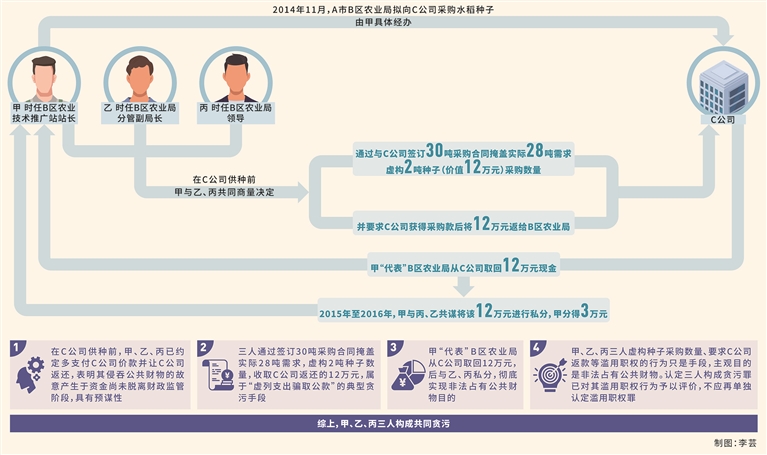
Core Points - The case involves three individuals (A, B, C) conspiring to falsely inflate seed procurement quantities, resulting in an overpayment of 120,000 yuan to Company C, which they later divided among themselves [5][9][10] - A, while serving as the head of the Agricultural Technology Promotion Station, engaged in corrupt practices, including embezzlement and bribery, totaling 2.08 million yuan in bribes and 460,000 yuan in collusion with another employee [6][12][14] - The investigation led to A being expelled from the party and public office, with subsequent criminal charges filed for embezzlement, bribery, and collusion [7][18][20] Summary by Sections Basic Case Facts - A was responsible for a seed procurement contract, where he, along with B and C, conspired to create a false procurement quantity, leading to an illegal return of 120,000 yuan [4][5] - A's actions included receiving bribes from multiple suppliers, totaling 2.08 million yuan over a decade [6][12] Investigation Process - The investigation began on September 25, 2023, with A being placed under detention, followed by disciplinary actions and criminal charges [7][19] - A was convicted on April 30, 2025, receiving a combined sentence of seven years in prison and a fine of 550,000 yuan [7][18] Legal Interpretations - The actions of A, B, and C were classified as joint embezzlement rather than bribery, as they involved the illegal appropriation of public funds [8][9] - The court determined that A and another employee, D, engaged in joint bribery, with A being the principal actor and D playing a secondary role [15][16]
以案明纪释法丨指使单位虚增交易环节让第三人获利行为性质辨析
Zhong Yang Ji Wei Guo Jia Jian Wei Wang Zhan· 2025-06-04 01:19
Core Viewpoint - The article discusses cases of state employees using their positions to inflate transaction processes, resulting in profits for third parties, and analyzes the legal implications of such actions [1][6]. Case Summaries Case One - A state-owned company manager, knowing that a procurement was already established, directed the company to sign a procurement agreement with a specific individual to inflate transaction costs, resulting in a commission payment that was misappropriated [2][8]. - The legal opinions diverge on whether the manager's actions constitute embezzlement or illegal profit-making for relatives, with a consensus leaning towards embezzlement due to the nature of the transaction [4][9]. Case Two - A financing platform manager, in collusion with a government official, inflated transaction processes to facilitate a payment to the official's son for minimal services rendered, despite the company having direct financing options [3][12]. - Similar to Case One, legal opinions vary, but the prevailing view is that the manager's actions constitute bribery and embezzlement due to the intent to benefit a third party while misusing public funds [11][14]. Legal Analysis - The article emphasizes that actions taken by state employees to inflate transactions for personal gain or to benefit specific individuals can lead to serious legal consequences, including charges of embezzlement and bribery [7][11]. - The distinction between embezzlement and illegal profit-making for relatives is crucial, as the former involves direct misappropriation of public funds, while the latter pertains to the improper allocation of business opportunities [10][14].