Supply Chain

Search documents
X @The Economist
The Economist· 2025-12-18 16:30
Supplies of everything from fuel and drugs to bags of saline, syringe needles and gauze are scarce or non-existent. There are no MRI machines in northern Gaza. Newborns in critical condition have to share incubators https://t.co/10s34UzXUb ...
How Hasbro's Meeting the Tariff Challenge
Bloomberg Television· 2025-12-18 02:32
The challenge, especially within my supply chain, is now how do you have enough productivity initiatives to offset the the increased cost of of all the products for the industry as a whole. You have more than 80% dependence on China as a sourcing market for some of the bigger players. That exposure is less and they have more nimble, more flexible supply chains to navigate this disruption For the medium sized and smaller players, this has been very, very disruptive.Can you just move your supply chain out of ...


Medline CEO on IPO: This is the right time for us to expand our voice
CNBC Television· 2025-12-17 14:43
Joining us right now first on CNBC is Medline CEO Jim Bole. Good morning to you. >> Good morning.>> Congratulations. This been this has been a quite a road for you to get to to this point. Uh why go public now.What's the what's what's the thinking in terms of where you came from and where you are right now. >> And as you know, we've been a private company for 58 years. Um with 58 years of consecutive growth, uh we just feel like this is the right time for us to kind of expand our voice.Historically, we've d ...

How tariffs changed the game for Hasbro
Bloomberg Television· 2025-12-16 16:15
Supply Chain Diversification - The industry faces a fundamental shift in government policy regarding market operations due to tariffs [1] - Companies are actively diversifying their supply chains to mitigate risks associated with concentrated manufacturing in one region [2][3] - A company's toy and game volume sourced from China decreased from approximately 60-65% to around 50% and aims to reach roughly 30% by 2027 [2] - Diversification requires time to onboard vendors and ensure quality, especially for products like toys [3] Cost Management - Companies are implementing productivity initiatives to offset increased costs resulting from tariffs [1] - Relocating supply chains is not a simple task, but flexibility exists [1][2] Risk Management - Over-reliance on a single geographic location for manufacturing is undesirable, regardless of tariff policies [3]

X @Bloomberg
Bloomberg· 2025-12-16 04:35
Supply Chain Outlook - Suez Canal and Red Sea are likely to reopen to shipping next year, which will alleviate supply chain tensions [1]
X @Balaji
Balaji· 2025-12-14 13:52
Perhaps obvious, but a chosen specialization for a city (like hair dryers) is very different from a given specialization (like a coal mine).The former is manufacturing, the latter is mining. You can’t choose the distribution of natural resources, but you can make the best of what you have.Original video:International Cyber Digest (@IntCyberDigest):China’s industry is a different beast 🤯Every product and its supply chain are tied to one huge city the size of a nation, Eric explains.This is why other nations ...
ASML CEO: China Won't Accept Being Cut Off From AI Chips
Bloomberg Television· 2025-12-13 07:00
AI Development & Competition - The US is currently far ahead of China in AI, exemplified by Nvidia's dominance, with approximately 80% of the most advanced chips being purchased in the US [1] - Major US companies like Google, META, and Microsoft are driving AI development significantly [2] - Europe is currently a consumer of AI technology, lagging behind the US and China in AI ecosystem development [2] - The debate is whether the US or China will win the AI race, but Europe is clearly losing, also evident in the semiconductor sector [3] - Europe's semiconductor consumption is low because companies developing AI chips are not based there [4] - Europe needs to create conditions to attract the AI ecosystem back to the region to catch up [4] - If Europe loses the AI race, it will primarily become a consumer of the technology, with limited knowledge creation within the region [6] Semiconductor Industry & Supply Chain - Shipments of systems to Europe account for only 1-2% of total business, a trend that has persisted for the last ten years, indicating a lack of semiconductor manufacturing build-up in Europe [3] - The interdependencies between China and the US are constantly highlighted, emphasizing the need to ensure open markets [9] - China will not accept being cut off from technology and will strive to advance, given its large population of 14 billion [11] - The West could choose to provide China with older generation technology, such as the fourth or fifth generation, while currently shipping products that are eight generations behind [12] - Products shipped to China are over ten years behind those shipped to Western customers in 2013-2014, slowing down China's technological progress [12] - Frustrating China too much could lead them to develop their own technology and potentially compete in the market [14]

Virginia Gov. on $698M investment by South Korea-based company: I’m just pleased they chose us
CNBC Television· 2025-12-12 18:32
Joining us now is Virginia Governor Glenn Yncan. Governor Yncan, it's great to have you. Welcome.>> Great. Sarah, thank you for being with me. And this was a big announcement today because it it directly uh attacks a supply chain failure in America, which is for rare earth magnets.The the entire rare earth element supply chains dominated by China. And this announcement with one of our great allies in South Korea, LS Cable and System will in fact meet that need here in Virginia. But we've had a big week, Sar ...

X @Bloomberg
Bloomberg· 2025-12-09 21:20
The US Navy is turning to Palantir as part of its years-long effort to speed up submarine production, in a bet that the company’s analytics capabilities can better expose supply-chain problems https://t.co/EM0ymfnltO ...
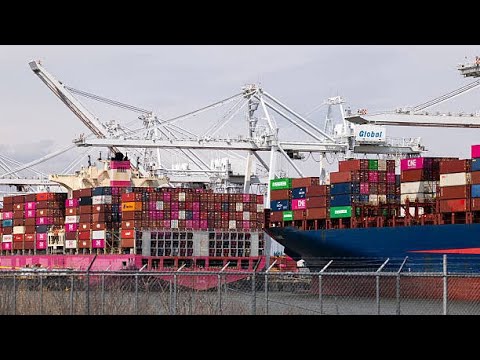
LA Ports See Fewer Imports From China Due to Tariffs
Bloomberg Television· 2025-12-09 16:29
Trade & Tariffs Impact - President Trump signaling potential new levies on Canada, India, and Mexico [1] - Uncertainty around tariffs has caused a "rollercoaster" year for trade, with importers initially slowing down and then surging when policies softened [2][3] - Retaliatory tariffs have negatively impacted US exports, as other countries make deals with normal trading partners [3] - The Supreme Court ruling on tariffs is a major factor in determining future stability and potential refunds [6] Shifting Trade Dynamics - China's share of imports to the Port of Los Angeles has decreased from 60% in 2018 to 40% currently, but overall volume has grown due to increased trade from Southeast Asia [4] - China is shifting from exporting products to exporting manufacturing expertise, investing in factories and supply chains in Southeast Asia [5] - China's exports to the rest of the world are up by double digits, indicating they are finding new customers in Europe, Africa, and Asia [17] - US exports are depressed due to tariffs, with other countries like Argentina and Brazil stepping in for soybeans, and Australia for almonds [18] Small Business Concerns - Small to midsize businesses (SMBs), representing over half of the 125,000 importers at the Port of Los Angeles, struggle to pass on increased tariff costs [9] - Removing the de minimis exemption has caused prices to skyrocket for small businesses importing small parcels from Asia, particularly China [12] - Toy importers face a squeeze on margins due to elevated tariffs, potentially impacting their ability to make payroll [14] Port of Los Angeles Performance - The Port of Los Angeles experienced its third-best performance on the container side in its history [3] - Anticipating approximately 800,000 container units for December, slightly off compared to elevated 2024 levels [15][16]