
Treasury Yields

Search documents
Treasury Yields Recover Amid Improved Mood on Wall Street
Barrons· 2025-11-19 17:13
Group 1 - The S&P 500 and Nasdaq are experiencing gains ahead of Nvidia's earnings report and upcoming labor data [2] - August's trade deficit was narrower than expected, which is seen as a positive indicator for Q3 GDP as it suggests more U.S. spending on domestic goods and services [2] - Treasury yields have bounced back from an early decline, indicating an improved market sentiment on Wall Street [1]

Treasury Yields Little Changed Ahead of Delayed Data Points
WSJ· 2025-11-17 13:57
Core Viewpoint - Treasury yields remained relatively stable as the release of official economic indicators is set to resume [1] Group 1 - Treasury yields showed little change, indicating a period of stability in the bond market [1]


Treasury Yields Rise Amid Doubts About Key Data Points
WSJ· 2025-11-13 13:50
Core Insights - Treasury yields increased as the U.S. government reopened, indicating a shift in investor sentiment and market dynamics [1] Group 1 - The reopening of the U.S. government has led to a rise in Treasury yields, reflecting changes in the bond market [1] - There are ongoing uncertainties regarding upcoming important data releases, which may impact future market movements [1]

Stock Market Today: S&P 500 Futures Rise on Progress to End Shutdown
WSJ· 2025-11-10 08:17
Core Insights - Treasury yields, gold prices, and bitcoin have all experienced an upward trend, indicating a shift in investor sentiment and market dynamics [1] Group 1: Treasury Yields - Treasury yields have risen, reflecting increased investor demand for government bonds as a safe haven amid market volatility [1] - The rise in yields suggests expectations of higher interest rates in the future, which could impact borrowing costs and economic growth [1] Group 2: Gold Prices - Gold prices have increased, driven by heightened demand as investors seek to hedge against inflation and economic uncertainty [1] - The rise in gold prices indicates a shift in investment strategies, with more investors turning to precious metals as a store of value [1] Group 3: Bitcoin - Bitcoin has also seen a price increase, suggesting renewed interest in cryptocurrencies as an alternative investment [1] - The rise in bitcoin prices may reflect a growing acceptance of digital currencies among mainstream investors [1]
Gold (XAUUSD), Silver, Platinum Forecasts – Gold Rebounds Despite Rising Treasury Yields
FX Empire· 2025-11-05 16:56
Core Viewpoint - The content emphasizes the importance of conducting personal due diligence and consulting with competent advisors before making any financial decisions, particularly in the context of investments and trading [1]. Group 1 - The website provides general news, personal analysis, and third-party content intended for educational and research purposes [1]. - It explicitly states that the information should not be interpreted as recommendations or advice for investment actions [1]. - The content is not tailored to individual financial situations or needs, highlighting the necessity for users to apply their own discretion [1]. Group 2 - The website includes information about complex financial instruments such as cryptocurrencies and contracts for difference (CFDs), which carry a high risk of losing money [1]. - Users are encouraged to perform their own research and understand the risks involved before investing in any financial instruments [1].

Market Valuation, Inflation and Treasury Yields: October 2025
Etftrends· 2025-11-04 16:51
Core Insights - US stock indexes are significantly overvalued, leading to cautious expectations for investment returns [1] Group 1 - Monthly market valuation updates consistently indicate overvaluation in US stock indexes [1] - The analysis suggests a need for caution in investment strategies due to high valuations [1]

US 10-Year Yield Ends Week Above 4% as Traders Pare Rate Bets
Yahoo Finance· 2025-10-31 20:08
Core Insights - Treasury yields increased as traders adjusted their expectations for a Federal Reserve rate cut in December, influenced by hawkish signals from Chair Jerome Powell and signs of economic resilience in the US [1][2] Group 1: Treasury Yields and Market Sentiment - The yield on 10-year notes closed around 4.09% after starting the week below 4%, indicating a shift in market sentiment regarding interest rates [2] - Interest-rate swap contracts related to the Fed's December meeting now suggest roughly even odds of a rate cut, reflecting a recalibration of expectations [2] - Powell's comments about further easing not being a "forgone conclusion" contributed to a market selloff, indicating a more cautious outlook among investors [2][4] Group 2: Economic Indicators and Corporate Activity - The US government shutdown has halted the release of key economic data, limiting traders' ability to make informed decisions and increasing the significance of Powell's remarks [4] - Meta Platforms Inc.'s $30 billion bond sale demonstrated robust corporate spending, which put pressure on Treasuries as investors absorbed new supply [5] - More corporate deals are anticipated in the coming week, suggesting continued corporate activity in the bond market [5] Group 3: Fed Officials' Perspectives - Dallas Fed President Lorie Logan expressed that she did not see a need to cut rates, while other Fed officials also voiced dissent against the recent rate cut [7] - The mixed signals from Fed officials contribute to the uncertainty surrounding future rate adjustments, with some indicating inflation concerns are driving yields higher [6][7]
We expect the Fed to cut rates on Wednesday, says Mortgage Bankers Association's Fratantoni
CNBC Television· 2025-10-29 14:07
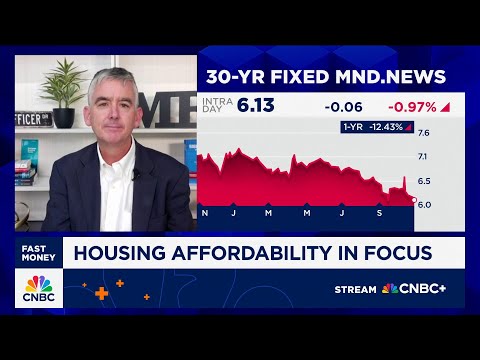
Mortgage Rate Outlook - Mortgage Bankers Association forecasts mortgage rates to remain above 6% through 2028 [1] - Expects the Federal Reserve to cut rates three to four times in the next six months [3] - Rising term premiums and concerns about debt and deficit will push up 10-year Treasury yields, impacting mortgage rates [4] - Mortgage rates are closely tied to the longer end of the yield curve, specifically 10-year Treasuries [4] Housing Market Analysis - 2023 was the low point for the housing and mortgage market [6] - Home sales are expected to increase by about 5% in 2026 [7] - Existing inventory has increased by approximately 30% compared to last year [11] - Builders are offering buy-downs, potentially permanent, to move new construction inventory, which is at nine months of supply [13][14] Buyer and Seller Dynamics - First-time buyers have acclimated to the 6% to 6.5% rate range [10] - Move-up buyers with lower locked-in rates (e g, 3%) are reluctant to give them up [10] - Increased inventory benefits buyers with more options, but challenges sellers as it takes longer to sell and home prices have flattened [8]
Treasury Yields Little Changed Ahead of Fed Decision
Barrons· 2025-10-29 13:02
CONCLUDED Bond markets await the Fed's decision on interest rates and, possibly, hints about when the central bank will stop shrinking its portfolio. The lack of official data raises questions about how Chair Powell will respond to likely questions about the next move on rates. Markets price high odds of a 25-basis-point cut today followed by a similar trim in December. Trump is expected to meet China's Xi Jinping tomorrow to discuss trade. Topics Memberships Stock Market News From Oct. 29, 2025: Stocks and ...
Treasury Yields Snapshot: October 24, 2025
Etftrends· 2025-10-24 21:04
Group 1: Treasury Yields and Economic Indicators - The yield on the 10-year Treasury note ended at 4.02% on October 24, 2025, with the 2-year note at 3.48% and the 30-year note at 4.59% [1] - An inverted yield curve, where longer-term Treasury yields are lower than shorter-term yields, is considered a reliable leading indicator for recessions, with the 10-2 spread turning negative before recessions [2][3] - The average lead time to a recession based on the first negative spread date is approximately 48 weeks, while using the last positive spread date yields an average lead time of 18.5 weeks [4][6] Group 2: Mortgage Rates and Federal Funds Rate - The Federal Funds Rate influences borrowing costs for banks, which typically leads to higher mortgage rates when the FFR increases; however, recent trends show mortgage rates declining despite the Fed holding rates steady [7] - The latest Freddie Mac Weekly Primary Mortgage Market Survey reported the 30-year fixed mortgage rate at 6.19%, marking its lowest level in a year [7] Group 3: Treasury ETFs - ETFs associated with Treasuries include Vanguard 0-3 Month Treasury Bill ETF (VBIL), Vanguard Intermediate-Term Treasury ETF (VGIT), and Vanguard Long-Term Treasury ETF (VGLT) [9]
