Uncertainty

Search documents
X @The Economist
The Economist· 2025-10-28 14:40
The limited impact of tariffs on current earnings conceals a potentially lasting effect on future growth. For when it comes to investments in that growth, America’s non-AI businesses look as paralysed by the uncertainty as deer in the headlights https://t.co/vHSJipvGpo ...
“This is like cooking an egg with a blowtorch” #shorts
60 Minutes· 2025-10-27 13:02
The weight of uncertainty and the rumble of armored vehicles can be felt throughout the country. >> An estimated 125,000 members of Venezuela's military have mobilized. >> While we were there, the government was holding emergency drills and urging civilians to prepare for combat.It's all a bit of theater and a response to this. Since September, the US military has blown up at least 10 vessels, killing more than three dozen alleged drug smugglers, most of them off the coast of Venezuela. >> What I can say is ...


X @Joe Consorti ⚡️
Joe Consorti ⚡️· 2025-10-26 20:32
This is the week when the cloud of uncertainty that has loomed over Bitcoin may finally lift.• Trump-Xi trade deal will be reached• The Fed will likely deliver guidance on the end of QT• Alphabet, Amazon, Apple, Meta, and Microsoft, along with 20% of the S&P 500, will report earningsCouple this with investors already moving into risk to juice their returns into year-end, and you've got all of the catalysts needed to ideally break BTC out of its 7-month consolidation period.Very, very optimistic here.🟢🟢🟢🟢 ...
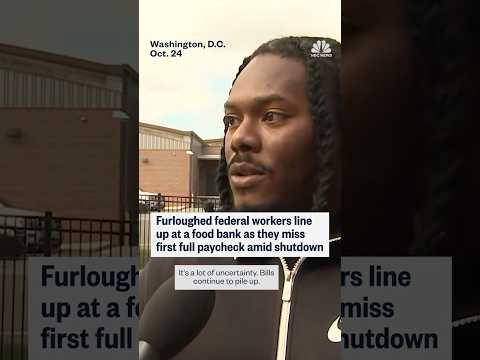
Furloughed federal workers line up at a food bank as they miss first full paycheck amid shutdown
NBC News· 2025-10-25 01:39
Government Shutdown Impact - Over 700,000 federal employees are displaced due to the government shutdown [1] - Federal workers missed their first full paycheck [1] - Many federal workers are struggling to afford basic necessities like food [1][2] Community Support - Food banks are providing assistance to federal workers, including produce, personal hygiene items, and household goods [1] - Donation efforts are being organized to support federal workers every Friday during the shutdown [3] - Federal workers express gratitude for the assistance provided [3] Personal Financial Strain - Federal workers are facing uncertainty regarding their financial situations [2] - Some federal workers are tapping into their savings to cover expenses [2] - Federal workers are struggling to pay mortgages and provide for their families [2]
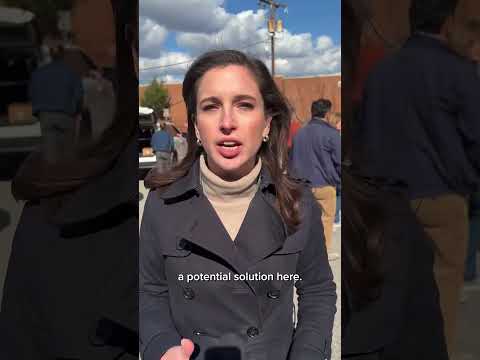
Federal workers turn to food banks as shutdown drags on
CNBC Television· 2025-10-24 18:00
We are at a food distribution center today in Alexandria, Virginia. And everyone you see who's getting a box of food is a federal worker. And that's because as of today, 2 million federal workers are missing their first full paycheck.And I've spoken with folks in this line and in others. They tell me that they're dipping into their savings. They're considering part-time work.They're just dealing with a lot of uncertainty here as the shutdown continues to drag on. And for the food distributors, it's not just ...
X @Bloomberg
Bloomberg· 2025-10-17 14:26
ECB’s Lagarde Says Price Risks Have Narrowed Despite Uncertainty https://t.co/3tDgKT5x21 ...
'Increased uncertainty and chaos': Dem govs counter admin's changes to health policies
MSNBC· 2025-10-16 16:19
Public Health Alliance Formation & Goals - Democratic governors have formed a public health alliance to share data on disease outbreaks, prepare for emergencies, deploy experts, and coordinate public health policy [1] - The alliance aims to address the diminished federal capability in public health across all 50 states [3][4] - The alliance represents 34% of the US population, coordinating efforts to ensure public safety and health [5] Concerns Regarding Federal Resources & Transparency - The alliance was formed due to increased uncertainty and chaos stemming from reduced CDC and federal health institution capabilities [6] - There are concerns about the transparency of the federal government regarding the state of the national stockpile and disease tracking [7] - States are stepping up to fill gaps left by diminished federal capabilities [11] Bipartisan Potential & Collaboration - The alliance welcomes Republican governors who support public health, emphasizing that it is not a partisan effort [10][12] - Collaboration among states is seen as more efficient than individual state efforts, especially in stockpiling equipment and providing guidance [5][11]
Fed Governor Stephen Miran: I do think uncertainty potentially explains first half weakness
CNBC Television· 2025-10-15 14:49
Economic Uncertainty & Policy - Uncertainty over policy, including potential tax hikes and global trading policy rearrangements, contributed to a weaker labor market in the first half of the year [1][2][3] - China's reneging on earlier trade deals introduces a new tail risk, potentially increasing downside risks to growth [3][4] - The balance of risks has shifted, necessitating policymakers to consider the implications for policy [5][6] Monetary Policy & Neutral Rate - Urgency to move to a more neutral policy stance quickly, as current policy is considered restrictive and vulnerable to shocks [7][8] - The speaker's view on the pace of reaching a neutral rate is somewhat out of consensus, advocating for a quicker move due to less concern about upside inflation [9][10] - Neutral policy rate is the rate at which monetary policy is neither restrictive nor accommodative, but it's difficult to observe directly and models provide wide confidence bands [11][12] - Significant shocks to the economy in recent years, such as changes in immigration policy, have likely caused substantial shifts in the neutral rate [13][14][15] Economic Indicators & Market Reaction - The economy was weaker in the first half of the year, potentially related to trade and uncertainty around trade and taxes [17][18] - The housing market is moribund due to high mortgage rates, representing a significant transmission channel for monetary policy [19] - Bond market reaction to rate cuts differs this year compared to last year, with long yields slightly down by 4-5 basis points in the 18 trading sessions since the cut, contrasting with a 30 basis points increase in the same period last year [22]
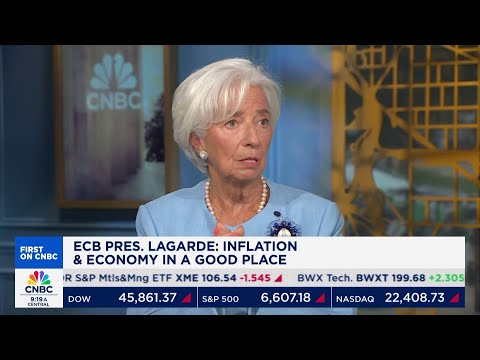
ECB President Lagarde: Would never say we're done cutting, we have to deal with uncertainty
CNBC Television· 2025-10-14 17:17
Monetary Policy Stance - The central bank's job on inflation is never done, implying a continuous monitoring and potential adjustment of monetary policy [1] - The central bank tamed inflation so far and is in a good place, but needs to anticipate any potential future events [1] - The central bank is deciding meeting by meeting and is data dependent, looking at models, empirical data, and applying judgment [3] - The central bank is trying to capture elements not easily captured by models [3] Uncertainty and Risk Factors - Uncertainty is a key factor that entrepreneurs, corporates, and the central bank must deal with [1] - Models cannot perfectly predict political development, geopolitical changes, and shifts in global order [2] - The central bank needs to understand how political development, geopolitical changes, and shifts in global order impact the world and monetary policy [2] Future Actions - The central bank cannot say how high the bar is for cutting interest rates or what would make them do that [2]
ECB President Christine Lagarde: I would like 'some certainty' on U.S.-China trade
CNBC Television· 2025-10-14 15:56
Economic Resilience & Monetary Policy - European economies have shown surprising resilience in growth, inflation, and employment, exceeding initial expectations [1] - Monetary policy is considered to be in a good place, with inflation around 2% [4] - Interest rates are currently at 2%, and the central bank is prepared to respond to potential economic shocks [5] - The focus remains on medium-term inflation targets, with current readings looking positive [6] Trade & Tariffs - Europe's trade with the United States accounts for 17% of its total trade, making the US the largest partner [1][2] - Tariffs between the US and Europe have increased from 1.5% to 13%, impacting exporters, importers, and consumers [2] - The impact of tariffs is currently being absorbed roughly equally by exporters, importers, and consumers [3] - Increased trade between Europe and China has been observed, partly due to diversion of goods [18][19] Risks & Uncertainties - Uncertainty remains a key factor, requiring anticipation of political developments, geopolitical changes, and shifts in the global order [7] - Risks to economic growth are now more balanced, with some initial fears regarding tariffs and exchange rates not fully materializing [10][11] - Both upside and downside risks to inflation are being carefully monitored, with the current balance considered fairly even [12] - Trade tensions between the US and China, particularly regarding rare earth elements, have direct and indirect impacts on Europe [13][14][15] - Geopolitics is seen as a key driver of tariffs, rather than the other way around [23] US-Europe Relationship - A stable and predictable relationship between Europe and the United States is considered necessary, despite recent deterioration [24][26] - There is a hope for a settlement of the relationship based on trust, predictability, and reciprocated consideration [27]